dailynewsnblog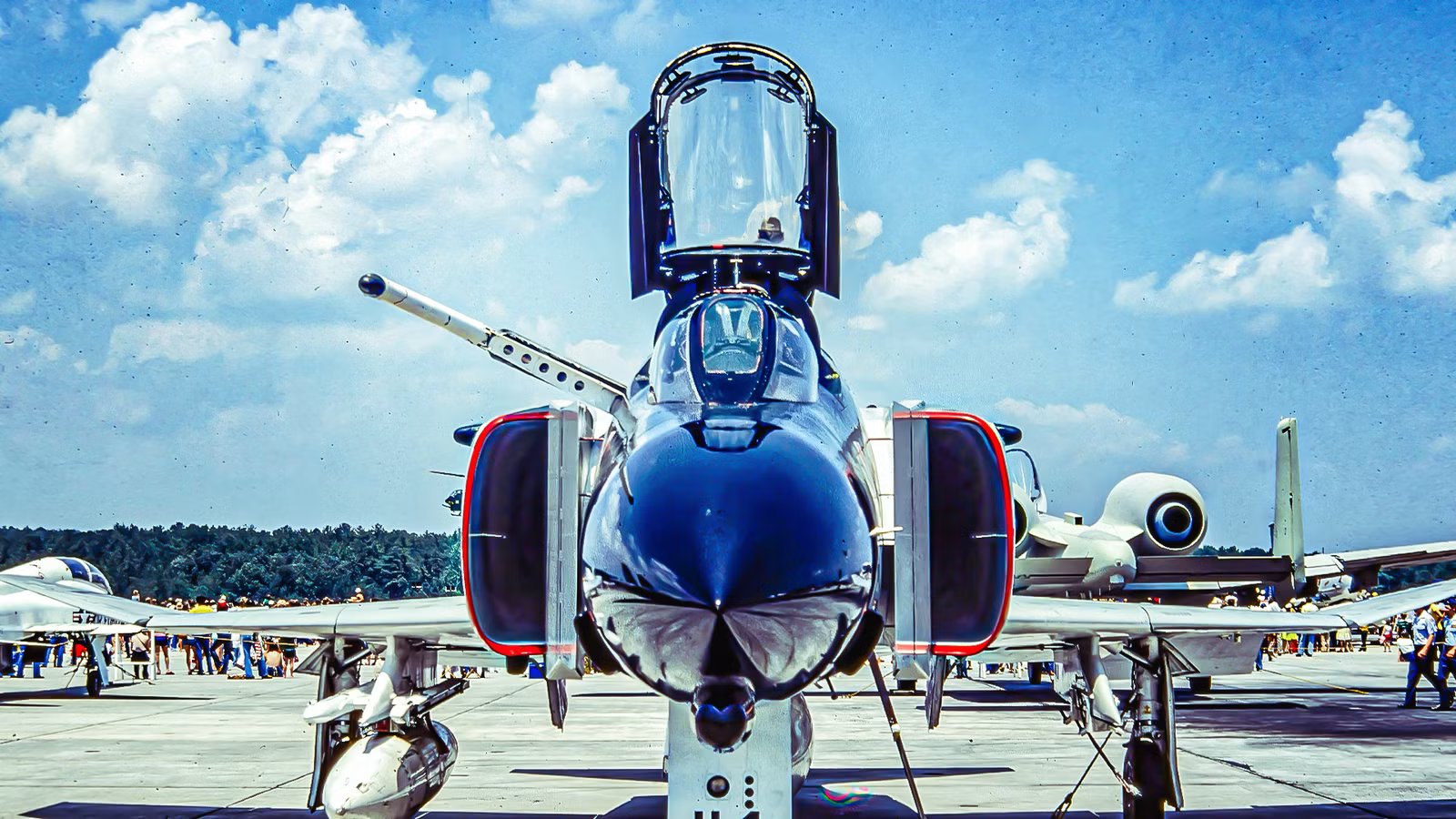
The McDonnell Douglas F-4 Phantom II was the most mass-produced supersonic fighter jet ever flown in the history of the United States of America. It was originally procured by the US Navy, but later went on to be the primary fighter platform for the US Air Force and the US Marine Corps. When the last example, an F-4EJ, rolled off the line at Mitsubishi Heavy Industries in Japan, the Pearl Harbor Aviation Museum records that the grand total came to 5,195 produced.
The last Phantom in service in the United States was retired in 1997, but to this day, a handful of examples remain airworthy and in service with air forces like Greece. Even when the United States retired the F-4 from frontline service, its story did not end there. The airframes were converted to drones and used as live fire missile targets.
Despite its checkered combat results in the skies over Vietnam after it first debuted, the Phantom was much loved by pilots and aircrew for its speed, power, and range, among other qualities. Among the aircraft made by McDonnell Douglas, which includes the F-15 Eagle, A-4 Skyhawk, and F/A-18 Hornet, its production run vastly overshadows all of them, nearly equaling the total production of all three of these equally iconic fighter jets.
Pressed Into Enemy Service

Iran presently has the world’s biggest remaining fleet of F-4 Phantoms, with roughly 63 aircraft in active service as of early 2026, according to the World Directory of Modern Military Aircraft (WDMMA). Despite a 45-year weapons embargo, the Islamic Republic of Iran Air Force (IRIAF) has preserved these aircraft by intense reverse-engineering, black-market parts purchase, and internal upgrading.
The fleet comprises three major versions purchased before the 1979 Revolution. With perhaps six or ten planes still airworthy, Iran is the only country currently using the outdated F-4D type. With about 50 in service, the F-4E is the mainstay of the strike force. There are still four to ten of the IRIAF’s specialist RF-4E reconnaissance type. Due to sanctions, Iran is unable to get the necessary parts to update and maintain its fleet, which has resulted in a ‘Frankenstein’ maintenance program.
According to the National Security Journal, the Iranian military has installed upgraded radar and targeting with Chinese equipment capable of guiding smart bombs and anti-ship missiles. Chinese and Russian avionics components include electronic warfare systems and head-up displays (HUDs). The Iranian local industry has also donated as many parts as feasible, when it can create equivalent or better quality than imports.
The Last Battle

President Donald Trump has significantly increased the US military presence near Iran since the new year, describing the force as the world’s biggest, most powerful naval assembly. There has also been a significant increase in US Air Force assets stationed in Jordan at the Muwaffaq Salti Air Base (MSAB). The 332nd Air Expeditionary Wing is deployed with approximately 35 F-15E Strike Eagles from RAF Lakenheath here to provide defensive cover for Israel, Jordan, and Iraq.
At the center of this deployment is the Abraham Lincoln Carrier Strike Group (CSG 3), which reached the Arabian Sea in early February 2026. Carrier Air Wing 9, ‘The Shoguns,’ is deployed with nearly 60 fourth and fifth-generation naval fighters, including the Lockheed Martin F-35C stealth plane. It is nearly a given that the outdated fighters will be destroyed if the Iranian F-4s face off against any of the USAF or USN jets now in service.
While Iran paid in full for 16 Russian Su-35s in 2024, Russia has apparently failed to complete the agreement, with just four aircraft delivered by mid-2025. Iran is now in high-level talks to purchase up to 40 J-10C multirole fighters in the near future, with long-term objectives perhaps reaching 150. After the Israeli strikes in June 2025, the chairman of the IRIAF allegedly went to China to try to reach an agreement. The F-4’s career is coming to an end, but they won’t arrive in time to protect Iran from the current ‘beautiful armada.’

Iranian Air Force Will Finally Retire Its F-14A Tomcats: Russian Su-35SE Replacement
Iran seems poised to finally retire its worn-out F-14 Tomcats are the new Su-35 Flankers enter service.
By The Numbers: Phantom II

F-4A was technically the first variant; however, the F-4B was the first to be produced in large numbers. This aircraft was made specifically as a carrier-based interceptor with thin wings for storage and a powerful nose radar. The absent gun was supplanted by AIM-7 Sparrow and AIM-9 Sidewinder missiles. The Marines used the F-4B for land-based close air support and air superiority, deploying their first operational squadron (VMFA-314) in June 1962.
The Phantom’s speed and heavy payload dwarfed its competitors in the 1960s, and it proved to be a highly versatile platform. The Phantom was immediately forged by the fire of the Vietnam War upon its introduction to service. US Navy squadrons would score the first and last air-to-air victories of the conflict, with both units being deployed aboard the same aircraft carrier, the USS Midway. VF-21 scored in 1965, and VF-161 in 1973, according to the US Naval Institute.
Below is a breakdown of the total F-4 Phantom II production run by variant as recorded by open sources from the US military and the history of McDonnell Douglas as written by Rene Francillon:
|
Phantom II Variant |
Number Produced |
|---|---|
|
F-4A |
45 |
|
F-4B |
649 |
|
RF-4B |
46 |
|
F-4C |
584 |
|
RF-4C |
505 |
|
F-4J |
522 |
|
F-4F |
175 |
|
F-4E |
1,370 |
|
RF-4E |
146 |
|
F-4EJ |
140 |
|
F-4G |
116 |
|
F-4K |
166 |
|
F-4N |
228 |
|
F-4S |
265 |
The Phantom was also the last fighter jet to use the catapult bridle system that was derived from the days of propeller-based carrier aviation. Before the tow bar on the nose wheel became standard, a cable was connected to the wing roots and the catapult shuttle. The F-4E was considered the ultimate version thanks to its internal gun as well as the leading-edge slats installed on later models, which significantly improved its maneuverability in dogfighting scenarios. This variant would go on to be the most popular, with 1,370 being made.
A Global Icon Of Air Power

The only factory that was not located in St. Louis, Missouri, to produce F-4 Phantoms was the Mitsubishi Heavy Industries facility in Japan. Of the 140 F-4EJ models, 138 were produced in Japan for the Japan Air Self Defense Force (JASDF). These aircraft did not have equipment for ground attack or aerial refueling initially; they were later upgraded to the ‘Kai’ model. Just under 100 of these aircraft were produced and featured radar from the F-16 as well as heads-up displays (HUD). The last JASDF examples would not be retired until 2021.
Meanwhile, in the United Kingdom, both the Royal Navy (RN) and the Royal Air Force (RAF) flew variants with Rolls-Royce ‘Spey’ turbofan engines that were more powerful than the General Electric J79s. The F-4K (RN) and the F-4M (RAF), had 30% more thrust but increased drag and slightly reduced the aircraft’s top speed at high altitudes.
The F-4F was a simplified version of the F-4E produced for West Germany. The ‘Improved Combat Efficiency’ (ICE) program equipped the Luftwaffe’s F-4Fs with the AN/APG-65 radar (from the F/A-18), allowing them to fire the AIM-120 AMRAAM missile for beyond-visual-range combat.
The Republic of Korea Air Force (ROKAF) was a major operator of the F-4 Phantom II, which they nicknamed the ‘Goblin of the Sky.’ South Korea first acquired the F-4D in 1969, and the aircraft served as the backbone of its air defense for 55 years. The ROKAF officially retired its last F-4E Phantoms in a ceremony on June 7, 2024.

America’s 5 Fastest Fighter Jets Of All Time
The speed kings of TACAIR.
The Enduring F-4

Israel not only flew its own specially modified Kurnass 2000 (‘Sledgehammer’) until 2004, but also helped upgrade F-4Es for the Turkish Air Force, dubbed the ‘2020 Terminator’ variant. The remaining operational Phantoms are concentrated in a single unit, 111 Filo ‘Panterler’ (Panthers), based at the Eskişehir Air Base. Reports estimate the active fleet size at approximately 30 to 40 aircraft.
Today, Greece and Turkey still operate the F-4E. Its days are numbered, however, as Greece is expected to receive the F-35 by the end of the decade, and Turkey also plans to begin phasing out its fleet after 2030. That will only leave Iran as an operator with its aging fleet acquired during the religious revolution that overthrew the Shah in 1979.
In a unique commercial application, the Florida-based Starfighters International (known for flying F-104 Starfighters) is in the process of acquiring 12 retired Phantoms from South Korea, according to The National Interest. And the Collings Foundation currently maintains the world’s only privately operated, airworthy F-4D Phantom II (N749CF), which is scheduled to return to the airshow circuit for this year’s season.

Why The F-4 Phantom Won’t Be Retired Anytime Soon
A Cold War icon defies expectations, remaining relevant in the 21st century. Discover the secrets behind the F-4 Phantom’s enduring legacy.
The Phantom’s Legacy

The Phantom holds the unique honor of being the only jet flown by both flight demonstrations of the USAF and USN’s Thunderbirds and Blue Angels, respectively. Although the aircraft did see some tragic losses in combat in its early years, it was considered widely successful in many tactical roles, including as an interceptor, fighter-bomber, and reconnaissance platform.
The legacy of the F-4 Phantom II is defined by its role as the template for the modern multirole fighter, establishing a design philosophy where a single airframe could perform air superiority, long-range interception, and ground attack missions. After its retirement by the US Armed Forces, the McDonnell Douglas F-15 Eagle succeeded its role as a fighter-interceptor for the USAF, while the Grumman F-14 Tomcat took over for the Navy.
The General Dynamics F-16 Fighting Falcon became the true successor of the multirole platform used by a wide range of Air Forces around the world. The McDonnell Douglas F/A-18 Hornet, and later the Boeing Super Hornet, was also a successor to the multirole mission pioneered by the F-4, serving the USN primarily, but also international air forces like Switzerland and Australia.