dailynewsnblog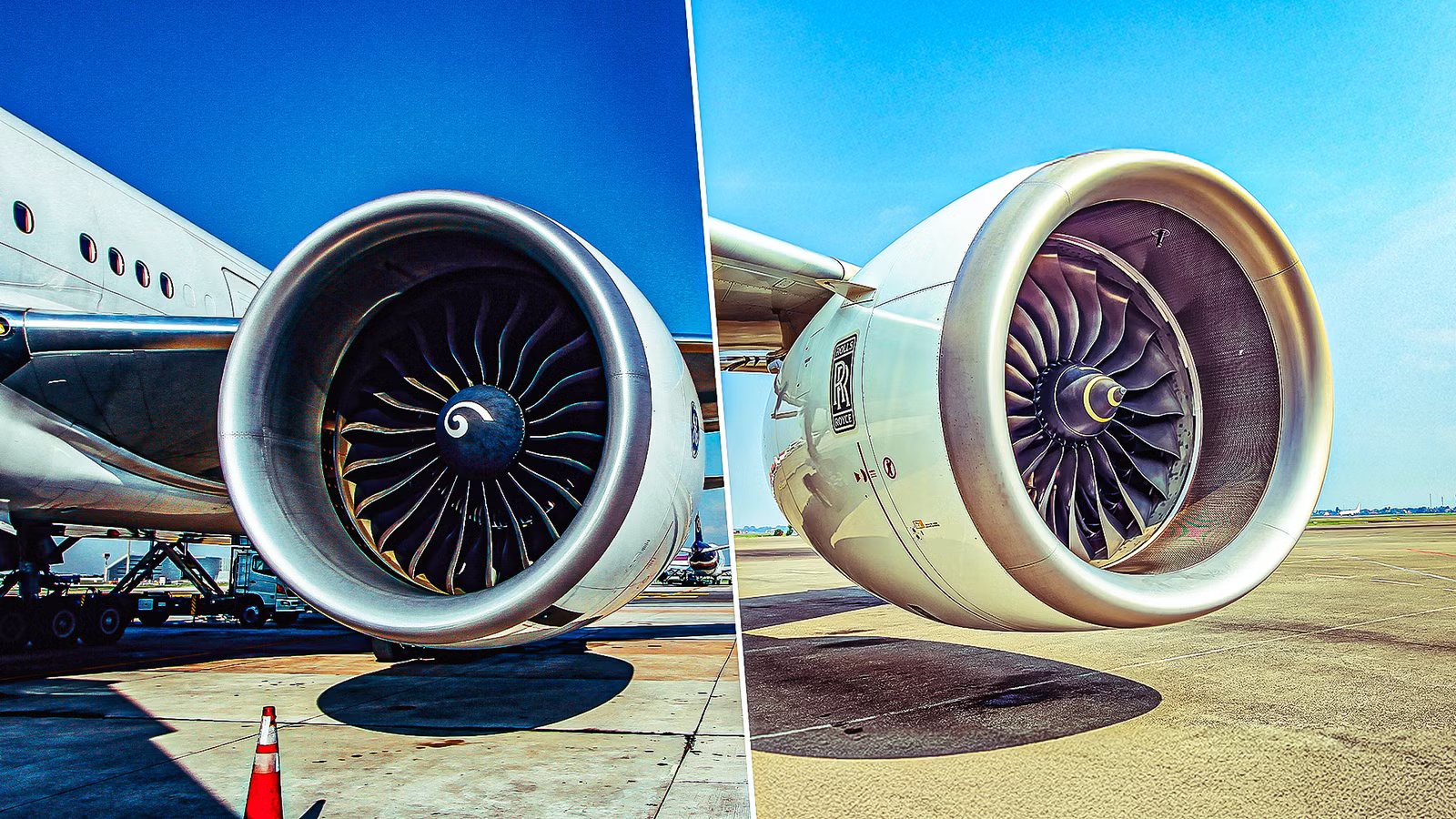
In the world of modern aviation, two names dominate the skies when it comes to large turbofan engines: General Electric (GE) and Rolls-Royce. Each represents a distinct philosophy in engineering and design. GE’s GE9X, developed exclusively for Boeing’s upcoming 777X, is a testament to size and raw power, the largest jet engine ever built. Rolls-Royce’s Trent XWB, meanwhile, powers Airbus’ A350 and has earned a reputation as one of the most efficient and reliable engines in commercial service.
As the global aviation industry faces growing pressure to cut emissions and operating costs, the rivalry between these two engine makers has never been more relevant. Airlines now scrutinize every kilogram of thrust and every fraction of fuel burn in pursuit of lower carbon footprints and higher profitability. In comparing the GE9X and Trent XWB, it becomes clear that while both engines share common goals of efficiency, reliability, and sustainability, the paths they take to achieve them couldn’t be more different.
Engineering Philosophy: Two Paths To Power

At the heart of the GE9X is a philosophy of power through simplicity. GE has long favored the twin-spool engine configuration. With one low-pressure and one high-pressure spool, this reduces complexity, weight, and maintenance demands. In the GE9X, this simplicity is paired with enormous scale. It’s the largest turbofan engine ever produced, with a fan diameter of 134 inches (3.4 meters), allowing vast volumes of air to move through the engine for exceptional efficiency.
The result is a design that pushes traditional boundaries without complicating the core mechanics. Rolls-Royce’s approach with the Trent XWB, meanwhile, reflects its faith in the three-shaft configuration that defines the entire Trent family. Instead of two rotating assemblies, it uses three: low, intermediate, and high-pressure systems, each spinning at its optimal speed. This architecture offers improved aerodynamic performance across various flight regimes and more stable operation under varying loads and altitudes.
It also gives Rolls-Royce engineers greater flexibility in fine-tuning the engine for specific aircraft variants, such as the Airbus A350-900 and Airbus A350-1000. Both philosophies have proven effective, yet they embody contrasting traditions. GE’s approach favours manufacturing scalability and fewer moving parts, while Rolls-Royce prioritizes refined mechanical harmony and in-flight adaptability. These differences shape everything from maintenance intervals to fuel consumption curves.
Size And Performance: The Numbers That Matter

The GE9X’s sheer dimensions are staggering. Its 134-inch (3.4-meter) fan, roughly the width of a Boeing 737 fuselage, makes it the largest jet engine ever certified for commercial use. Capable of producing up to 105,000 pounds of thrust, it is designed to meet the demands of the 777X, which is set to be the world’s largest twinjet. The engine’s bypass ratio of around 10:1 ensures that most of the air it moves bypasses the core, resulting in both quieter operation and improved fuel efficiency compared to its predecessor, the GE90.
By contrast, the Trent XWB’s fan measures a smaller but still impressive 118 inches (three meters) and delivers thrust levels ranging from 84,000 to 97,000 pounds, depending on the model. Its bypass ratio sits just below GE’s at roughly 9.6:1, and is optimized for the Airbus A350’s aerodynamic profile. While not the most powerful engine in raw terms, it offers a balance of thrust and efficiency that perfectly suits the A350’s long-haul and ultra-long-haul mission profile, enabling flights of up to 9,700 nautical miles ( Airbus A350-900ULR).
The difference in thrust reflects the distinct aircraft they power. The Boeing 777X requires higher thrust to accommodate its greater takeoff weight and payload capacity, while the A350 prioritizes range and fuel economy. In practice, both engines deliver near-identical gains in specific fuel consumption compared to previous generations, a testament to how far propulsion technology has advanced, even as design philosophies diverge.
Materials & Innovation

GE’s GE9X marks a breakthrough in materials engineering. It features carbon-fibre composite fan blades and cases, reducing overall engine weight by hundreds of kilograms. More critically, it incorporates ceramic matrix composites in high-temperature turbine components. These advanced ceramics can withstand temperatures hundreds of degrees hotter than metal alloys while remaining lighter and more durable, contributing directly to higher efficiency and longer component life. Rolls-Royce, meanwhile, takes a different approach.
Indeed, it emphasizes incremental improvement over radical change. The Trent XWB uses single-crystal turbine blades, advanced nickel alloys, and sophisticated cooling technologies to manage extreme heat within its high-pressure core. The manufacturer’s expertise in thermal control allows the engine to maintain optimal performance over long service intervals, reducing wear and extending the time between overhauls. This design philosophy has given the Trent XWB one of the highest dispatch reliability rates in the industry.
|
Specifications |
Rolls-Royce Trent XWB |
General Electric GE9X |
|---|---|---|
|
Manufacturer |
Rolls-Royce PLC |
GE Aerospace |
|
Introduction / Entry into Service |
In service since 2015 (XWB-84) |
Certified in 2020; entering service with Boeing 777X |
|
Maximum Thrust (take-off) |
84,000 lbf (XWB-84) to 97,000 lbf (XWB-97) |
Tested up to 134,300 lbf (record); typical commercial rating 105,000 lbf |
|
Bypass Ratio |
9.6:1 |
10:1 |
|
Overall Pressure Ratio (OPR) |
50:1 |
60:1 |
|
Fan Diameter |
118 inches (3.00 meters) |
134 inches (3.40 meters) |
|
Engine Length |
154 inches (3.91 meters) |
176 inches (4.47 meters) |
|
Dry Weight |
16,500 lb (7,480 kg) |
23,000 lb (10,430 kg) |
|
Key Technological Features |
Three-shaft design; carbon-titanium fan blades; advanced aerodynamics; optimized for efficiency and long-haul operation; “world’s most efficient large aero engine in service.” |
Composite fan blades and case; ceramic matrix composites in the hot section; record-high pressure ratio; largest and most powerful commercial jet engine built; designed for high thrust and low emissions. |
|
Applications / Aircraft Platforms |
Airbus A350-900 and A350-1000 |
Boeing 777-8 and 777-9 (777X family) |
Both engines also reflect sustainability-focused innovation. Their advanced materials allow for higher combustion efficiency and lower emissions, and both are certified to operate on up to 100% sustainable aviation fuel ( SAF). While GE has made headlines for its aggressive use of composites, Rolls-Royce’s steady evolution underscores that innovation can come as much from refinement as reinvention.
Fuel Efficiency & Environmental Goals

Fuel efficiency has become the defining metric of modern engine success, and both manufacturers tout impressive numbers. GE claims the GE9X offers a 10% improvement in specific fuel consumption over the GE90, achieved through its larger fan, lean-burn combustor, and advanced turbine materials. This translates into significant fuel savings for airlines, a crucial advantage as fuel costs remain the single largest operating expense for most carriers.
The Trent XWB, meanwhile, has already established itself as a benchmark for efficiency in real-world operations. Since entering service in 2014, it has powered the A350 fleet through millions of flight hours, consistently delivering the lowest fuel burn per seat among widebody aircraft. Rolls-Royce’s continuous software updates and engine health monitoring systems have further optimized performance, ensuring that each engine operates as close as possible to its theoretical efficiency limits throughout its lifespan.
Both companies are deeply invested in sustainability initiatives. The GE9X and Trent XWB are fully compatible with sustainable aviation fuels and form part of broader efforts to reduce lifecycle emissions. As the industry shifts toward net-zero carbon targets by 2050, these engines represent transitional technologies bridging today’s fossil-fuel era with a cleaner future built on hydrogen, hybrid-electric, or next-generation SAF propulsion systems.

What Are The Key Differences Between The PW4000 & GE90 Engines?
The GE90 and PW4000 turbofan engines achieve remarkable performance, setting the standard for power and reliability in modern aviation.
Reliability, Maintenance & In-Service Record

Reliability remains a cornerstone of any successful commercial engine program. Here, the Trent XWB enjoys the advantage of time. With more than a decade of service, it boasts dispatch reliability rates exceeding 99.9%, and operators consistently report stable performance across varying climates and cycles. Rolls-Royce’s long experience with the Trent family provides a robust foundation for predictive maintenance and global support infrastructure.
The GE9X, though newer, benefits from the lessons learned across decades of GE engine development. Having completed over 5,000 hours of testing, including extreme temperature, crosswind, and endurance trials, it has proven capable of withstanding punishing conditions. GE’s use of digital twin technology, real-time virtual replicas of each engine in service, promises to revolutionize maintenance scheduling and reduce unscheduled downtime once the 777X enters airline fleets.
With that being said, reliability is only proven in service, and GE will need to demonstrate consistency across thousands of operational hours before airlines can fully trust its long-term performance. Rolls-Royce’s Trent XWB, while largely trouble-free, has not been without challenges; regulatory inspections in recent years remind the industry that even mature engines can face component fatigue issues. Ultimately, both engines underline that reliability is not just about design; it’s about continuous monitoring, data, and global support.
Market Impact: The Future Of Widebody Power

The GE9X and Trent XWB represent more than just engineering triumphs; they embody the strategic alignment of engine manufacturers with aircraft makers. GE’s exclusive partnership with Boeing on the 777X ensures complete integration and optimization, a move that consolidates GE’s dominance in the large twin-engine market. Rolls-Royce, in turn, enjoys exclusivity on the A350, giving it a stable, long-term platform to refine and expand its Trent family.
In market terms, both engines are vital to the recovery and modernization of the long-haul segment. The Trent XWB’s proven efficiency makes it a favorite for airlines rebuilding international routes post-pandemic, while the GE9X’s upcoming entry into service with the 777X will reintroduce new performance benchmarks for payload and range. Each engine anchors its manufacturer’s future competitiveness and signals a long-term bet on sustained demand for large twin jets.
Looking ahead, both companies are investing heavily in next-generation propulsion concepts, from Rolls-Royce’s UltraFan program to GE’s open-fan architecture under the CFM RISE initiative. These efforts will likely redefine what efficiency and sustainability mean in aviation. But for now, the GE9X and Trent XWB remain the crown jewels of widebody propulsion, proof that while the race toward greener skies is far from over, the competition at 40,000 feet has never been more compelling.