dailynewsnblog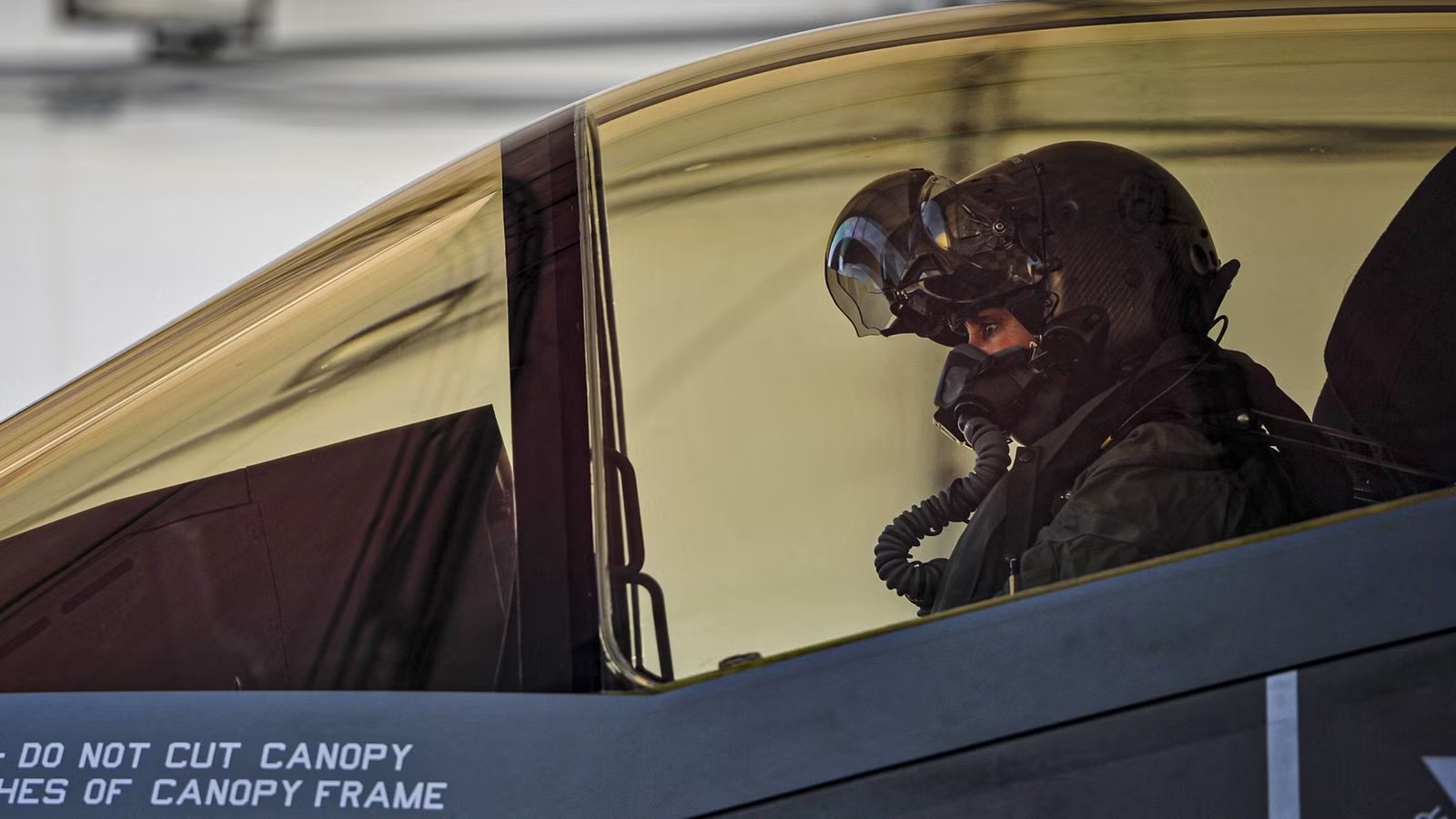
At the most expensive defense industrial project in world history, the Lockheed Martin F-35 Lightning II is more than just a fighter jet that doesn’t appear on radar. The incredible fifth-generation stealth aircraft is described as a ‘digital quarterback’ on the battlefield, thanks to its host of bleeding-edge technology never seen before.
One of the most advanced pieces of flight gear ever created is the F-35 Gen III Helmet Mounted Display System (HMDS). This unique helmet and its integrated electronics give the pilot a ‘God’s Eye view’ and allow them to look directly through the bottom of their own aircraft. It also integrates a vast amount of data from their systems and sensors into one instantly accessible display.
The Road to HMDS

HMDS replaces the previous generation heads-up display (HUD) that has been common on 4th-gen fighter jets for the past decades since it was introduced in the 1960s. HUDs evolved from reflector sights and gyro gunsights used during WWII. The first operational system appeared in 1961 on the British Blackburn Buccaneer. These systems evolved from WWII-era reflector gunsights, providing pilots with critical flight and weapon-aiming data projected onto a glass screen.
The HUD didn’t appear out of thin air; it was the result of engineers trying to solve the deadly problem of ‘head-down’ time in dogfights. As planes got faster, looking down at a dashboard meant a pilot could travel several hundred feet while their eyes were off the target. Early HUDs utilized cathode ray tubes (CRT) to display information, evolving into more advanced holographic and digital systems.
HUDs became standard in, or were retrofitted into, aircraft like the A-7 Corsair II, F-4 Phantom II, and F-16 Fighting Falcon in the 1970s. Modern fighter HUDs are shifting away from bulky, older CRT technology toward fully digital, lightweight, and augmented reality (AR) systems. The U.S. Air Force is currently modernizing the F-22 Raptor’s HUD with BAE Systems’ Digital Light Engine. It increases reliability by 35x and provides a much sharper, brighter image for the pilot.
God’s Eye View

In the newest jets, the HUD is no longer a piece of glass on the dashboard. Instead, it follows the pilot’s eyes wherever they look. It uses a virtual HUD projected inside the pilot’s helmet. Because it tracks head movement, the HUD remains visible whether the pilot is looking forward, sideways, or even down through the floor of the plane. The F-35 uses the HMDS, but the Eurofighter Typhoon also has a next-gen helmet called the Striker II.
The Typhoon’s helmet displays night vision without the need for external goggles attached, but the F-35 takes it to a completely different level with a distributed aperture system (DAS). The ability to see through the floor is made possible by the AN/AAQ-37 DAS. This system consists of six infrared cameras embedded around the fuselage of the jet in 360 degrees. When the pilot looks down, the system instantly streams the video feed from the bottom cameras to the visor, even in night vision.
Raw video is only half the story. The F-35’s onboard computer performs sensor fusion, which blends data from multiple sources into a single intuitive picture that no other platform can currently match. The computers in the F-35 combine radar sensor data with targeting systems and electronic warfare sensors as well as data net into a single ‘fused picture.’ If an enemy plane is 50 miles away, the pilot sees a small green square exactly where that plane is, even if it’s blocked from view.
The Networked Stealth Fighter

The F-35 uses the Multifunction Advanced Data Link (MADL) to talk to other F-35s and advanced military assets. If one networked unit sees a target with its radar, every other F-35 in the flight sees that same target on their helmets instantly. The helmet then enables ‘off-boresight’ targeting. This allows a pilot to fire a missile at a target they haven’t personally detected, relying instead on the shared data from a wingman or an AWACS plane.
Pilots aren’t seeing a ‘video game’ version of the world. They see the real world through the glass, with a transparent digital overlay, or AR, that highlights threats and displays flight instruments. The incredible technological capability of the F-35 allows it to do things that even the F-22 cannot, as its internal systems are decades older than the newer, yet lower-performance stealth fighter.
When the pilot of an F-35 simply looks at the target, they can designate a lock to the weapon system by pressing the button on their control stick, even if the plane is not facing towards the threat. Then an exceptionally maneuverable missile like the AIM-9X can be fired even if it is initially launched away from the target. The high-off-boresight weapon will then make a sharp turn and pursue the target in the pilot’s line of sight, regardless of the direction the nose of the jet is traveling in.

Why The F-35 Is The US Air Force’s Most Important Fighter Jet
Discover why the F-35 is the US Air Force’s most critical fighter — from stealth and sensors to strategy, readiness, and future upgrades
The Master of Tomorrow’s Battlefield

From a strategic and tactical standpoint, the F-35 helmet isn’t just a piece of flight gear. It is a command-and-control node that fundamentally changes how the U.S. Air Force wins wars. The HMDS shifts the pilot’s role from being just the pilot of a plane to a battle manager in a system of systems. An F-35 pilot sees the entire battlefield and can pass these targets to older 4th-gen ‘arsenal planes,’ like F-15s or F-16s, naval vessels, or even ground batteries.
F-35 pilots can continue to observe the battle space while they remain dark, with their own onboard sensors and passive modes that will keep them hidden from the enemy’s weapon systems. Yet the F-35 can continue to gather data and find targets across the battlefield. By consolidating all flight, tactical, and sensor data into a single, immersive workspace, it allows the F-35 to act as a quarterback in the sky, directing other 4th-gen fighters and unmanned systems like the upcoming ‘Loyal Wingman’ drones.
Thousands of Collaborative Combat Aircraft (CCAs), or Loyal Wingmen, will serve as semi-expendable drones that act as loyal wingmen, sensor nodes, or ‘missile trucks.’ The latest batch of the F-35 is being equipped to control multiple drones from the cockpit. This will allow the F-35 to stay in a standoff position while the CCAs fly into high-threat zones to identify targets or ‘soak up’ enemy missiles.

Disaster? Why The F-35 Program Is Under Fire Again
A storm of controversy surrounds the F-35 program, but what’s really behind the criticism?
The Ultimate Flight Gear

The HMDS of the F-35 is described as a ‘wearable cockpit,’ and at the price of $400,000 each, it certainly deserves to be known as more than a mere helmet. Some estimates, accounting for research and international conversions, range as high as $700,000 per unit. As the first tactical fighter in 50 years to fly without a traditional fixed HUD, the F-35 projects all critical flight parameters, like airspeed, altitude, and heading, alongside targeting alerts directly onto the visor.
Each helmet is custom-fit to the pilot of the F-35, which takes two days to complete. Technicians use a high-resolution laser scanner to create a 3D model of the pilot’s head. The scan data is sent to a CNC machine that mills a personalized Styrofoam liner. This liner ensures the helmet sits in the exact same position every time it is worn. The fitters use a special measuring instrument to align with the distance between the pilot’s eyes by a margin of two millimeters.
The visor is custom-contoured and trimmed so that it does not hit the oxygen mask when the pilot talks or moves. Gaining or losing as little as 5–10 lbs, or even getting a significantly different haircut, can shift the helmet’s position and require a refit. Pilots must undergo a fit check every 120 days to ensure the helmet remains properly calibrated.

What Is The TR-3 Upgrade To The F-35?
TR-3 will increase the F-35’s computer processing power and enable the jet to see further and become significantly more powerful.
The Most Exquisite Fighter

The F-35 program is the most expensive weapon system in history, with costs spanning decades of research and development. It’s estimated that the helmet system alone required an investment of between $300 and $500 million. The average cost for an F-35A is $79 million, an F-35B is $104 million, and an F-35C is $98 million. That price excludes the engine, which costs an additional $20 million.
The Department of Defense (DOD) projects the total cost of the F-35 program over its 94-year lifecycle (from 1994 to 2088) to be approximately $2.1 trillion. The cost of operational sustainment and lifetime maintenance is projected to be $1.58 trillion, representing the bulk of the overall program cost. While the cost per aircraft had been trending downward, recent inflationary pressures and the integration of Technology Refresh 3 (TR-3) and Block 4 upgrades have caused a slight uptick.
The Pentagon is aiming to achieve a cost of $25,000 per flight hour currently, which would put it between the F-16 and F-15EX. Reports from the Government Accountability Office (GAO) indicate some portions of the F-35 fleet have struggled with readiness, with some units grounded up to 50% of the time due to spare parts shortages and maintenance delays.
Lockheed Martin has even begun to propose an upgrade path that will make the jet what they call a ‘5th-Gen Plus’ platform. The Sidekick upgrade is increasing internal missile carriage from four to six AIM-120s. New Adaptive Engine Transition Program (AETP) technology is aimed at providing the power and cooling needed to run the intense AI and electronic warfare systems required for drone command.