dailynewsnblog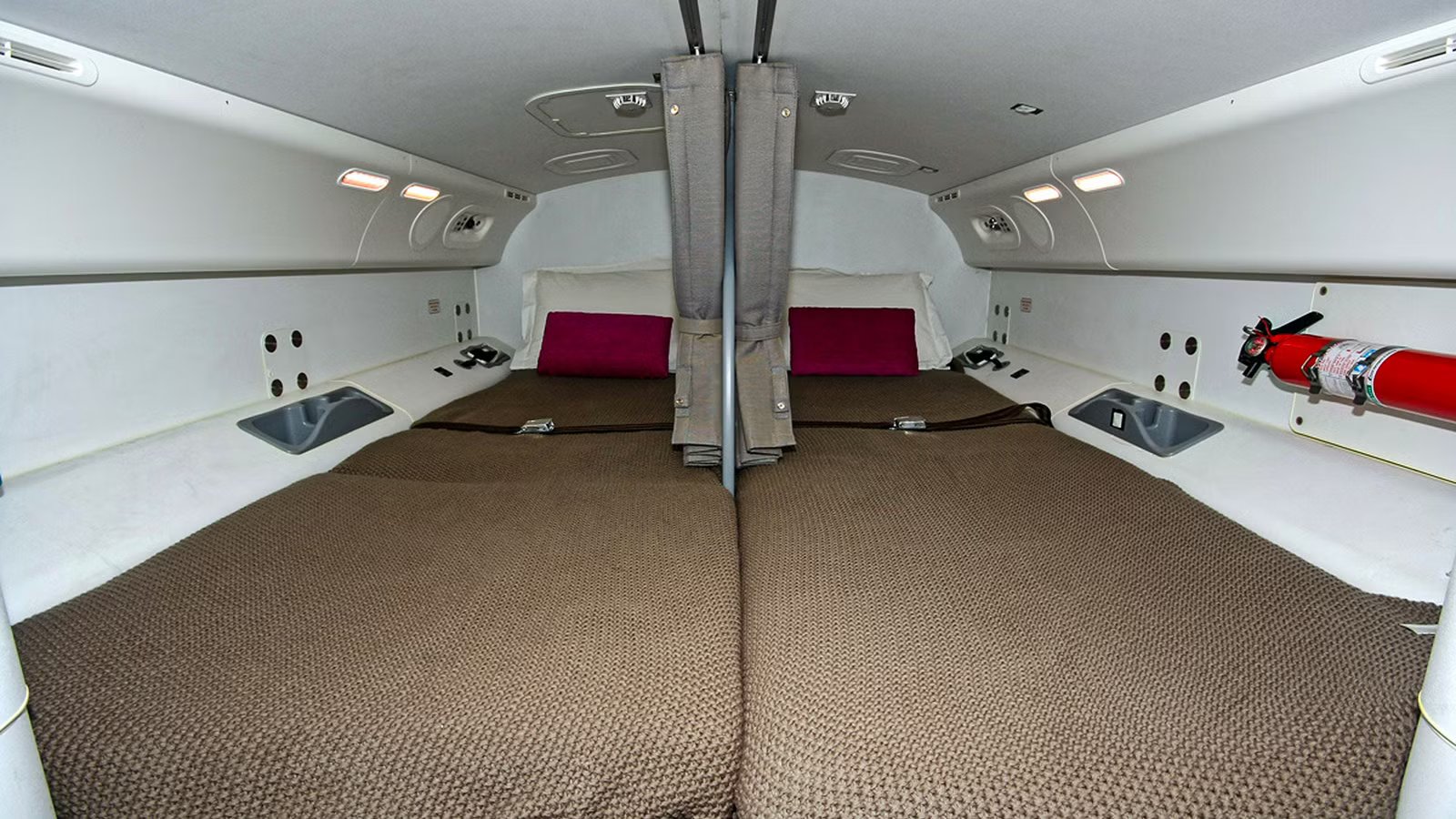
The Queen of the Skies unlocked flights that were so long that airlines and manufacturers had to seriously consider how they were going to keep crew members rested and alert throughout the entire flight. Bleary-eyed cabin crew don’t only struggle to provide a high standard of service, but could also be a liability in the case of an emergency. As a result, Boeing introduced a large cabin crew rest area, and a smaller rest area for pilots.
This was upgraded aboard the modern Boeing 747-8, allowing crew members to take time off in the comfort needed to sleep. This article gives detail on the rest areas available to 747-8 crew members, before comparing them with the A380, which are usually more advanced. It then looks into why dedicated rest areas are needed aboard widebody aircraft, and spares a moment’s thought for the cabin crew members unlucky enough to work aboard widebody aircraft that don’t have rest areas.
The Rest Areas Aboard A 747-8

A 747-8 has a pilot rest area that is directly behind the flight deck and directly above the foremost seats available to passengers. There are usually two levels of bunks to allow two pilots to rest while their colleagues are at the controls. Exact specifications of the rest area will vary, but it may also include rest seats. The aircraft also has a larger rest area designed for cabin crew at the back of the aircraft. It is above the rearmost seats on the main deck and features several bunks.
Cabin crew members climb several steep steps to get up to it. The rest area allows the aircraft to carry additional cabin crew members for longer flights. Some can catch some well-earned sleep, while others keep passengers safe and comfortable. Comparing the Lufthansa 747-400 with the 747-8, one cabin crew member said in a video by GreatFlyer: “The crew rest [area] is a little bit more comfortable.” The full video, which details cabin crew members’ impressions of the 747-8 during a Lufthansa flight to Palma, is below:
The layout of the cabin crew rest area will also vary slightly depending on the carrier. Lufthansa has a small front room section, with lockers and other space available. This area also has a telephone to keep in contact with the working crew. After the front room is the main rest area, featuring ten beds. The rest area is barely the height of a person, meaning that the bunks are extremely cramped. However, the beds do come with bedclothes and a curtain for privacy. The cabin crew member who spoke with GreatFlyer described it as “super comfortable.”
How Does The 747-8 Rest Area Compare To The A380?

As with the Boeing 747-8, the pilots rest area aboard and the A380 is directly behind the flight deck. Rather than being above seats, it is above the main avionics bay and the nose landing gear. It offers a substantial upgrade compared with the 747-8. The bunks are separated properly with a door each, although they are still one on top of the other.
Each of the two beds also has a comfortable chair should the pilot not wish to sleep. This allows them to sit and read or make use of the entertainment screen if their airline provides one. The Instagram reel embedded below shows a crew member making the bunk in the crew rest area on a Boeing 747-8F:
Qantas’s rest area has twelve rest areas available for cabin crew. This is the most common rest area for an A380, located under the main deck. Cabin crew take steep steps down rather than up to get some shut-eye. Aboard Qantas’s A380s, the steps are located between rows 65 and 66. Seat 70D is also missing, which features an escape hatch that the resting crew can use if there is an emergency and they cannot use the main entrance. Crews aboard a long A380 flight may get up to a four-hour rest break. According to Executive Traveller, some airlines, including Emirates, provide an entertainment screen. Alongside the beds, the rest area also includes a toilet with a wash basin. An air conditioning unit is also common, allowing the crew to relax in the optimum environment.

Airbus A380 Vs. Boeing 747: How Do They Compare On Ultra-Long-Haul Flights?
Does it make a significant difference to to choose one aircraft or another for a long flight? If so, that’s the thing, which is the best airliner?
What Makes A Crew Rest Area Essential?

Widebody aircraft like the 747 fly for far too long to expect cabin crew to work without respite. Flight times for 747-8s can far exceed ten hours. Add to this the time spent boarding and deboarding the aircraft before and after the flight, and the time spent traveling to accommodation after the flight. Widebody cabin crew expect 90 minutes to three hours of rest on average.
The Federal Aviation Administration (FAA) also acknowledges that a proper rest area is essential for cabin crew members’ well-being and to ensure they can do their jobs properly. It mandates certain requirements for the rest space, detailed in the table below:
|
Feature |
Requirement |
|---|---|
|
Bunk dimensions |
78 inches (198 cm) by 30 inches (76 cm) |
|
Space around the bunks |
35 cubic feet (1 cubic meter) |
|
Communal area |
Used for changing, entering and exiting. It should be at least 65 cubic feet (1.8 cubic meters) |
|
Location |
Noise, odors and vibration won’t disrupt sleep. |
The FAA also defines three types of rest areas. Airlines need to ensure their cabin crew have access to the right type for what is demanded of them. A class one rest area is a dedicated sleeping area with bunks or flat sleeping surfaces accessed by a hidden door. This is the type used by jumbo jets like the 747 and A380.
A class two rest area is a lie-flat seat with a curtain separating the crew member from passengers. The most spartan rest area is class three, which is simply a curtained-off reclining seat with a foot support. Most airlines also have rest policies that they expect cabin crew and supervisors to abide by. For example, Cathay Pacific mandates that its crew members need at least three hours off duty if the flight duty period is longer than 14 hours.
But Who Sleeps When?

Cabin crew aboard a 747-8 don’t simply head for the rest area when they are ready to sleep. Instead, most airlines have a clearly defined system that dictates who sleeps when. This ensures that there are always enough crew members on duty if there is an emergency. Usually, the Senior Cabin Crew Member (SCCM or Purser) leads the cabin crew, and they will divide it into two shifts. The first shift catches some rest after the meal service is completed.
Once their mandated rest time has elapsed, the second shift gets some rest. Crew members tend to prefer the second shift. It is much easier to sleep if you’ve been hard at work for a long time. Rest areas ultimately enable crew to be refreshed for later portions of the journey, allowing them to be optimal and alert when conducting their duties.
There are also quirks in terms of who gets which bunks. Cabin crew members who have been with the airline the longest and are the most senior will sleep closest to the door and intercom, with the SCCM taking the bunk closest to the door. They can quickly get to the intercom if an emergency occurs and the duty cabin crew needs to contact them.

How Cabin Crew Rest & Sleep On Ultra-Long-Haul Journeys
A simple strategy – rest when you can.
Not All Aircraft Have Dedicated Rest Areas

The 747-8 has a substantial rest area, but this isn’t always the norm. Unsurprisingly, most narrowbody aircraft don’t have dedicated rest areas. The routes they fly simply aren’t long enough to justify them. Furthermore, margins are tighter, so airlines don’t want to take up excessive space that could be used by paying customers. Instead, cabin crew have access to jump seats, so they can remain safely sitting down for takeoff, landing and during turbulence.
Furthermore, some widebody aircraft also lack rest areas. An example is the Boeing 767, which is not configured with a separate rest area. Airlines, such as  United Airlines, have to get creative for long-haul flying. The carrier equips four seats in the rear of its Boeing 767 economy-class cabin with extra legroom, leg rests, oversized tray tables, privacy curtains and upgraded arm rests. These seats can be used as improvised rest areas, likely considered class 3 by the FAA.
The lack of a rest area is surely unpopular with cabin crews, but does allow airlines to be more flexible and improve their profit margins. A Simple Flying reader, Camomile, also points out that Qantas’s oldest A330s don’t have a dedicated rest area. This becomes a serious problem for cabin crews if they are asked to fly the aircraft for 15 hours to the US West Coast. Camomile said: “[Qantas A330s] are bad enough for passengers but for crew with no rest area they are a nightmare.”