dailynewsnblog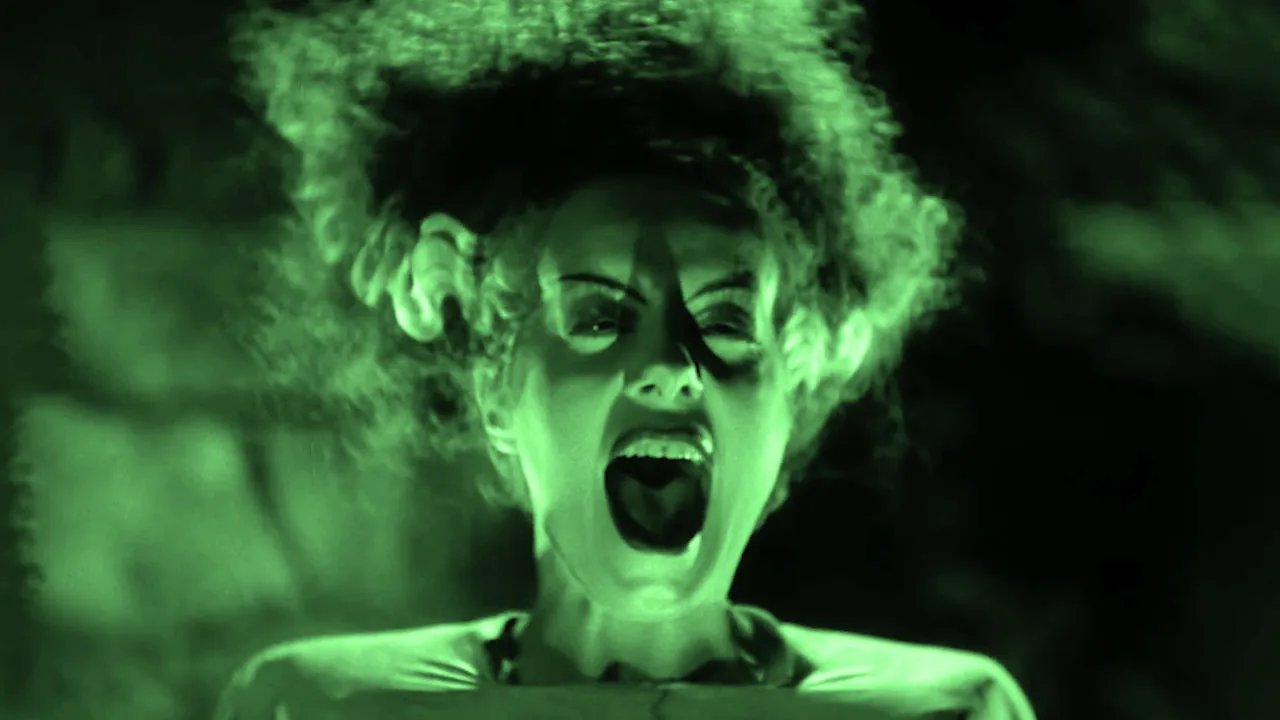
IGN’s only been around for 30 years, but movies have been going for much, much longer than that. And the thing is, so many of them have never been reviewed by us. But that’s where IGN’s Flashback Reviews come in, so today we’re jumping almost 90 years back in time to talk about one of the greatest horror movies ever made… if you can even call it a horror movie, that is: Bride of Frankenstein!
Elsa Lanchester’s Bride of Frankenstein is an icon, even if most people have never actually seen the only film in which the character appeared. Her image is instantly recognizable – the lightning-striped, shocked bouffant, the bandaged arms and sweeping gown, the impeccably scarred yet beautiful face. Oh, and the hiss – don’t forget the hiss! And this despite the poor creature only getting about four minutes of screentime in total. Again, 90 years ago.
But the birth of the Bride also came at a critical moment for the horror genre, as the looming dangers of censorship would soon drain much of the life out of the creative boom that had led to the film in the first place.
When director James Whale’s Bride of Frankenstein was released in 1935, the horror genre was at the peak of a vast surge in popularity. The huge success in 1931 of the Bride’s Universal Monsters predecessor Dracula, and her would-be-paramour, Frankenstein’s Monster, meant that every mummy, invisible man, black cat, raven, and werewolf in town was about to get their own picture. Meanwhile, Fredric March had won the Oscar in 1932 for playing not just Dr. Jekyll, but also that awful Mr. Hyde (tying with Wallace Beery for the boxing flick The Champ, by the way). Horror was big, and monsters were where horror was at.
The funny thing is, James Whale didn’t actually want to make a sequel to his original Frankenstein, despite its success. You can’t blame him, having helmed three horror films in the previous four years with Frankenstein, The Old Dark House, and The Invisible Man. But the director’s mischievous leanings that were already popping up in those pictures would become the lifeblood of Bride, a film that is as much a great comedy as it is a monster movie.
Right off the bat, the film feels bigger than its predecessor, as the title credits reveal Franz Waxman’s foreboding score, before segueing into the melodious Bride’s theme. The first Frankenstein film, having been produced at the cusp of the advent of sound, featured minimal music, instead leaning into frequent spans of crackling silence. But Bride’s new scope, hinted at in this music, is immediately confirmed as Whale’s opening scene takes us for a humorous if unexpected visit to Frankenstein’s very creator, Mary Shelley, along with Percy Bysshe Shelley and Lord Byron, as the three chatter about ghost stories on a stormy night.
As such, Bride of Frankenstein begins in an elegant drawing room of the Romantic Era, where the Rs roll with aplomb and audiences – still in the midst of the Great Depression – surely could only look on in wonder. Played by the uniquely off-kilter Elsa Lanchester – who of course would also play the Bride at the end of the film – Mary seems to speak directly of the viewer, and to the viewer, at one point: “Such an audience needs something stronger than a pretty little love story. So why shouldn’t I write of monsters?” No doubt this well-placed bit of dialogue by Whale and his writers is also a jab at the recently implemented self-censoring Hays Code, which would soon hobble many a horror movie in Hollywood.
Why was horror so popular during those dark days of the Depression? Much has been written on the topic, and it seems safe to say that in 1935 audiences were seeking some kind of escapism in the dark safety of the movie house. But there’s also the more lurid, violent, and sexual aspects of these films, elements which folks obviously wanted to indulge in, and ironically the very same aspects that the Hays Code would soon crack down on, taking away much of the spark that had fueled the genre. Viewers wouldn’t have known it at the time, but when the Bride is electrified to life, those four brief minutes of agony and ecstasy were sort of the climax for this heyday of horror.
So who are the monsters that Shelley is talking about in the prologue? Certainly not Boris Karloff’s sad-sack creature, who in a feat that would be replicated by every Freddy, Jason, and Michael Myers who followed, managed to survive the unsurvivable climax of the previous film. Sure, he kills some people here or there, basically to keep the cheap seats happy, but that’s not what interests Whale in the character. While Karloff would later say that he wasn’t particularly fond of the development, the typically mute Monster famously acquires the power of speech in this picture. This leads to some humorous moments – you’ll never forget seeing Karloff half-choking on a cigar – as well as some dark ones, as when the Monster proclaims that he “loves dead… hates living.” The actor can still be scary as the towering Monster, of course, but it’s his moments of pathos and humanity – there, I said it – that work best in Bride.
Certainly the brief time he spends living happily with the blind old man who he encounters in the forest can only end in heartbreaking fashion – even if the whole set-up has become a well-trodden trope by today’s standards. As the old man attempts to teach the Monster about the difference between good and bad, one can’t help but peer past the script and see a meditation on the world in which Whale and his audience were living, survivors of a World War now living through another unimaginably difficult time.
Nor is Colin Clive’s Dr. Henry Frankenstein a villain. Indeed, while Henry was a crackpot who caused a ton of problems for everyone in the first film, in Bride he becomes more of an unwilling participant in the bigger action – almost a bystander. Sure, he’s one of the two creators of the Bride, but he does so under duress. Poor Clive, meanwhile, seems aged and stricken here, a not surprising result, perhaps, of what the character has been through, but one tempered by the knowledge that in reality the actor was reportedly suffering from alcoholism and would die just two years after the film’s release.

But we must look to Ernest Thesiger’s Dr. Pretorius to find the real monster in Bride of Frankenstein. An old mentor of Henry’s, Pretorius shows up to convince Henry to create a new creature with him. He shows off his own dabblings in creating life, specifically weird little men and women who he keeps in jars; this reveal makes for a really odd scene that’s kind of silly but just another example of how Whale didn’t only make this sequel bigger than the first film, but also insisted on branching out in surprising ways with it. Audiences in 1935 expecting more of the same after the first film were in for a surprise.
Thesiger is another highlight, long noted for his camp portrayal and the queer coding that he brings to Bride. Pretorius is the kind of guy who sends his men out to find “fresh” hearts that he can use in his experiments, while also enjoying some wine and dinner over a coffin in a newly robbed crypt. Would you like a cigar? It is his only weakness, you know.
The production design is sweeping. Throwing continuity to the wind, Castle Frankenstein now features arched ceilings everywhere, sometimes lit seemingly only by flickering candlelight. The Bride’s creation scene is somehow even more spectacular than the first film’s, and indeed, the set pieces are exciting and often beautiful to behold. Whale didn’t hesitate to throw some Christ imagery into the proceedings here or there, but hey, this is the same guy who literally had Dr. Frankenstein throw dirt in the face of a statue of Death in the first film, so let him have his fun. The world of Frankenstein that Whale creates is not the real world – monsters notwithstanding – but rather something closer to a dreamed state. His affinity for using painted and lit backdrops to serve as the cloudy horizon and sky in certain scenes never really makes such scenes feel like they’re truly taking place outdoors; instead, what you wind up with is a sort of otherness, a heightened and theatrical feeling that pushes things just a notch into the fantastic. (Whale made his name in the theater, after all, and incorporates here some of the tricks he learned there.)
Of course, this also raises the question of how modern audiences, who have been trained to expect perfect, computer-generated recreations of just about any setting in their movies and TV, might react to a near-century-old picture like this. I think what it comes down to is less about how the film looks and more about how it makes one feel. The Bela Lugosi Dracula, for example, hasn’t aged all that well. Yes, horror and film fans might still appreciate it on multiple levels, but it’s also the kind of movie that tends to elicit unintentional laughs from modern audiences. Bride of Frankenstein, on the other hand, remains as funny today as it surely was in 1935, perhaps even more so. But it’s not a case of us laughing at the movie; no, we’re laughing with it. I think there’s a difference there, and as a result the Bride’s film is kind of timeless.
By the time Elsa Lanchester finally appears as the title character, at around the one-hour, 10-minute mark (of a one-hour, 14-minute movie!), it’s been a long wait for this legend to arrive, but a worthwhile one. Lanchester doesn’t attempt to mimic Karloff in any way. No, her time is limited, and she makes the most of it with her tics and quick, halting, bird-like movements, and of course that hiss. As Dr. Pretorius announces her to the world – “The Bride of Frankenstein!” – little could he, or Whale, or the audiences sitting in the darkened theater, for that matter, have known that the Golden Age of 1930s horror had just peaked.