dailynewsnblog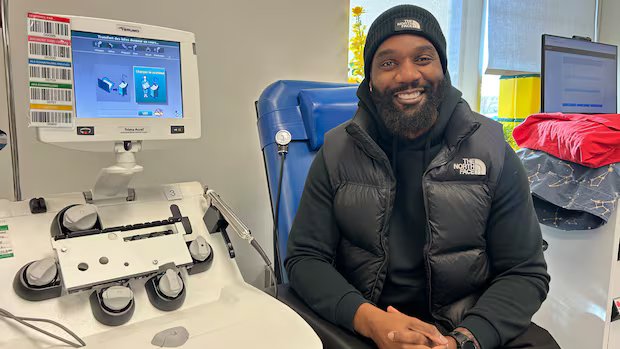

Listen to this article
Estimated 5 minutes
The audio version of this article is generated by AI-based technology. Mispronunciations can occur. We are working with our partners to continually review and improve the results.
Stanley Étienne is no stranger to giving blood. The 41-year-old Montreal bus driver has donated 37 times in recent years.
It all started when a friend of his had a health crisis related to her sickle cell anemia — a disease which largely affects the Black community. He brought her to a clinic and learned donating blood was the best way he could help, and that it’s particularly important for the Black community to step up.
Patients with sickle cell require frequent transfusions, and the most compatible blood — which prevents life-threatening immune reactions — usually comes from donors of the same ethnic background.
Héma-Québec says more than 200 sickle cell patients in the province rely on regular donations to survive. A single person with sickle cell anemia needs blood from an average of 130 donors a year.
Nowadays, not only does Étienne donate, but he also helps organize Héma-Québec blood drives and get the word out, posting to social media and speaking to groups about the importance of giving.
“Your blood is going to end up helping someone who needs it,” he said.
Haitians were discouraged from giving blood
But Étienne said he had to persuade his own mother to give blood due to the lingering mistrust in the medical establishment within the Haitian community, rooted in the early years of the HIV/AIDS crisis.
In the 1980s, U.S. health authorities wrongly singled out Haitians as a “high-risk group” for HIV alongside homosexuals, heroin users (intravenous drug users) and hemophiliacs, known as the 4Hs.
That classification fueled stigma and discrimination across North America and led the U.S. Food and Drug Administration to bar people of Haitian origin from donating blood.
By 1983, the Canadian Red Cross asked recent immigrants from Haiti to voluntarily stop donating blood as well. These policies led to public outcry in both the U.S and Canada.

Ottawa protestors ask why agency singles them out for further discrimination.
The high-risk classification for Haitians was dropped in the U.S. by the Centers for Disease Control (CDC) in 1985 after it was found to be scientifically unsound and unfairly stigmatizing. However, the Food and Drug Administration (FDA) continued to exclude Haitians who immigrated after 1977 from donating blood until 1990.
In Canada, self-exclusion was quietly lifted in 1988, but despite the controversy, there was no public announcement.
The self-exclusion policy had long-lasting effects on the Haitian community, reinforcing mistrust of health institutions. Étienne said his mother was among those who lost trust.
“A lot of Haitians don’t want to give blood because of that,” said Étienne.
But Haitians aren’t the only members of the Black community who have felt stigmatized. Canadian Blood Services (CBS) also had a screening question that limited donations from people who lived in, were born in or had sexual contact with a person from certain African countries after 1977 due to a lack of reliable testing for HIV.
The question wasn’t removed from the screening process until 2018 due to improved testing technology.
Working to repair the damage
In a statement updated last year, CBS acknowledged that systemic and anti-Black racism have impacted the national donor base. While Black Canadians reached 1.5 million people in 2021 — accounting for 4.3 per cent of the population — they represent less than one per cent of Canada’s blood donors.
As CBS works to repair the distrust, Héma-Québec has also been campaigning for years, trying to get more Black Quebcers to donate. The blood agency estimates about 10,000 Black Quebecers donate blood every year, but it needs 26,000 donors.
Akelia Campbell, who has sickle cell anemia, is among those who relies on those blood donations. She frequently speaks to the media about her condition, which first manifested when she was just a few months old.
“In childhood, I was in and out of the hospital a lot,” she said.

As an adult, she said she has a fairly normal life, but it affects her socially, at work and in parenting as she has to prioritize rest and avoid getting too cold or overexerting herself — triggers that cause her painful avascular necrosis arthritis to flare up.
Chantal Goupil, a Héma-Québec nurse, said people with sickle cell anemia are in pain.
“It’s very difficult for them,” she said. “Therefore, we need more blood from the Black community.”
Mobilizing donors from Black communities makes a major difference in the quality of life of people with sickle cell anemia, Héma Québec says on its website.
“To treat those affected effectively, the donor and recipient must share the same genetic makeup,” it says. “It’s the reason why Black donors are vital to the community.”
As for Étienne, he said his blood is going to one patient.
“It feels good,” he said. “I don’t know that person, but because of me, I give a chance to that person to survive.”