dailynewsnblog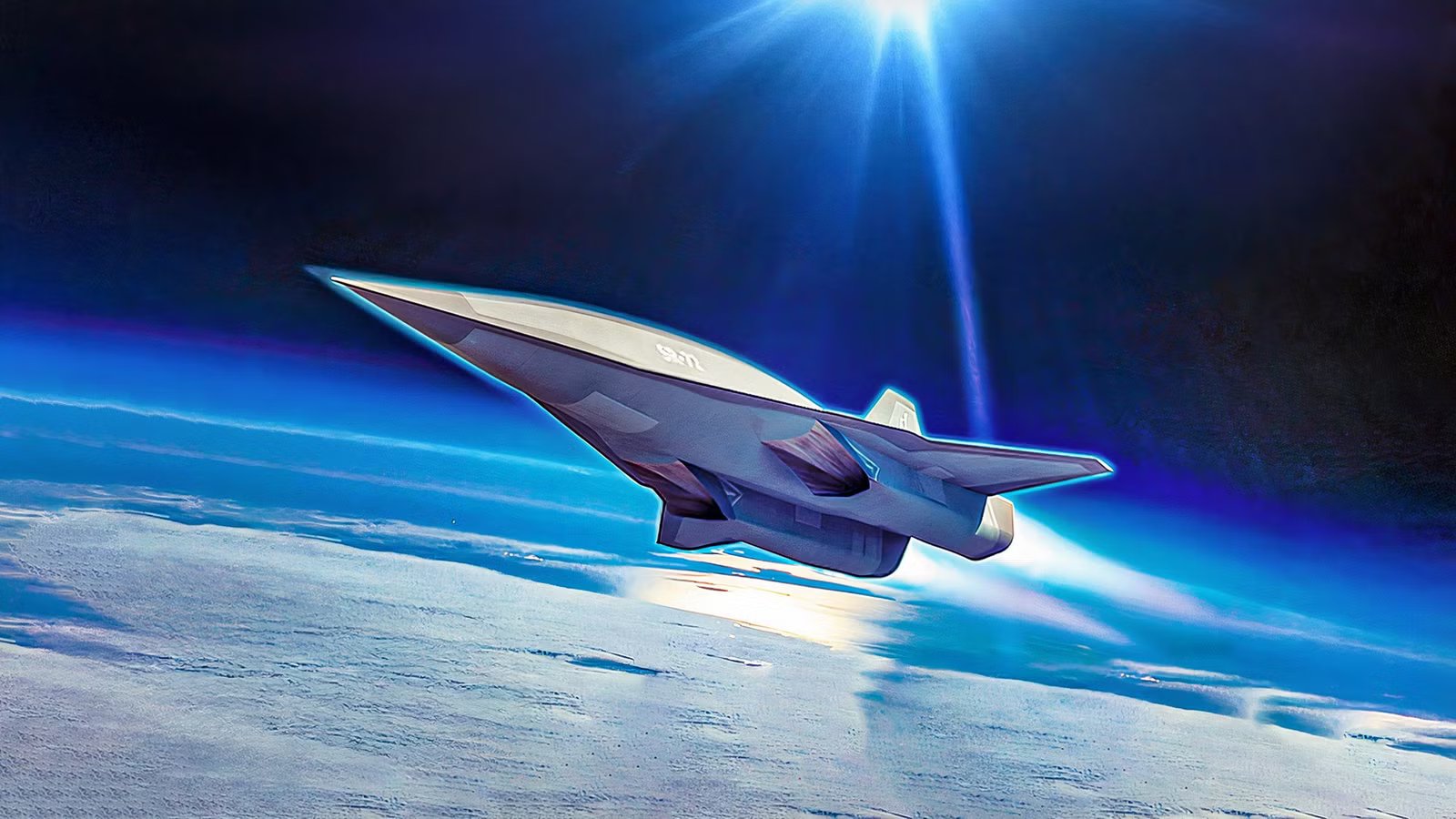
The proposed Lockheed Martin SR-72, often nicknamed “Darkstar”, or the “Son of Blackbird”, has captured renewed attention within the United States Air Force because it promises a capability the service has lacked since the late 1990s: ultra-fast, survivable strategic reconnaissance. Designed to reach speeds of around Mach 6 (roughly 4,600 mph), the aircraft would be capable of crossing continents in a couple of hours while collecting intelligence or even striking time-sensitive targets at the same time, which is an advantage over satellite surveillance. Such impressive performance would make it the fastest operational aircraft ever developed if it enters service.
Lockheed Martin’s Skunk Works division is well known for its secretive and innovative experimental projects. The company first unveiled the concept publicly in 2013 as a successor to the legendary SR-71 Blackbird, which retired from USAF service in 1989 and NASA in 1999, after more than thirty years of high-speed reconnaissance missions. The aircraft is expected to combine hypersonic propulsion, advanced sensors, and possibly unmanned operation into a single platform. Based on technical disclosures, defense reports, and aerospace research, several factors explain why the SR-72 has generated so much excitement among military and aviation enthusiasts.
A Hypersonic Successor To The Legendary SR-71

The origins of the SR-72 lie in the legacy of one of the most remarkable aircraft ever built: the SR-71 Blackbird. Introduced during the Cold War, the SR-71 could fly at speeds exceeding Mach 3.2 and at altitudes above 80,000 feet, allowing it to outrun nearly every interceptor and missile developed during its operational lifetime. Despite thousands of attempts to intercept it, the aircraft was never shot down or damaged.
But when the Blackbird retired in 1998, the United States effectively lost its fastest airborne reconnaissance platform. Satellites and drones have taken on many intelligence-gathering roles, but each has its limitations. Satellites follow predictable orbital paths and cannot always reposition quickly during a crisis, and thick clouds might obstruct visibility for some types of satellites. Meanwhile, unmanned aircraft flying at conventional speeds can be vulnerable in heavily defended airspace, especially given recent advances in anti-drone technology due to the ongoing war in Ukraine and the Middle East.
The SR-72 concept attempts to close that gap by reviving the philosophy that made the Blackbird so successful: speed as a form of survivability. Instead of relying solely on stealth technology to evade radar, the aircraft would depend on extreme velocity and altitude to penetrate contested airspace and exit before defenses could respond effectively. Analysts have increasingly argued that in an era of advanced anti-access and area-denial systems, speed may again become as valuable as stealth in military aviation.
If realized, the SR-72 would not simply match the SR-71’s capabilities, but it would also dramatically surpass them. Doubling the Blackbird’s speed would allow the aircraft to cover vast distances in minutes rather than hours, reshaping how the US military conducts surveillance missions.
The Breakthrough Engine That Makes Mach 6 Possible

Perhaps the most technically ambitious aspect of the SR-72 is its propulsion system. Flying at hypersonic speeds requires solving a fundamental engineering challenge: no single engine type performs efficiently across the entire range from takeoff to Mach 6.
Traditional turbojet or turbofan engines perform well at subsonic and low supersonic speeds, typically up to about Mach 2.2. Ramjets perform best at higher speeds around Mach 3, but they cannot operate efficiently during takeoff. Scramjets (supersonic combustion ramjets) are designed specifically for hypersonic flight, but they require extremely high speeds to operate and typically do not sustain long flights.
To bridge these regimes, engineers working on the SR-72 have explored a propulsion architecture known as a turbine-based combined cycle (TBCC) engine. In simple terms, the system integrates a conventional turbine engine with a scramjet inside a single propulsion system. During takeoff and early acceleration, the turbine engine provides thrust like a conventional jet. As the aircraft approaches supersonic speeds, airflow gradually transitions toward the scramjet channel, which then powers the aircraft through the hypersonic regime.
This approach allows the aircraft to accelerate continuously from runway speeds to Mach 6 without requiring rocket boosters or multiple propulsion systems. According to Army Recognition reporting, the concept may involve collaboration between Lockheed Martin and propulsion specialists such as Aerojet Rocketdyne.
If successful, this propulsion system would mark a major milestone in aerospace engineering. Hypersonic aircraft have long been a theoretical possibility, but developing an engine that can operate efficiently across such a broad flight envelope remains one of the toughest challenges in aviation. So far, the secrecy surrounding this project, together with its brief appearance in the movie Top Gun: Maverick (the model can be seen in the video above), fuels greater public interest but prevents Lockheed Martin and the USAF from going into detail.

Will Lockheed Martin Build The SR‑72?
Lockheed Martin’s SR-72 “Darkstar” could be real. From Top Gun fame to Mach 6 specs, here’s what we know about the hypersonic spy plane’s future.
Why Mach 6 Changes The Strategic Equation

The most obvious advantage of the SR-72 is its extraordinary speed. At Mach 6, the aircraft would travel more than six times the speed of sound—approximately 4,600 mph. This is nearly twice as fast as the SR-71 and more than three times the cruising speed of the retired Concorde supersonic airliner.
At these speeds, geography begins to matter much less. A hypersonic reconnaissance aircraft could theoretically fly from the continental United States to the Middle East in about 90 minutes. That capability would enable intelligence gathering or strike missions almost immediately after a crisis emerges.
Speed also fundamentally alters the survivability equation in modern air warfare. Air defense systems rely on a sequence of events: detecting a target, identifying it, launching interceptors, and guiding missiles to impact. When a plane is traveling at Mach 6, the time available for each step shrinks dramatically.
In effect, the aircraft’s velocity becomes its primary defensive mechanism. Even highly capable surface-to-air missile systems may struggle to engage a target that can cross hundreds of miles in minutes. This concept has become increasingly relevant as radar and sensor technology improve. For the US Air Force, this capability could provide a new tool for penetrating heavily defended airspace without relying exclusively on stealth aircraft.
Beyond Reconnaissance: A Potential Hypersonic Strike Platform

Although the SR-72 is frequently described as a reconnaissance aircraft, its potential mission set may extend far beyond surveillance. Some defense analysts believe the aircraft could also function as a platform for launching hypersonic weapons, given the fact that Lockheed Martin is also developing hypersonic missiles, as reported by the National Security Journal.
The ability to combine intelligence gathering with rapid strike capability would significantly compress the military decision cycle. Instead of relying on separate platforms, such as one to identify a target and another to attack it, a single aircraft could perform both tasks in rapid succession.
For example, a hypersonic reconnaissance aircraft could locate a mobile missile launcher or command center and then immediately deploy a precision weapon against it before the target relocates. In modern warfare, where many high-value targets are mobile and fleeting, this ability could prove decisive.
The aircraft’s payload may include advanced sensors, communications equipment, and electronic intelligence systems. High-resolution imaging sensors, radar mapping technology, and signals-intelligence receivers could all feed real-time information back to command centers thousands of miles away.
Such potential capabilities would transform the SR-72 into a multirole strategic asset, not just a simple spy plane. It would effectively become a high-speed node in a global intelligence network, capable of rapidly gathering and transmitting critical battlefield data, and strike when needed and, most importantly, when an enemy has no time to respond or defend itself.

What to Expect From Military Hypersonic Aircraft In The Next Decade
There are some incredible hypersonic aircraft in the works.
Why The Aircraft May Be Unmanned

Another intriguing aspect of the SR-72 concept is the possibility that it could operate without a human pilot on board. Many early descriptions of the program have suggested the aircraft could be designed as an unmanned or optionally piloted platform.
Hypersonic flight introduces extreme environmental conditions. At Mach 6, friction with the atmosphere generates enormous heat across the airframe, while acceleration forces during maneuvering can place tremendous stress on both the aircraft structure and the human pilots. Removing the pilot eliminates many of these physiological limitations, freeing up space for more payload and/or fuel.
An unmanned design also allows the aircraft to undertake riskier missions deep inside contested airspace. Military strategists could deploy the aircraft in scenarios where sending a crewed platform would be politically or operationally unacceptable.
This approach also aligns with broader trends in military aviation. Over the past two decades, unmanned aerial systems have become essential for reconnaissance and strike missions. Combining autonomous operation with hypersonic speed could create an entirely new category of aircraft—one capable of responding to global events almost instantly.
Why The SR-72 Matters For The Future Of Airpower

The enthusiasm surrounding the SR-72 reflects a larger shift occurring in global military technology. Hypersonic weapons and vehicles have become a central focus for major powers, including the United States, China, and Russia. Each country is investing heavily in research to develop systems capable of traveling at speeds above Mach 5.
Within this broader competition, the SR-72 represents much more than a new reconnaissance aircraft to replace an old SR-71. It is part of a strategic effort to maintain technological leadership in high-speed aerospace systems, combining the best of the previous Blackbird, F-117, and various UAVs. If the aircraft reaches operational status, it could provide the United States with a unique capability to conduct intelligence and strike missions across vast distances in extremely short timeframes.
There are also signs that development work continues behind the scenes. According to The Air And Space Forces Magazine, Lockheed Martin has expanded facilities at its Skunk Works complex in Palmdale, California, including a production site designed for advanced digital engineering and hypersonic platform manufacturing. The company has also reported cost overruns in a classified aeronautics program widely believed to be related to the SR-72, indicating that significant research and development efforts are ongoing.
Although many details remain classified, the timeline frequently discussed by analysts suggests that a demonstrator aircraft could fly during this decade, with potential operational service sometime in the 2030s. If that happens, the “Son of Blackbird” may once again redefine the limits of speed in aviation—just as its legendary predecessor did more than half a century ago.