dailynewsnblog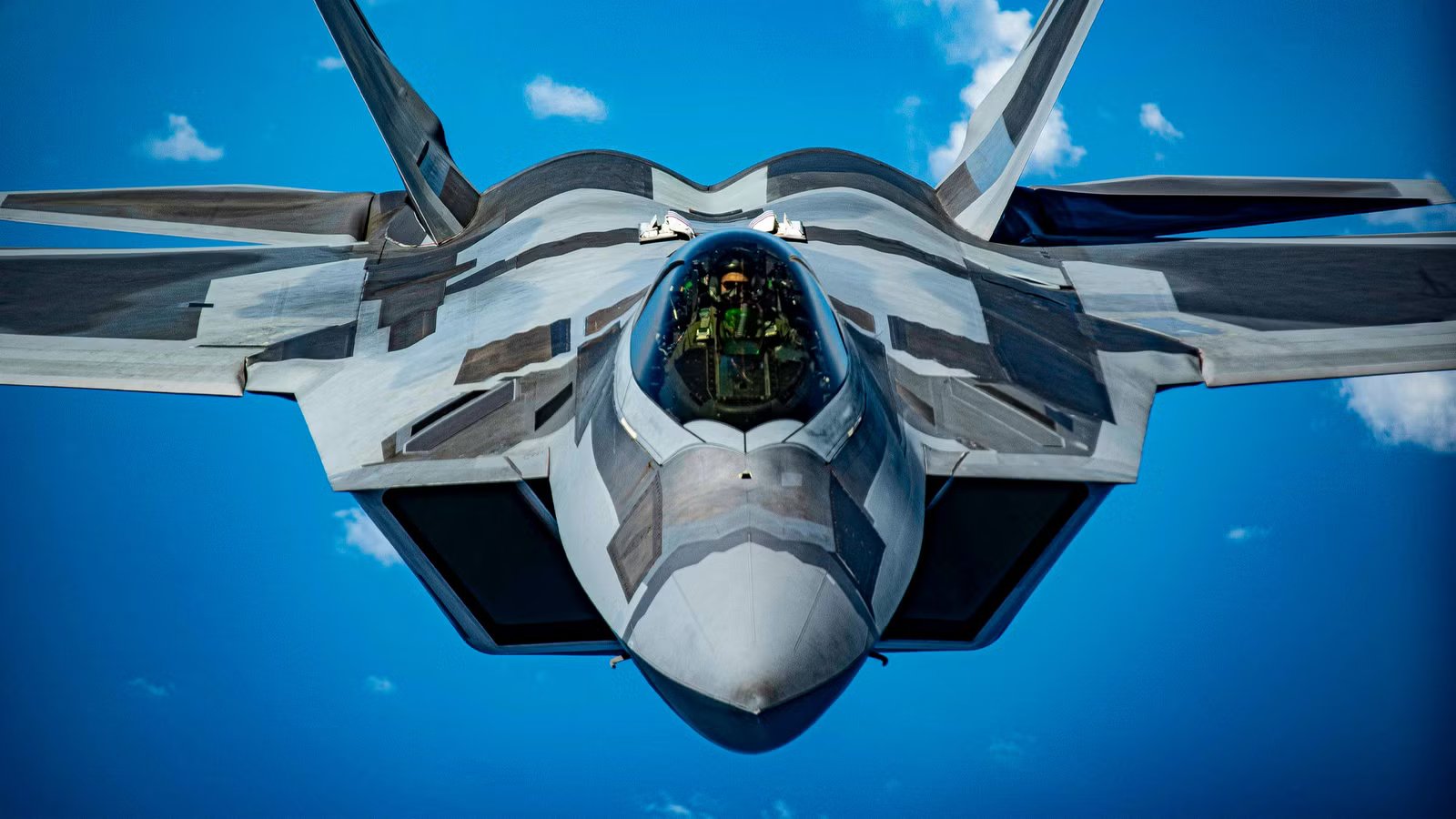
The United States Armed Forces have rapidly expanded programs in the past decade to advance stealth technology to maintain both the strategic and tactical upper hand in any conflict. These 5th and 6th-generation fighter jets are far more ‘exquisite’ than many combat situations demand. However, they are the only way in which an armed contest between the US and its most advanced adversaries can be won.
Over 3,000 airspace violations were estimated to have been committed by Chinese Air Force and Navy aircraft in 2024. This gross act of hostility has the Pentagon concerned that adversaries are conducting these flights of harassment to probe defenses and refine their own stealth designs and counter-stealth sensors. Top brass say continuous exposure to US response tactics during these incursions may grant these adversaries technical insight, eroding the technological gap that the F-22 and F-35 hold.
Meanwhile, although the Russian Air Force has a much smaller number of stealth aircraft than China, they have proven ready to use them in combat, unlike virtually every other air force on Earth. Additionally, the Russian military is continuing to progress in the refinement of its designs and defensive ‘anti-stealth’ weapons like air-to-air missiles and advanced surface-to-air missiles. These threats have prompted the United States and allies around the world to rally for a renewed push towards advanced sixth-generation aircraft designs.
The 6th-Gen Arms Race: Ultimate Air Dominance

The Pentagon believes Chinese 6th-gen jets, tentatively named the J-36 and J-50, could go into service as early as 2035, so the United States and its allies around the world are currently advancing the development of sixth-generation stealth fighters. The Mikoyan PAK DP, an interceptor that Russia is still developing to replace the MiG-31, is not currently a threat because of industrial choke points brought on by sanctions and the protracted invasion of Ukraine.
The Air Force selected Boeing to lead its NGAD program in early 2025 and named the future fighter the F-47, in homage to the WWII fighter, the Republic Thunderbolt. Current estimates hold that the US may build a fleet of roughly 500 6th-gen aircraft. Alongside the F-47 will be the new Northrop B-21 radar bombers. Operating jointly, the two advanced platforms will maintain air superiority in a future conflict with even the most advanced adversary, such as China or Russia. The first F-47 is expected to fly by 2028, while the B-21 is nearing entry to service next year.
A few days ago, on March 17, top lawmakers told Air and Space Forces magazine that neither the F-47 nor the Navy’s F/A-XX will be fully operational until the mid-2030s. Budgetary constraints have made the development of the Navy’s F/A-XX carrier-based fighter slower and more difficult. Congress brought the program back to life in early 2026 by adding almost $900 million to the budget after it had been shelved in early 2025 to give priority to the Air Force’s F-47. The last two candidates for the contract are Northrop Grumman and Boeing.
GCAP & FCAS: Allied Air Power

A trilateral partnership between the United Kingdom, Japan, and Italy is developing a 6th-generation platform called the Global Combat Air Programme (GCAP), also known as the Tempest in the UK, to replace their current Eurofighter Typhoon and Mitsubishi F-2 fleets. The Future Combat Air System (FCAS) is a massive trilateral European project led by France, Germany, and Spain that follows the Tempest model but is currently stalled due to political disagreements over industrial sharing.
GCAP is moving forward beyond a political vision to a structured and actionable program. BAE Systems, Leonardo, and Japan Aircraft Industrial Enhancement each have a share in the Edgewing joint venture that was launched in the UK last year as the central headquarters. The GCAP International Government Organisation (GIGO) is now operational in Reading, UK, led by its first CEO, Masami Oka from Japan. In March 2026, India even signaled its desire to join a GCAP after declining Russian and US export offers owing to its stable progress. Saudi Arabia is also reportedly in high-level discussions regarding potential entry.
The FCAS program aims to develop the Next-Generation Weapon System (NGWS), which includes a manned stealth fighter as the centerpiece, supported by loyal wingman drones connected by a high-speed combat data cloud. The program is currently in a state of high uncertainty due to disagreements between Dassault Aviation in France and Airbus in Germany over leadership, work sharing, and intellectual property.

Can The F-35’s Software Really Be Jailbroken?
How hackable is a 5th-Gen fighter?
Joint Strike Fighter: Linchpin Of Global Air Defense

Lockheed Martin’s F-35 stealth fighter, the Lightning II, is the single largest defense industrial project in the history of the world. Not only is it one of the most complex military aircraft that was constructed, but the procurement program is also on a massive scale, seen only by a handful of preceding projects. Far more technically simple and much cheaper, the McDonnell Douglas F-4 Phantom and General Dynamics F-16 Fighting Falcon were both multinational fighter jet programs that laid the foundation for Fat Amy, as the F-35 is endearingly known.
With a final cost estimated to be as high as two trillion dollars, the unprecedented defense-industrial cooperative program was made possible precisely because of its huge scale. Despite political challenges generated by the Donald Trump presidential administration, the global fleet already has 19 partner nations, with even more being considered. Today, there are more than 1,300 examples in service, and there will be more than 3,000 delivered when the current backlog is finally fulfilled. Meanwhile, the program is still considering new members, which could raise the final production tally even higher.
The F-35 is an invaluable asset in the era of the 5th-gen arms race for both stealth aircraft and advanced air defense weapons. Yet it is a compromise between capability and price. That may sound strange considering the program’s total cost; however, the ‘fly away’ price of a single jet is comparable to previous generation airframes like the Boeing F-15, Eurofighter Typhoon, and even lower than some like the Dassault Rafale. This has allowed Fat Amy to provide a defense en masse for the US and its partners around the world while they pursue the development of even more capable 6th-gen fighter jets.

Explained: The 6 Generations Of Fighter Jets
There are six generally accepted generations of fighter jets, with each leap frogging the previous generation.
Wolves At The Door: The Clear And Present Danger Of Hostile Air Power

China performs daily flights around Taiwan as a ‘gray zone’ tactic to wear down Taiwan’s air force and probe Japan’s defense as well as America’s response, according to ISW. This activity has produced a number of unverified reports from Taiwan that it’s possible Chinese J-20 fighter jets flew through territorial airspace around the island without being detected by radar. If this is true, that would mean that the Chinese stealth fighter was able to evade American and Allied detection networks, making the reliability of the ‘kill chain’ apparatus in the region that is designed to give the US and its allies an advantage highly questionable.
Meanwhile, earlier this month, NORAD launched its largest response in ten years, scrambling twelve aircraft, including F-35s and F-22s, to intercept Russian Tu-142s. In recent intercepts in the Alaskan Air Defense Identification Zone, lone bombers have evolved into complex, multi-aircraft formations that challenge US interception capabilities near the border of Alaskan airspace. There have also been past indications that Chinese and Russian aircraft may eventually intend to operate jointly near North American airspace as the two air forces conducted their first-ever combined patrol in 2024 near Alaskan airspace.

The World’s Largest Air Forces By Total Fighter Jet Numbers
Find out how the biggest fighter fleets stack up!
Near-Peer Adversary Advancement: Stealth Parity

The Chinese and Russian Air Forces both have fully functional stealth fighter jets in production, but it is the Chinese aircraft that are the greatest threat to American military supremacy in the air. The Sukhoi Su-57 is Russia’s sole operational fifth-generation fighter. Even so, the Felon has begun receiving new and improved powerplants to enhance its combat lethality.
Compounding the stealth and long-range lethality of the Felon is the electronic warfare system built into the jet that is designed to make it a force multiplier alongside legacy Russian platforms on the battlefield. Production of the Su-57 is estimated to be limited to just a couple of dozen airworthy planes, although the Russian Air Force claims to expect around 75 airworthy examples next year.
In contrast, not only has China produced hundreds of Chengdu J-20 Mighty Dragons, but it is also currently in the final stages of development of the Shenyang J-35, with other prototypes also seen in test flights via social media leaks. The J-20 is currently being produced at a large, full-rate scale, making it the greatest threat to US air superiority.
It is predicted that China could challenge the US’ numerical advantage in the Indo-Pacific by deploying a fleet of 1,000 J-20 stealth fighters by 2030. Reports also surfaced from SCMP earlier this year that the J-20A is now starting to be manufactured with the eagerly anticipated WS-15 engines, which are both high-thrust and stealth profile-optimized.
Meanwhile, the J-35 is a more adaptable twin-engine stealth fighter. The J-35B is designed with electromagnetic catapults (EMALS) for China’s newest aircraft carrier, the Fujian. Another variant was seen in green primer paint for a flight test early this year, suggesting that the land-based model has potentially begun low-rate production.