dailynewsnblog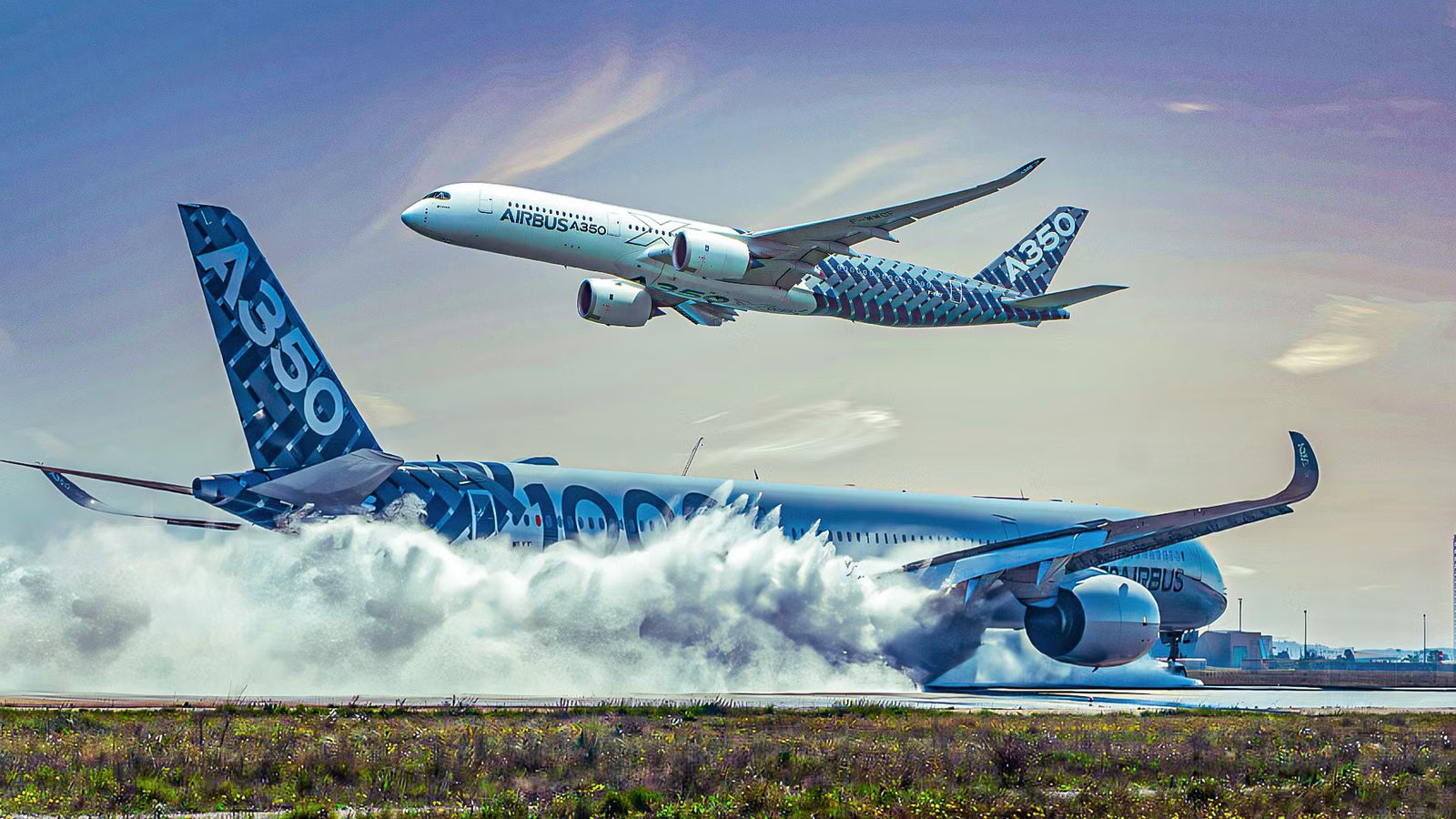
The Airbus A350 “Extra Wide Body” is rapidly becoming one of the company’s best-selling aircraft. It was inspired by the 787 Dreamliner, which is going to be the most successful widebody aircraft ever made with the highest sales in history. Naturally, clean sheet designs packed with innovative new technology are going to come at a pretty high price. The Boeing 787 goes for just about $320 million, but the A350 is a bit pricier.
The flyaway cost for the smaller A350 comes in between $308 and $317 million, according to Flightradar24. But its larger counterpart, the A350-1000, costs anywhere from $355 to $366 million. That puts a $50 million difference between the two models. Notably, the entry-level A350 can be similarly priced to the Dreamliner. Additionally, these sticker prices do not factor in the discounts that are frequently negotiated between manufacturers and carriers.
We know the Airbus A350-1000 has almost 20% more seats on board, but what other factors go into the higher cost of this exceptionally large twinjet airliner? Let’s break down how the higher cost is calculated for the bigger, heavier, and more powerful A350-1000 compared to its smaller cousin.
Two Sides Of The Same Airframe

Often referred to as a versatile workhorse, the Airbus A350-900 is perfect for long-distance, narrower routes with moderate demand. The A350-1000 is a stretched giant designed for high-density, premium-heavy routes where yield and capacity are given top priority. The regular A350-1000 can really fly a little farther than the standard -900, despite the fact that both have remarkable range.
The A350-1000 is about seven meters (23 feet) longer than the A350-900. This allows it to carry around 40 additional people in a typical three-class arrangement, or up to 480 in a high-density layout. This necessitates more internal systems, such as more oxygen units, safety devices, cabin illumination, and environmental control zones.
While both have a wingspan of 64.75 meters, the A350-1000’s wing has a slightly different trailing edge to accommodate its greater profile. These modest aerodynamic modifications, designed to enhance lift-to-drag ratios for larger loads, increase manufacturing complexity and expense.
Both aircraft use the Rolls-Royce Trent XWB family, but they employ different variants optimized for their specific airframes. The A350-1000 uses the most powerful commercial engine Rolls-Royce has ever built, the Trent XWB-97 engine, providing 97,000 lbs of thrust compared to the 84,000 lbs of the Trent XWB-84 used by the -900. This extra power is necessary to handle the -1000’s higher Maximum Takeoff Weight (MTOW).
A350s Side By Side

Although the systems and pilot type rating of the A350-900 and A350-1000 are around 95% similar, they differ significantly in performance engineering to handle the bigger dimensions and heavier weights of the -1000. Both make use of sophisticated flight control principles such as Differential Flap Settings (DFS) and Variable Camber (VC). By autonomously shifting the wing’s center of lift during cruise, these technologies lower drag and structural stress in real time.
The most visible engineering change is the main landing gear, which is designed to distribute the increased mass of -1000 without exceeding airport runway pavement limits. The -1000 gear, developed with Safran, uses advanced digital brake-by-wire technology and carbon brakes to absorb the higher kinetic energy of a 322-tonne aircraft during landing or rejected takeoff.
|
Specification Table |
Airbus A350-900 |
Airbus A350-1000 |
|---|---|---|
|
List Price (Est. 2025) |
~$317 Million |
~$366–$367 Million |
|
Typical Seating |
300 – 350 passengers |
350 – 410 passengers |
|
Fuselage Length |
219 feet (66.8 m) |
242 feet (73.79 m) |
|
Maximum Range |
~8,100 – 8,500 nautical miles |
~8,700 – 9,000 nautical miles |
|
Engines |
2x RR Trent XWB-84 |
2x RR Trent XWB-97 |
|
MTOW |
283 tons (624,000 lbs) |
316 – 322 tons (710,000 lbs) |
|
Landing Gear |
4-wheel main bogies |
6-wheel main bogies |
|
Operating Cost/Hr |
~$8,500 – $9,000 |
~$9,000 – $9,500 |
The -1000 wing has a 4% increase in overall wing area. This was achieved by extending the trailing edge (chord) by about 400mm. However, the A350-900 can fly higher, with a service ceiling of 43,100 feet, which is approximately 1,650 feet higher than the A350-1000’s limit of 41,450 feet.
For high-density routes, the A350-1000 can be up to 15% to 25% more profitable per flight than the smaller version; airlines frequently see the higher initial cost as an investment in lower seat-mile costs. The -1000 may use less fuel per passenger than the -900 on high-density routes. The A350 program cost roughly $15 billion to develop. The additional engineering expenses specifically needed to “stretch” the platform beyond its initial baseline design are partially covered by the A350-1000’s higher price.

Why The Airbus A350-1000 Has Such An Insane Fuel Burn Advantage
The Airbus A350-1000 cuts fuel burn by 25% thanks to ultralight design, Trent XWB engines and smooth aerodynamics — a real game-changer for long-haul.
Powered By Rolls-Royce

The Airbus A350 is powered only by the Rolls-Royce Trent XWB engine family, which has two basic variants: the XWB-84 and the XWB-97. While superficially identical, their interior engineering varies greatly to accommodate the bigger aircraft’s higher thrust needs. The greater thrust of the XWB-97 causes much higher operating temperatures in the combustor and turbine.
To maximize performance for the heavier A350-1000, the XWB-97 increases the fan’s rotational speed by 6% in comparison to the XWB-84. The XWB-97 uses advanced composite coatings on high-pressure turbine (HPT) blades and an additive layer manufactured front-bearing housing to withstand greater loads. Concerns regarding engine “time-on-wing” in hot, sandy conditions have long been voiced by Gulf airlines like Emirates. By investing £1 billion in durability initiatives in 2025, Rolls-Royce is aggressively tackling these issues.
Compared to the XWB-84, the Trent XWB-97’s higher thrust and operating temperatures may cause engine parts to wear down more quickly, especially in hostile regions like the Middle East. This could result in more frequent maintenance cycles. Rolls-Royce tests engine resilience at its “Testbed 80” facility in Derby using artificial dust that resembles the fine, talc-like sand of the Middle East.
The XWB-97 has a “smart cooling system” that regulates the amount of cooling air given to the blades dependent on the working conditions, ensuring longevity while maintaining fuel efficiency. A special coating has been created for turbine blades that reacts with swallowed sand (CMAS) to increase its viscosity, preventing it from melting and passing through the cooling pores in the blades. The IntelligentEngine platform provides backup support after the sortie as it streams data to Rolls-Royce’s Blue Data Thread from more than 1,000 sensors per engine.
Artificial intelligence models can now anticipate possible problems up to 500 flight hours ahead of time. With the goal of doubling the time-on-wing by 2028, these improvements have already enabled engines to run 60% longer between overhauls in challenging conditions as of late 2025. It goes without saying that innovation is expensive, with these massive jet engines accounting for a significant amount of the total cost of an aircraft.

Boeing 777X Vs. Airbus A350-1000: Who Will Win The Battle For Tomorrow’s Flagship?
The 777X is nearly ready for service, how will it fare against Airbus’ A350?
The Same, But Different

While both aircraft use roughly 53-54% Carbon Fiber Reinforced Polymer (CFRP) by weight, the A350-1000’s construction is significantly more complex due to the physical stresses of its larger structure. The 7-meter fuselage stretch generates significantly higher bending moments. To address this, Airbus reinforced the CFRP fuselage barrels, particularly around the center wing box and the joints between sections, with thicker composite layers in high-stress areas such as the top and bottom panels.
The higher-density application of these materials and the sophisticated computational modeling needed to make sure a 74-meter composite tube doesn’t flex excessively under extreme loads are what give the -1000 its complexity, rather than the various materials. The locations where the bulky, six-wheel landing gear fastens to the composite wing are incredibly complicated because carbon fiber is less flexible than aluminum.
Airbus employs a “hybrid architecture” at these joints, combining titanium and composite elements to distribute the massive landing loads without cracking the carbon fiber structure. Instead of a circular barrel, the A350’s fuselage is divided into four panels (top, bottom, and two sides). The -1000 requires even more precise engineering to ensure that the longer, thinner side panels can maintain cabin pressure and structural integrity over a longer period of time.

Project Sunrise: Will Qantas’ Ultra-Long-Haul Initiative Succeed?
Project Sunrise is an initiative by Qantas that would offer many ultra-long-haul flights from Australia. The carrier has announced routes like Sydney to New York JFK, which would exceed 19 hours. Project Sunrise is aimed at boosting connectivity to destinations that are located a long way from Australia. The airline said that:
“Project Sunrise will deliver more direct routes to Australia, significantly reduced point-to-point travel time (up to four hours compared with one-stop flights) and a flying experience second to none, with a cabin interior and service design influenced by medical and scientific research carried out on research flights. The first aircraft is scheduled to arrive in mid-2026, which will operate flights from Sydney to London and New York.”
The airline is known for its modified aircraft types, which are configured to be capable of serving ultra-long-haul routes, such as the iconic Boeing 747-400ER (Extended Range). For Project Sunrise, the carrier chose a modified
Ultra Long Haul In The A350

Airbus manufactures two customized “Ultra Long Range” (ULR) versions intended to fly the world’s longest commercial trips. While the A350-900ULR has been in service since 2018, the A350-1000ULR is presently being developed for Qantas’ “Project Sunrise” and is set to arrive in late 2026.
To accommodate nonstop flights from Sydney to Europe and New York, the -1000ULR features a redesigned Rear Center Fuel Tank. This design was recently redesigned to guarantee safety during such lengthy operations, as required by the regulator. As of late 2025, the first aircraft (MSN 707) has finished substantial structural assembly in Toulouse. Test flights are scheduled for early 2026, with commercial service beginning in early 2027.
In addition to six opulent First Class suites intended to lessen the physical strain of spending more than twenty hours in the air, the Qantas configuration features a special “Wellbeing Zone” where travelers can stretch and work out. With a range of up to 9,700 nautical miles, the A350-900ULR continues to lead the family in endurance for the time being.
In contrast to the -1000ULR, the -900ULR uses a modified current fuel system and a deactivated forward cargo hold to save weight in order to achieve its range. It usually operates in a two-class (Business and Premium Economy) configuration and only serves Singapore Airlines on the world-record routes to New York (JFK and Newark).