dailynewsnblog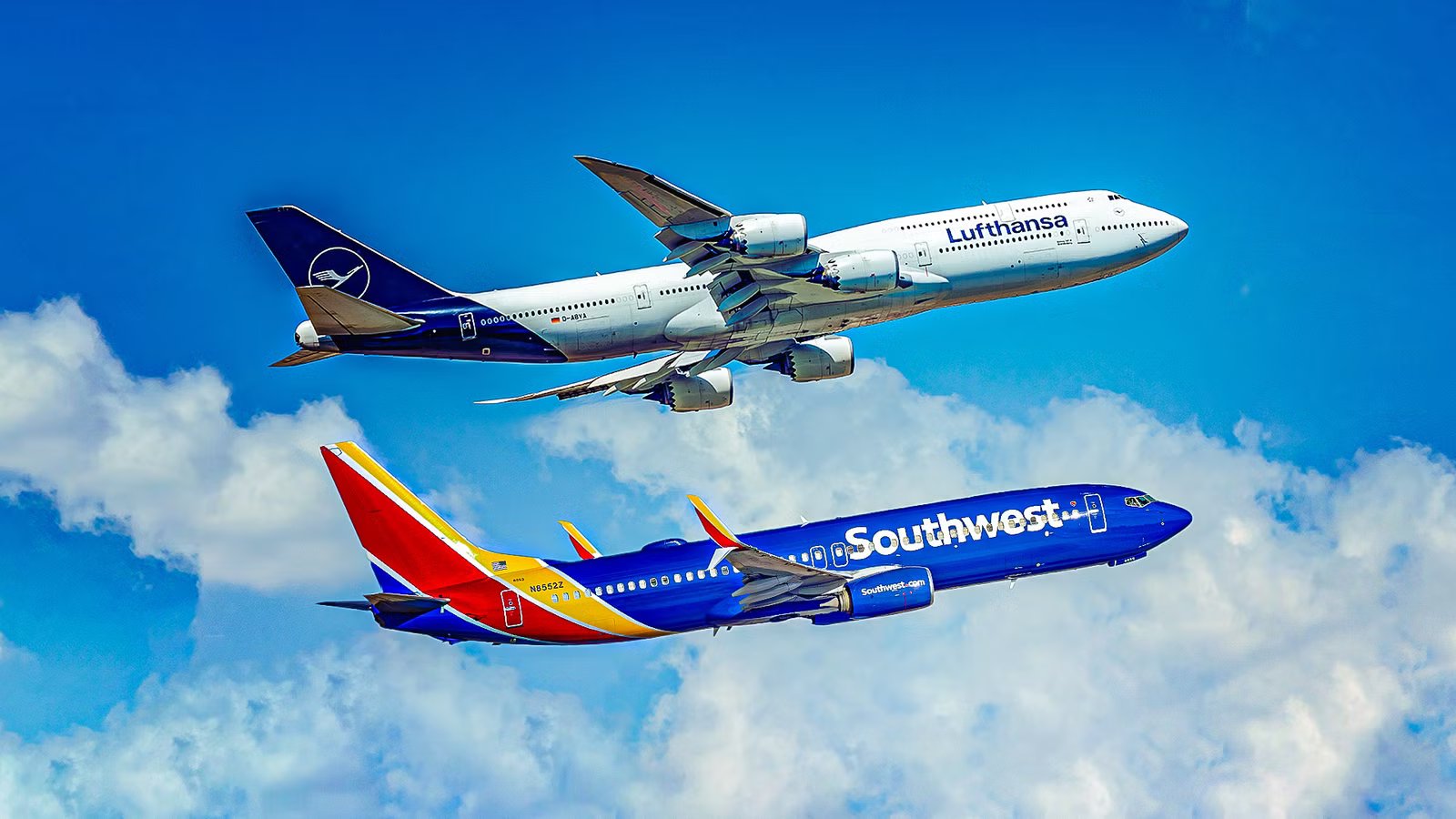
The Boeing 737 and the 747 are the two most iconic aircraft ever built by  Boeing, as well as some of the most famous airliners to ever fly. The 747 is most commonly referred to as the Queen of the Skies, due to its provenance and unique appearance. The 747 revolutionized air travel with its long-range and widebody design, opening up flying to the masses. While the 747 has been retired by most passenger operators due to its age and high fuel consumption, it was a tremendously successful aircraft for the majority of its five-decade-long career.
The Boeing 737 wasn’t a revolutionary aircraft, but it was well-sized for most commercial operators, had low operating costs, and was capable enough to serve the needs of airlines across different decades. It was produced in four distinct generations (737 Original, 737 Classic, 737NG, 737 MAX), with each being more popular than the last. Unlike the 747, demand is as high as ever for the 737, ensuring that we’ll continue to see the number of 737s in the world increase while the 747 goes away.
Looking At The Most Popular Boeing 737

Boeing’s disadvantage against the Airbus A320 family, which has overtaken the 737’s orders in recent years, is with large narrowbodies, as the 737-900ER was simply uncompetitive against the Airbus A321. But while other variants have experienced much more success, the 737-800 is a true bright spot within Boeing’s lineup. In total, Boeing has delivered 4,989 737-800s in the 28 years since the variant first entered service, making it the most widely produced commercial aircraft variant of all time.
Nearly 74% of all 737NG orders were for the 737-800 variant, and while the first-generation Airbus A320 family outsold the 737NG as a whole, the 737-800 outsold the A320-200, the type’s closest competitor. Like all 737NG variants, the 737-800 is powered by the CFM56-7B, and has an updated wing that can accommodate blended winglets or split-scimitar winglets. In addition, the 737NG has an updated full glass cockpit, as opposed to the partial glass cockpit found in the 737 Classic.
Exact figures vary by airline due to different interior layouts, but a Boeing 737-800 typically has an empty weight of 41.4 tons, and is rated for a Maximum Takeoff Weight (MTOW) of roughly 79 tons. As a point of comparison, the A320-200 typically has an empty weight exceeding 42 tons, and late-model A320-200s could be specced with a 78-ton MTOW. The 737-800 can carry more payload, has more interior space, and burns around the same amount of fuel as the A320-200.
The Most Popular Variant Of The Boeing 747

Unlike the 737, the passenger Boeing 747 is practically a relic of the past. But in its heyday, the 747 was the pride of airlines worldwide, and in the late 20th century, many airlines essentially had to have Boeing 747s to be taken seriously by the public. The Boeing 747 was the world’s most widely produced widebody until it was overtaken by the Boeing 777 in 2018, and the most popular variant was the 747-400, introduced in 1989. Of the 1,574 747s built, 694 were 747-400s or a 747-400 subvariant.
The actual empty weight of a widebody airliner like the massive Boeing 747-400 varies more than that of a narrowbody due to the added floor space and more options for customization, but a passenger 747-400 will typically weigh anywhere from 178 tons to 181 tons, with premium-heavy layouts adding additional weight. In addition, the standard 747-400 has an MTOW of nearly 397 tons, while the extended-range Boeing 747-400ER comes with an MTOW of 412.7 tons. In total, a 747-400 can weigh four to five times more than a 737-800.
|
Boeing 747-400 Subvariants |
|---|
|
747-400 |
|
747-400ER |
|
747-400D |
|
747-400F |
|
747-400ERF |
|
747-400M |
The 747-400 could be equipped with the General Electric CF6-80, Pratt & Whitney PW4000-94, or Rolls-Royce RB211-524. Compared to the 747-300, its engines are modernized with added power, and the plane features significant technological updates, including a full glass cockpit and an EICAS system. Furthermore, the 747-400 features a stronger structure, along with canted winglets and increased fuel capacity to make it not just the world’s largest airliner, but also the world’s longest-ranged airliner when introduced.

Why Might The Queen Of The Skies Still Have Airbus Worried?
The Boeing 747 still remains hugely popular in the air cargo sector.
The Largest Boeing 737 Variant

Boeing sold 52 737-900s and 505 737-900ERs, whereas Airbus sold 1,784 A321s. With the next generation 737 MAX 9 and A321neo, this sales gap would only worsen. The 737-900ER burned less fuel than the Airbus A321, but the A321 is sufficiently larger that it has lower per-seat costs. The 737 MAX 9 didn’t solve this problem. As the A321neo sells in increasingly higher numbers, Boeing is betting that another stretch of the 737, dubbed the 737 MAX 10, is the company’s answer.
As of March 2026, the 737 MAX 10 has not been certified, but when the plane receives type certification in late 2026 (if the timeline sticks), it will be the largest 737 variant. It will measure at 143 feet eight inches (43.79 meters) in length while retaining the 737 MAX’s wingspan of 117 feet 10 inches (35.92 meters). It will be powered by the CFM LEAP-1B, and while limited data is available on the plane’s exact specifications, its empty weight is likely to be under 50 tons, while the MTOW will be slightly boosted to 89.8 tons. Among other differences, the 737 MAX 10 will also feature a telescoping main landing gear to preserve field performance.
|
Boeing 737 Original Variants |
Boeing 737 Classic Variants |
Boeing 737NG Variants |
Boeing 737 MAX Variants |
|---|---|---|---|
|
737-100 |
737-300 |
737-600 |
737 MAX 7 |
|
737-200 |
737-400 |
737-700 |
737 MAX 8 |
|
737-500 |
737-800 |
737 MAX 9 |
|
|
737-900 |
737 MAX 10 |
||
|
737-900ER |
The 737 MAX 10 won’t be as capable as an Airbus A321neo equipped with auxiliary fuel tanks (a commonly selected option), but Boeing is betting that it doesn’t need to be. The stretch that created the 737 MAX 10 is intended to squarely address the per-seat cost issue, and Boeing is heavily advertising that the 737 MAX 10 will deliver some of the lowest per-seat costs for a large narrowbody. Given that the type has already received over 1,200 orders, it appears to have been a sound move, and sales are sure to increase once the 737 MAX 10 finally enters service.
The Largest Boeing 747 Variant

While the largest Boeing 737 variant is being sold on large promises, airlines are voting with their money that the plane will deliver. With the largest 747 variant, however, Boeing was looking to compete in a small pond against a clean-sheet design and was unable to provide meaningful competition. In total, the Boeing 747-8 received a paltry 155 orders, whereas the Airbus A380 received 251 orders. On top of that, 107 of these were for the 747-8F model, whereas only 48 orders were for the passenger 747-8i.
In total, only three airlines (Lufthansa, Korean Air, and Air China) ordered the 747-8i, and even these carriers have already trimmed their fleets, selling a handful of planes to the United States Air Force. The 747-8 features numerous technological advances, along with four General Electric GEnx-2B engines. Notably, the 747-8 features a fuselage stretch, a first for the 747, which brings the plane’s length to 250 feet two inches (76.25 meters). In addition, it also features a reprofiled wing, along with an increased wingspan measuring 224 feet seven inches (68.45 meters).
The passenger 747-8i typically has an empty weight of roughly 220 tons, and can be specced with an MTOW of 448 tons. This makes the 747-8 the heaviest aircraft ever manufactured in the United States. When empty, the 747-8 is over four times heavier than the 737 MAX 10, while it’s nearly five times heavier than a 737 MAX 10 when fully loaded. The 747-8 is a true behemoth that dwarves anything other than an Airbus A380 in both dimensions and weight.

The Boeing 747‑400F’s Incredible Cargo Hold
Exploring the design of the Boeing 747-400F.
The Future Icons Of The Skies

The sweet spot of the narrowbody market has generally moved up in size, since the 737 MAX 10, for example, only costs slightly more to operate than a 737 MAX 8 while offering much greater revenue potential. However, the Airbus A321neo has a significant head start on the 737 MAX 10, and it has become the most widely ordered aircraft variant of all time, with over 7,000 sales (the 737-800 still leads in total deliveries). It has a high capacity with an efficient interior layout, and sips fuel. For airlines that need more range, Airbus offers additional fuel tanks, with the A321XLR offering the most range and payload capacity.
In the widebody market, the Boeing 787-9 has become history’s most ordered widebody variant, with over 1,400 sales. Just like the 747, the 787-9 is selling largely due to its incredible range. In addition, although it can’t fly quite as far as the Airbus A350 or even the older Boeing 777-200LR, it burns less fuel on the missions that it can operate. In addition, the 787-9 is relatively small and is extremely efficient on shorter routes as well.
These two planes are the future of aviation, but they’re much closer in size than the 737-800 and the 747-400. The 787-9’s typical empty weight of roughly 130 tons is only 2.6 times as much as the A321neo’s typical empty weight of roughly 50 tons, and its MTOW of 259 tons is 2.67 times more than the A321neo’s MTOW of 97 tons (the A321XLR is available with an MTOW of 101 tons). As a whole, what we see is that airlines are favoring larger narrowbodies and smaller widebodies compared to before.