dailynewsnblog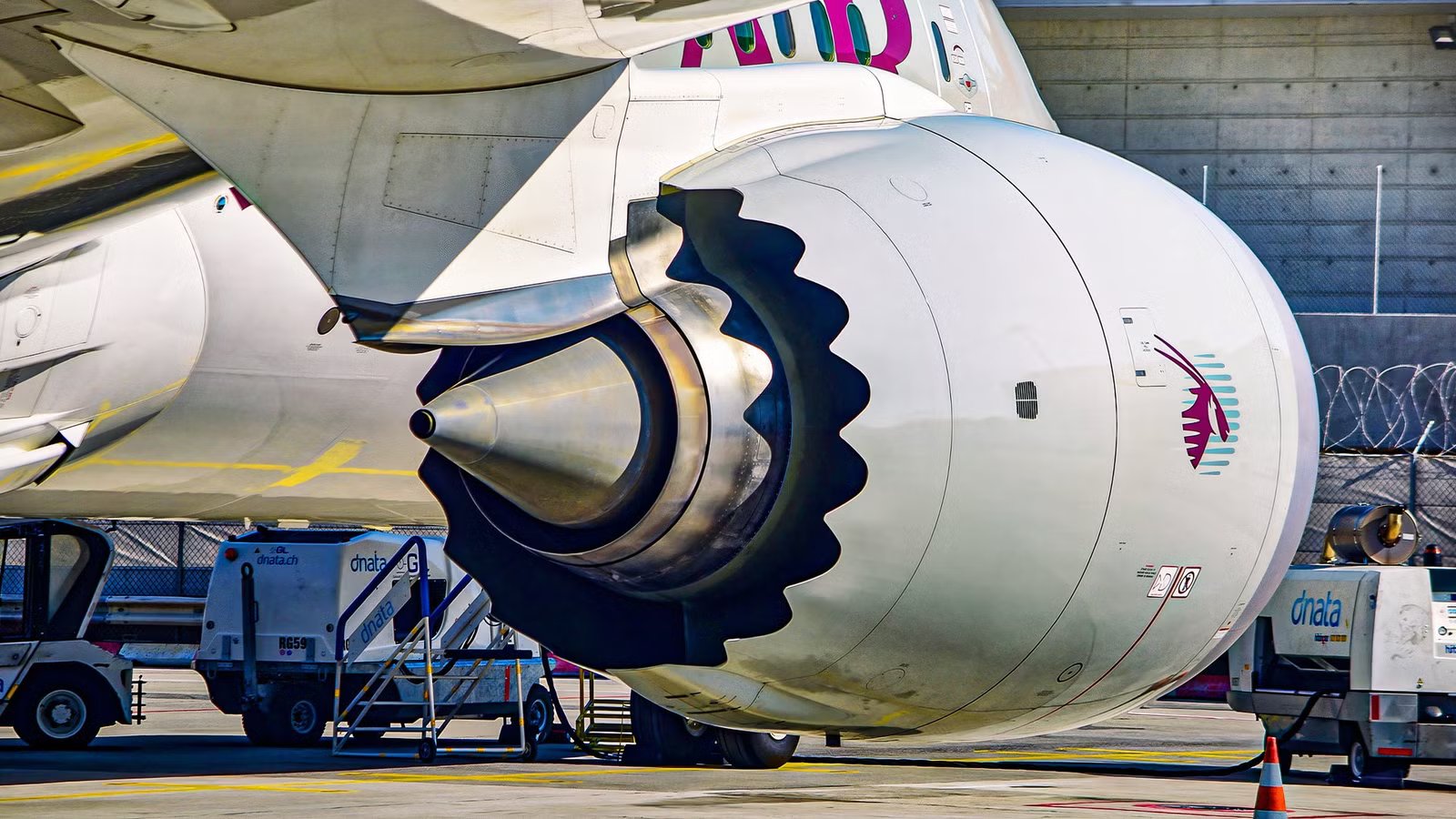
There are three levels of aviation geeks. The first can tell the difference between aircraft types. The second knows which engines power them—whether it’s General Electric or Rolls-Royce. And the third? They can spot the difference between engine variants that look almost identical—like the General Electric GEnx‑1B on the Boeing 787 Dreamliner and the GEnx‑2B on the Boeing 747‑800.
At first glance, the engines hanging under the wings of the Boeing 747‑8 and Boeing 787 Dreamliner appear nearly identical. Both belong to the General Electric GEnx family—one of the most advanced turbofan platforms ever built. But beneath the nacelle, these engines were designed around two completely different philosophies of aircraft design.
A Fundamental Shift To “More Electric”

The biggest engineering difference between the engines on the Boeing 747-8 and the Boeing 787 Dreamliner isn’t their size, thrust, or fan diameter. It’s something far less visible: how the aircraft uses the engine’s energy.
For decades, most commercial airliners relied on bleed air systems. In a traditional turbofan aircraft, high-pressure air is tapped—or “bled”—from the compressor section of the engine and routed throughout the airplane to power critical onboard systems. Before the engines are running, this air typically comes from the aircraft’s APU or a ground air source. Once the first engine is started, the remaining engines can often be started using cross-bleed air supplied by the running engine.
That hot compressed air becomes the hidden workhorse of the aircraft, powering a wide range of systems, which may include:
- Engine Starting
- Cabin Air Conditioning
- Wing and Engine Anti-Icing
- Cabin Pressurization
- Leading Edge Flaps
- Thrust Reversers
- Hydraulic Pumps
- Cargo Smoke Detection
- Potable Water Tank Pressurization
- Hydraulic Revervoir Pressurization
- Aft Cargo Heat
The GEnx-1B on the Boeing 787, on the other hand, is often referred to as a “bleedless” engine. Instead of tapping high-pressure air from the compressor to run cabin systems, the 787 uses two Variable Frequency Starter Generators (VFSG) per engine to produce a massive amount of electrical power. This design allows the engine to handle increased power draw without compromising the efficiency gained from its advanced core.
Even a quick look at the General Electric GEnx engines used on the Boeing 747-8 and the Boeing 787 Dreamliner reveals the contrasting design philosophies behind the two aircraft.
|
Boeing 747-8 (GEnx-2B) |
Boeing 787 (GEnx-1B) |
|
|
Cabin Pressurization |
Traditional Bleed Air |
Electric |
|
Anti-Icing |
Traditional Bleed Air |
Electric |
|
Hydraulic Systems |
Traditional Bleed Air |
Electric |
The benefits of a bleedless design can be seen from both the passenger experience and the pilot’s operational perspective. From the passenger’s perspective, there are noticeable improvements in cabin comfort. On the Boeing 787 Dreamliner, the electrically powered environmental control system allows cabin environment management more precisely than in traditional aircraft. This enables higher humidity levels, which helps reduce the dryness often experienced during long flights, as well as more stable cabin temperatures that improve overall passenger comfort.
From the pilot’s perspective, the benefits are related more to engine performance and efficiency. In conventional aircraft, bleed air is extracted from the engines to power systems such as the environmental control system. Removing this high-pressure air reduces the energy available to produce thrust, which can slightly decrease engine efficiency. By reducing the need for bleed air and relying more on electrical systems, the engines can use more of their airflow for propulsion.
Bypass Ratio

The bypass ratio describes how a turbofan engine moves air to produce thrust. Most of the air pulled into the engine actually flows around the engine’s core rather than through it. This large volume of bypass air helps modern jet engines produce thrust more efficiently, quietly, and with less fuel.
However, the bypass ratio cannot increase indefinitely. Achieving a higher ratio requires a larger fan, and beyond a certain point, the engine diameter becomes too large for practical aircraft installation.
This tradeoff is clearly visible when comparing the engines on the Boeing 787 Dreamliner and the Boeing 747-8. While both aircraft are powered by variants of the General Electric GEnx, the 787 uses a significantly larger fan diameter to achieve a higher bypass ratio, whereas the 747-8’s engine is slightly smaller to meet the aircraft’s ground clearance and wing design constraints.
Take a closer look :
|
Bypass Ratio During Takeoff |
|
|
Boeing 787-8 (-1B70) |
9.0 : 1 |
|
Boeing 787-9 (-1B74/75) |
8.8 : 1 |
|
Boeing 787-10 (-1B76) |
8.8 : 1 |
|
Boeing 747-8 (-2B67B) |
8.0 : 1 |
|
Boeing 737 MAX (LEAP-1B) |
8.6 : 1 |
To elaborate, a 10:1 bypass ratio means that out of every 11 portions of air entering the engine, 10 travel around the outside of the core while only 1 passes through the combustion section. In essence, a higher bypass ratio means better efficiency.
Building the GEnx : A Global Effort

Building the General Electric GEnx is a global process that involves multiple manufacturing sites and specialized technologies. The production of a single engine requires more than 1.1 million individual parts, produced across several countries before being assembled into a complete engine.
The process begins with the manufacturing of key components. One important part is the composite fan case, produced at a GE facility in Mississippi. This structure surrounds the engine fan and is made from advanced composite materials that are both strong and lightweight. At the same time, large composite fan blades are manufactured through a joint venture between GE Aerospace and Safran Aircraft Engines. These blades are designed to move large volumes of air efficiently while reducing engine noise. Next, other internal components of the engine are produced. Facilities in New Hampshire manufacture blisks, single-piece blade-and-disk units used in the compressor. These parts improve airflow through the engine while reducing the number of separate components that would normally require maintenance. Meanwhile, in Indiana, engineers manufacture and assemble the Twin Annular Pre-Swirl (TAPS) combustor, which mixes air and fuel before combustion. This design allows the engine to burn fuel more efficiently and produce fewer emissions.
Once these components are completed, they are transported to a facility in North Carolina where the engine core is assembled. This stage brings together the compressor, combustor, and turbine sections that form the heart of the engine. The partially assembled engine is then transported to Ohio for final assembly and testing. At this stage, the fan blades and fan case are installed, and the completed engine undergoes a series of performance tests to ensure it meets safety and performance standards. After testing, the finished engines are delivered for installation on aircraft such as the Boeing 787 Dreamliner and the Boeing 747-8, where they power long-distance flights around the world.

Why The General Electric GEnx Became A Game-Changer For Boeing
The popular jet engine is a marvel of cutting-edge technology.
Comparing Power and Size

One of the most obvious differences between the engines on the Boeing 747-8 and the Boeing 787 Dreamliner comes down to a simple question: how many engines the aircraft uses.
The Dreamliner relies on just two engines, meaning each engine must generate significantly more thrust. The Boeing 747-8, meanwhile, spreads its power requirements across four nacelles, allowing each one to operate at a slightly lower thrust level. As a result, the engines on the two aircraft have markedly different takeoff thrust ratings, as illustrated in the table below:
|
Take Off Thrust |
|
|
Boeing 787-8 (-1B70) |
69,800 |
|
Boeing 787-9 (-1B74/75) |
74,100 |
|
Boeing 787-10 (-1B76) |
76,100 |
|
Boeing 747-8 (-2B67B) |
66,500 |
For perspective, the CFM 56 engines powering the Airbus A320ceo and the Boeing 737 NG’s produce between 18,500 and 32,000 pounds takeoff thrust. This difference in thrust is also visible in the physical size of the engines as seen in the table below :
|
Fan Diameter (Inches) |
|
|
Boeing 787-8 (-1B70) |
111.1″ |
|
Boeing 787-9 (-1B74/75) |
111.1″ |
|
Boeing 787-10 (-1B76) |
111.1″ |
|
Boeing 747-8 (-2B67B) |
104.7″ |
|
Boeing 737 NG (CFM 56-7) |
61″ |
The 787’s engine features a massive 111.1-inch fan, while the 747-8’s version is smaller at 104.7 inches. The reason is simple: the iconic low-slung wing of the 747 requires additional ground clearance, limiting how large the fan can be.
Operational Performance and Efficiency

Beyond engineering differences, the choice between a twin-engine and four-engine aircraft has major economic implications for airlines. The 787 was designed from the outset for maximum fuel efficiency. On average, the Dreamliner burns about 2,900 gallons of fuel per hour, while the much larger 747-8 consumes roughly 3,800 gallons per hour.
Since fuel typically represents 20–40% of an airline’s operating expenses, reducing fuel consumption is a key factor in improving profitability.
Comparison with the Boeing 777X’s GE9X Engine

Shutterstock | Simple Flying
The next evolution in large turbofan technology can be seen in the GE9X, developed by GE Aerospace for the Boeing 777X.

Here’s How Much More Range The Boeing 777X Has Compared To The 777-300ER
While the 777-300ER has more range than the larger 777-9, the similarly sized 777-8 can fly 1,375 NM further, while carrying a few more passengers.
The GE9X features an enormous 134-inch fan diameter, making it the largest jet engine fan ever installed on a commercial aircraft. The GE9X fan is about 23 inches larger than the GEnx-1B and nearly 30 inches larger than the GEnx-2B. This massive fan allows the GE9X to move a much larger volume of air around the engine core, contributing to its higher efficiency and lower fuel consumption. However, such a large fan also requires an aircraft specifically designed to accommodate it—one of the reasons the Boeing 777X features longer landing gear and folding wingtips to maintain ground clearance.
Performance improvements are also significant. The GE9X delivers approximately 5% better specific fuel consumption than any current twin-aisle engine and up to 10% better fuel efficiency compared with the GE90-115B used on earlier Boeing 777 models.
The engine achieves a bypass ratio of roughly 10:1, which contributes to :
- Lower Fuel Consumption
- Reduced Engine Noise
- Improved Propulsive Efficiency