dailynewsnblog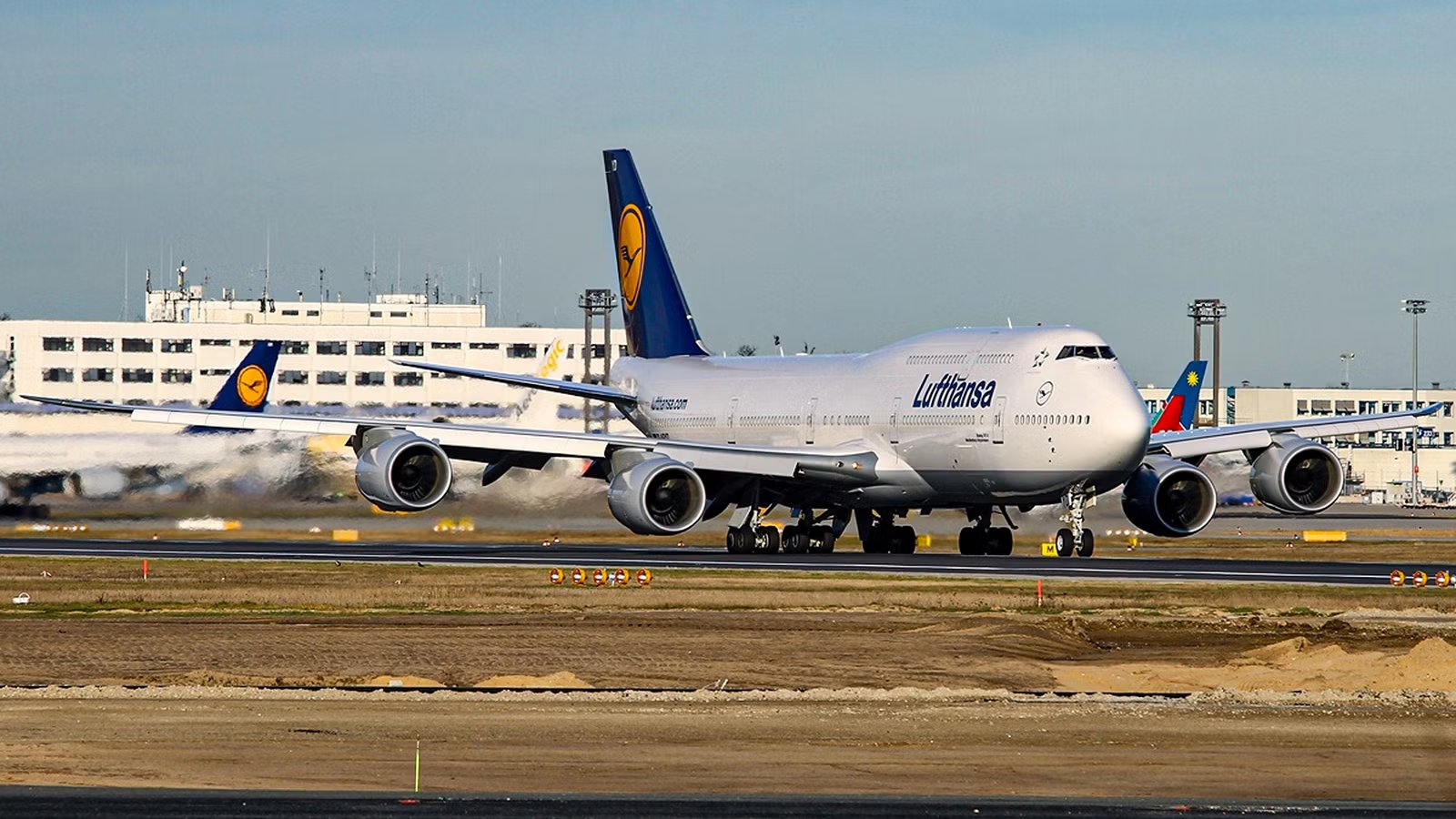
The Boeing 747 is dying out. Some carriers continue to find uses for them despite the rise of efficient long-range twinjet aircraft like the A350, 787, and 777. Carriers like Lufthansa regularly fly these aircraft to meet high capacity demands and reduce the impact of slot limits at congested airports.
This article covers the passenger flights that the 747 took part in last year. It then explores how carriers have found success using them and which jets will replace them as they continue to be retired. It closes with how cargocarriers will find use for the 747 long after it becomes entirely obsolete among passenger airlines.
Boeing 747 Flights Last Year

Last year, four carriers flew commercial services for the Boeing 747. In order of the number of flights, these were Lufthansa, Korean Air, Air China, and Aeroflot. Lufthansa far dwarfed its competitors, achieving almost 12,000 flights. Meanwhile, the 747 had a marginal role for Air China (853 flights) and Aeroflot (596 flights).
The table below ranks the four airlines currently flying the Boeing 747 according to Cirium. It includes both the 747-400 and the 747-8:
|
Marketing Airline |
Flights |
Seats |
Available Seat Miles (ASMs) |
|---|---|---|---|
|
Lufthansa (LH) |
11,719 |
4,288,578 |
22,397,855,711 |
|
Korean Air (KE) |
2,166 |
797,088 |
4,422,145,600 |
|
Air China (CA) |
853 |
293,432 |
311,296,264 |
|
Aeroflot (SU) |
596 |
311,112 |
893,737,080 |
|
TOTAL |
15,334 |
5,690,210 |
28,025,034,655 |
In total, carriers worldwide flew over 15,000 747 flights in 2025, offering customers 5.69 million seats and over 28 billion available seat miles. Although these numbers seem big, they are tiny compared with the total across global aviation. They show just how far the 747 has fallen from its former status as the Queen of the Skies.
Lufthansa: The Airline That Won’t Give Up On The 747

Most of the 747’s continued relevance is down to Lufthansa’s continued trust in the 747 to turn a profit. The carrier currently flies eight 747-400s, set to be retired in 2028, which is when Lufthansa hopes it can replace them with the 777-9. The carrier is also the world’s largest operator of the 747-8I, flying 18 jets of this type. Within this fleet is D-ABYP, the 1,500th Boeing 747 built.
Lufthansa uses its two variants of the 747 differently. The 747-8I is a larger, more efficient, and quieter aircraft with a range roughly 500 miles longer. The carrier takes a distinctly more premium approach to the 747-8I, offering 8 first-class and 80 business-class seats. Meanwhile, it has an economy class cabin that is smaller by 28 seats. These configurations make the 747-8I ideal for Lufthansa’s ultra-long-haul and high-yield routes. Examples include Frankfurt to Buenos Aires, Los Angeles, and Tokyo Haneda. The 747-400 is used for higher capacity routes, such as to Indian airports like Mumbai, Bengaluru, and  Delhi Indira Gandhi International Airport
The table below uses data from planespotters.net to show the rich history that Lufthansa has with the world’s first super jumbo:
|
Lufthansa passenger 747 fleet |
Number |
Years in service |
Engines |
|---|---|---|---|
|
Boeing 747-100 |
3 |
1970 – 1979 |
Pratt & Whitney JT9D |
|
Boeing 747-200B |
7 |
1971 – 2004 |
Pratt & Whitney JT9D, General Electric CF6-50 |
|
Boeing 747-200M |
14 |
1976 – 2004 |
General Electric CF6-50 |
|
Boeing 747-400 |
24 |
1989 – Present |
General Electric CF6-80 |
|
Boeing 747-400M |
7 |
1989 – 2014 |
General Electric CF6-80 |
|
Boeing 747-8 |
19 |
2012 – Present |
General Electric GEnx |
One reason the 747 has remained essential for  Lufthansa is that its capacity can’t currently be matched by any of the market’s twinjets, although this will change once it starts receiving 747s. Lufthansa flies out of congested airports like Frankfurt, where it needs to make the most of limited slots. While the uses for its 747-400s are now diminishing, Lufthansa doesn’t yet have enough 787s and A350s to replace them, though the 777X is set to alleviate this.

Why In The World Does Lufthansa Still Fly The Boeing 747-400?
Lufthansa, unlike almost every other airlne in the world, has been holding on to its old “jumbo jets.” What’s the reason, and what’s next?
The Death Rattle Of Britain’s 747s

Jumbo jets were once a staple of flying from London Heathrow and Gatwick. Now, the jumbo jet era is over for British aviation. With Korean Air’s announcement that it will no longer use its 747-8s for flights from Seoul Incheon International Airport (ICN) to London Heathrow (LHR), there will now be no 747 passenger flights in the UK in 2026. The carrier had previously restarted such flights in June 2024 following the post-pandemic recovery. Please note that cargo carriers will still be flying the 747 in British airspace, so spotters will still have opportunities to see the Queen of the Skies.
A spokesperson from Korean Air said, “As part of our overall fleet operations management, Korean Air has changed the aircraft for the Incheon-London route this summer. Please note that future aircraft deployment plans remain subject to change.”
As shown by the data at the start of this article, Korean Air hasn’t completely stopped flying its 747-8Is. You can still enjoy this aircraft before it is totally retired from the fleet. The carrier flies the Queen of the Skies from Seoul to Los Angeles, Hong Kong, Taipei, and Tokyo Narita. Retirement may not be imminent as Korean Air’s 747-8s are still relatively young. Its passenger 747-8s are 9.3 years old on average, while its freighters are 12.4 years old on average.
Which Aircraft Will Replace the 747?

Every time a 747 exits service, it leaves a large capacity gap behind, and carriers must purchase new aircraft to serve their passengers. Airbus’ answer to 747 retirement isn’t more super jumbos. The A380 is now out of production. Instead, it is marketing the A350 as the answer. This twinjet can’t match the 747’s capacity. However, it offers a substantially longer range and utilizes a host of technological advantages to offer airlines unmatched efficiency and low operating costs.
Even if Airbus’s A350 doesn’t meet the 747’s capacity, it has been producing them at a remarkable rate to fill the capacity gap in global aviation. It has produced almost 700 aircraft of the family. Popular operators include Cathay Pacific, Qatar Airways, Delta Air Lines, and Air China.
The table below shows specifications for the four aircraft set to replace the 747, the 777-9, 777-8, A350-900, and A350-1000. It makes use of Boeing and Airbus data:
|
Specification |
A350-900 |
A350-1000 |
777-8 |
777-9 |
|---|---|---|---|---|
|
Length |
219 feet 2 inches (66.8 meters) |
242 feet (73.8 meters) |
232 feet 6 inches (70.9 meters) |
251 feet 9 inches (76.7 meters) |
|
Height |
55 feet 11 inches (17.0 meters) |
56 feet (17.1 meters) |
63 feet 11 inches (19.5 meters) |
64 feet 7 inches (19.7 meters) |
|
Wingspan |
212 feet 5 inches (64.7 meters) |
212 feet 5 inches (64.7 meters) |
235 feet 5 inches (71.8 meters) |
235 feet 5 inches (71.8 meters) |
|
MTOW |
625,892 pounds (283,900 kg) |
711,872 pounds (322,900 kg) |
805,000 pounds (365,100 kg) |
775,000 pounds (351,500 kg) |
|
Range |
8,500 nautical miles (15,742 km) |
9,000 nautical miles (16,668 km) |
8,745 nautical miles (16,196 km) |
7,285 nautical miles (13,492 km) |
Boeing takes a slightly different approach to the issue. They have built a huge widebody aircraft, the Boeing 777X. It is an aircraft that can approach the 747’s capacity, even though it is another twin-jet. The aircraft uses General Electric GE9X turbofans producing 110,000 pounds of thrust to get such an enormous bulk into the skies. The main obstacle to the 777X replacing the retiring 747s is the ongoing delay in its entry into service. 35 777-8s, 521 777-9s, and 63 777-8Fs have been ordered by carriers around the world, although none are based in the USA. None have been delivered.

Here’s What Ended The Boeing 747’s Historic Production Run
Over 1,500 planes built over more than half a century.
Cargo Airlines Still Love The 747

The last decade has seen an explosion in the number of efficient twin-jet widebody aircraft that can operate long-haul point-to-point flights. That has rendered hub-and-spoke networks, in which super jumbos excel, obsolete in most cases. Still, cargo airlines continue to find great use in flying the 747. Carriers like Cargolux, Nippon Cargo Airlines, Cathay Pacific, and UPS continue to operate the 747, and there are over 100 freighters of this family in active service.
The first 747 freighter, the 747-200F, came into service over 50 years ago. The jet could lift 200,000 lbs of cargo over 5,000 miles. Operational efficiency was critical to the jet’s success. Automated handling systems allowed just two people to load 30 pallets in half an hour. The 747-400F then became the most widely used cargo model. This aircraft incorporated the iconic nose door, allowing carriers to load awkwardly shaped cargo. This feature was not available on Boeing Converted Freighters (BCF).
The most recent and efficient 747 freighter, the 747-8F, entered service in 2011. It could carry 140 tons of freight, with up to 34 pallets on the main deck. While demand for the passenger 747-8I was waning, the 747-8F was popular for its combination of range, efficiency, and capacity. The freight industry is also less susceptible to the pitfalls of the hub-and-spoke model. Freight pallets don’t get grumpy about waiting for a connection, and the freight industry is more centralized around hubs.