dailynewsnblog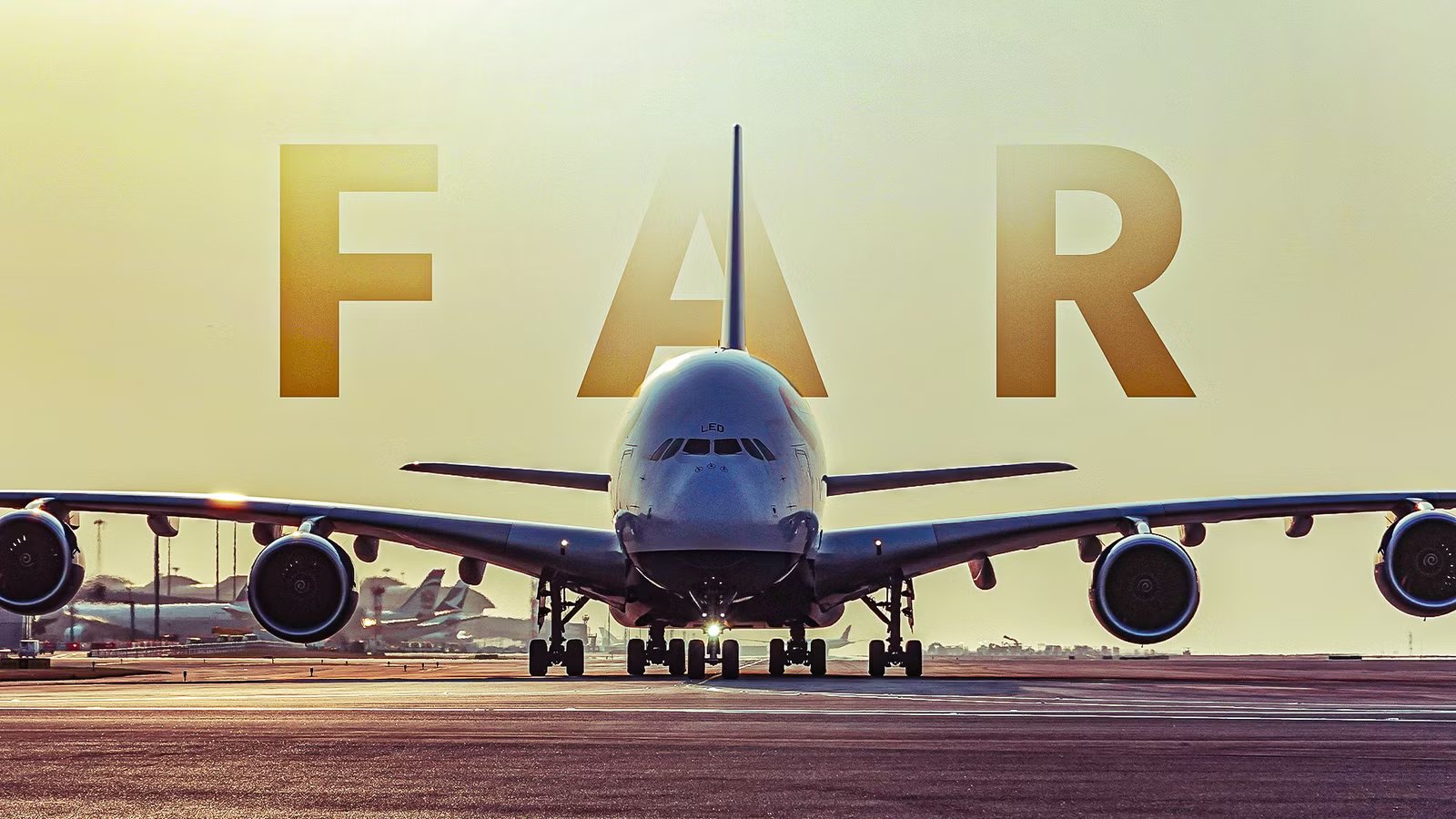
When the Airbus A380 entered service almost 20 years ago, it brought ridiculous range and capacity. Airlines could carry several hundred passengers between hubs on opposite sides of the globe. When full, the A380 also had a remarkably low operating cost.
Read on to discover the A380’s exact range, and the remarkable technology introduced to facilitate it. The article then covers how its range compares to its primary competitor, the Boeing 747, and how it has now been thoroughly outstripped by the capabilities of new twin-jet widebody aircraft. Such jets include the Airbus A350 and the upcoming Boeing 777X.
How Far The A380 Can Fly Without Refueling

According to Airbus’ data, the world’s largest passenger airliner can fly for 8,000 nautical miles (14,800 km) while the aircraft is flying in a four-class, 545-seat configuration. Engine Alliance, manufacturer of the GP7200, one of the engines used to power the A380, claims the range is closer to 8,200 nautical miles (15,200 km). These slight differences are all down to the amount of cargo and passengers that the aircraft is carrying. The more weight onboard, the more power needed to take off, climb, and cruise, therefore increasing fuel consumption and reducing range.
Regardless of these slight variations, that range is sufficient to cover enormous routes like London-Singapore and Dubai-Los Angeles. Other long routes well within its capabilities include Dubai to Auckland – 7,668 nautical miles (14,202 km) – and the 7,474 nautical miles (13,840 km) from Sydney to Dallas/Fort Worth. The longest A380 routes routinely force the aircraft to remain in the sky for over 14 hours, with its maximum flight time capability of 16 hours (although legal mandates on minimum fuel reserves mean this theoretical limit is never approached). Such a capability, combined with its enormous capacity, was central to the Airbus A380 becoming the king of the hub and spoke model. A380s would carry hundreds of passengers between the world’s largest hubs, who would then board smaller aircraft to reach their exact destination.
The A380 combines this with relatively low operating costs. Its capacity means it has a lower cost per seat mile than some modern widebody jets. However, this advantage applies only to carriers that can regularly fill their A380s.
What Makes The A380 Capable Of Such High Range?

The A380 combined efficient engines, a revolutionary wing and airframe design, and an enormous fuel tank to facilitate its range. The jet was built from 25% composite materials. That made it far lighter than its enormous size would suggest, while maintaining the strength needed. Lighter weight means a lower fuel burn during all stages of flight. While flying its 8,000 nautical mile range, an A380 burns through 84,535 US gallons (320,000 liters) of fuel, which is distributed across 11 fuel tanks, mostly in the wings. This isn’t just dead weight. Instead, automated systems ensure the fuel is always distributed to keep the center of gravity in the optimal position for stable, efficient flight.
The table below displays specifications for the A380-800, as collected by Simple Flying:
|
Launch customer |
Singapore Airlines |
|---|---|
|
Length |
238 ft 7 in (72.72 m) |
|
Wingspan |
261 ft 8 in (79.75 m) |
|
Height |
79 ft 1 in (24.09 m) |
|
Engine options |
Rolls-Royce Trent 900 or Engine Alliance GP7200 |
|
Range (Airbus’ claim) |
8,000 nautical miles (14,800 km) |
An A380 has a maximum takeoff weight of 1,268,000 lbs (575,000 kg). That requires four Rolls-Royce Trent 900 or Engine Alliance GP7200, each delivering upwards of 70,000 lbf. So much thrust burns through fuel quickly, so A380 pilots alter their flying style accordingly. The A380 is known for having one of commercial aviation’s slowest climb rates. Pilots also cruise at Mach 0.85, not the A380’s maximum speed, but faster cruising increases air resistance and fuel burn, reducing the jet’s range.

British Airways’ Longest Nonstop Routes With The Airbus A380 In 2026
The A380 performs an invaluable role on the carrier’s high-capacity, high-value routes.
How Does The A380’s Range Compare To The Boeing 747?

The world’s other superjumbo, the Boeing 747, was the A380s main competition for dominion of hub-and-spoke aviation. The A380 has a higher capacity than all 747 variants, and a similar range to the most modern 747 variants. The 747-8I can fly for 8,000 nautical miles (15,000 km). That means it is only slightly outstripped by the A380 under certain loading and engine circumstances.
Yet, the A380 has a significantly higher range than the older Boeing 747 variants. This should come as no surprise, given that the Boeing 747-100 entered commercial service for its launch customer, Pan American World Airways, in 1970. The table below shows how far the older 747 variants can fly:
|
747 variant |
Range |
|---|---|
|
747-100 |
5,300 nautical miles / 9,800 kilometers / 6,100 miles |
|
747-200 |
6,857 nautical miles / 12,700 kilometers / 7891 miles |
|
747-300 |
6,330 nautical miles / 11,723 kilometers / 7284 miles |
|
747-400 |
7,285 nautical miles / 13,492 kilometers / 8,383 miles |
|
747 LCF Dreamlifter |
4,212 nautical miles / 7,801 kilometers / 4,847 miles |
Some experimental 747s have been able to push well beyond these usual limits. Almost four decades ago, a Boeing 747-400 flew from London Heathrow Airport (LHR) to Sydney Kingsford Smith Airport (SYD). This service was almost 10,600 miles (17,000 km) long and lasted over 20 hours. It set a new Fédération Aéronautique Internationale world record for distance. To facilitate the flight, Shell Germany produced 60,000 gallons (227,000 liters) of special high-density jet fuel. In recognition of the achievement, the aircraft, VH-OJA, gained the name City of Canberra. It flew for Qantas until March 2015, flying other lengthy routes. The record was eventually broken by a Boeing 777-200LR in 1995.
The Airbus A380’s Engines

When Engine Alliance and Rolls-Royce designed engines for the A380, they were met with a challenging task. Their powerplants had to be strong enough to get the enormous weight up to cruising altitude and efficient enough not to compromise the aircraft’s range. Both engines produce around 75,000 lbf, giving the aircraft a total maximum power of around 300,000 lbf. That is equivalent to six Boeing 737 MAX aircraft or 2,500 family cars. The Rolls-Royce Trent 900 engine is marginally more powerful, with around 300 to 2,100 lbf more in thrust. However, it has a lower bypass ratio of 8.5 to 8.7:1 compared with the Engine Alliance GP7200’s 8.8:1
Rolls-Royce marginally won the battle to power the majority of A380s, with around two-thirds of the delivered jets being powered by Rolls-Royce engines. A substantial reason for this success is Emirates’ preference for the Trent 900. 90 of its 123 delivered A380s had this engine. The table below shows which carriers chose which A380 engine option:
|
A380 Engine Option |
Airlines |
|---|---|
|
Rolls-Royce Trent 900 |
All Nippon Airways (ANA), Asiana Airlines, British Airways, China Southern Airlines, Emirates (33 aircraft), Lufthansa, Malaysia Airlines, Qantas, Singapore Airlines, Thai Airways |
|
Engine Alliance GP7200 |
Air France, Emirates (90 aircraft), Etihad Airways, Korean Air, Qatar Airways |
However, due to a 2011 update, Engine Alliance has been keen to point out that its A380 engine is more efficient. Using data from 72 million flight hours, Engine Alliance has made several claims about its engine’s performance compared to the Trent 900. It claims that the payload-range advantage offered is worth $5.5 million to customers annually. Its efficiency also yields fuel savings of $500,000 per aircraft per year. The efficiency is also seen in reduced noise pollution, with Engine Alliance claiming it produces 0.8 dB less sound. Finally, the engine manufacturer claims the engine is more reliable than the Trent 900.

This Is How Powerful The Airbus A380 Is
The four-engined giant remains the most powerful commercial jet in history.
Which Aircraft Can Fly Further Than The A380?

The emergence of incredibly efficient twin-jet aircraft like the Airbus A350 and Boeing 787 have brought about the end of the hub-and-spoke model in all but a few select cases. By matching and exceeding the A380’s range and providing better efficiency, albeit with a lower capacity, carriers can fly passengers directly to their precise destinations. These jets’ smaller size makes them much more flexible, as it isn’t only the world’s largest hubs that can facilitate them, as was the case with the A380.
The A350-900 can fly 8,500 nautical miles (15,750 km) while the A350-1000 has a range of 9,000 nautical miles (16,700 km). The A350-900ULR, flown exclusively by Singapore Airlines, achieves an even higher range of 9,700 nautical miles (17,964 km), which is further than any other passenger aircraft in service. The -900ULR has a host of range-increasing modifications, including a modified fuel system which adds another 24,000 liters in fuel capacity.
When the Boeing 777X enters service, it will also have a further range than the Airbus A380. Boeing claims that the 777-8 will be able to fly 8,745 nautical miles (16,196 km) with 384 passengers. The larger 777-9 will be able to carry 426 passengers, but will have a shorter range of 7,285 nautical miles (13,492 km). However, that range is still long enough for it to replace the A380 on almost all of its routes. When this will happen remains to be seen, as the 777X continues to face delays regarding its entry into service.