dailynewsnblog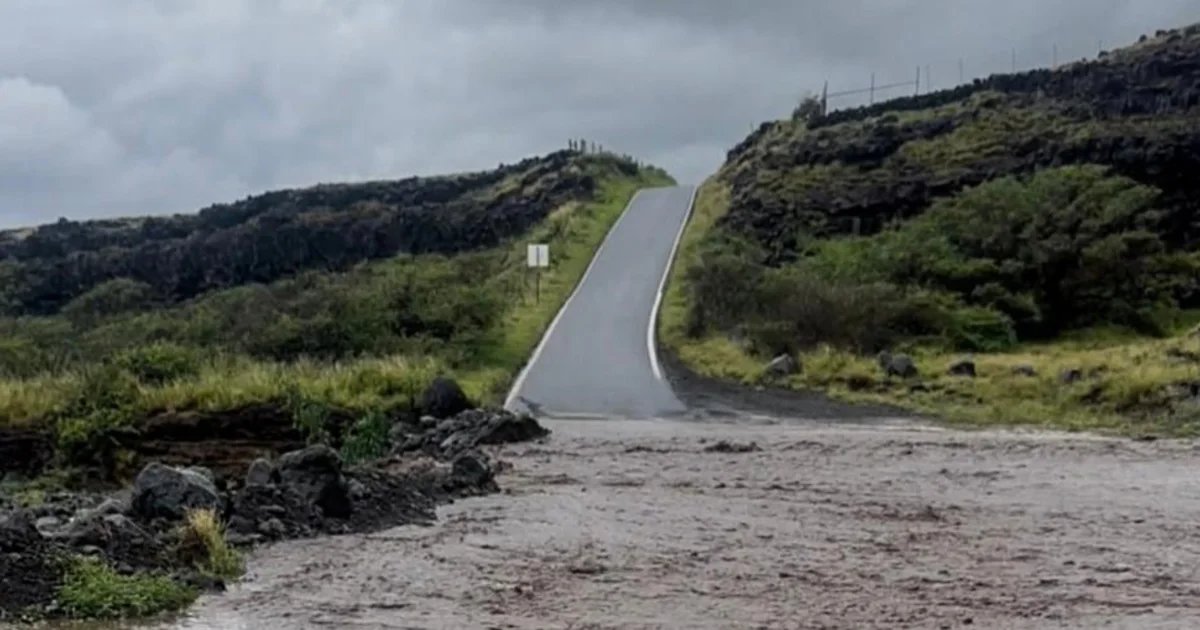
The rain-drenched Hawaiian Islands are bracing for another deluge on Thursday, less than a week after a record-breaking storm buckled roadways and collapsed buildings.
More than 5 feet of rain fell in some parts of Maui from March 10 to 16, according to the University of Hawaii’s climate data team. Some 33 inches fell in just 24 hours at Haleakalā crater, near the island’s summit.
Although the coming storm is weaker than the prior one, National Weather Service forecasters have said it won’t take much to restart the flooding. Much of Hawaii is under flood watch.
“Given the high soil saturation from the recent kona storm, even moderate rainfall rates could pose a risk for rapid runoff and flooding,” NWS forecasters said Thursday.
A kona storm is a Hawaiian weather pattern that can cause heavy rainfall on typically dry, leeward areas of the islands that are usually sheltered from such precipitation. The anticipated rain this week is from a new kona storm.
These storms are interacting with a different type of disaster in Hawaii — wildfires — with compounding effects. The regions of the islands that get pounded by ferocious rains from kona storms are the same regions where wildfires have become more common over the past several decades. When rain hits the fire-affected areas, it triggers runoff and erosion, worsening flooding and raising the risk of mudslides.
Lahaina, where more than 100 people died in a disastrous Maui fire in 2023, was one of the areas hit hard by the recent floods. Joseph Pluta, a Lahaina resident who lost his home in that fire, said debris was flowing down burn scars.
“All that crap is washing down the hill to people’s homes and to the ocean and into the streets. It’s a real mess,” Pluta said.
The extreme rain in Hawaii has come amid a period of weather madness across the U.S.: Temperatures in California and Arizona broke records on Wednesday and Thursday in an ongoing heat wave, with highs into the 90s and triple digits in some areas. Earlier, heavy snow pounded the Northeast and Nebraska saw its worst wildfires ever.
Hawaii is, of course, accustomed to rain, but most of it is generated by a phenomenon called “orographic lift,” in which trade winds hit the islands’ mountainous terrain. The air is forced upward, where it cools, condenses into clouds and delivers rain. Most of the time, the winds come from the northeast and Hawaii’s mountains keep the majority of precipitation on that windward side.
“We have windward locations that get on average 400 inches a year,” said Thomas Giambelluca, a professor emeritus at the University of Hawaii at Mānoa.
By contrast, the south and west parts of the islands generally remain relatively dry.
Kona storms, however, throw that logic into reverse. The storms form as a result of changes in the jet stream — air currents that flow from west to east at high altitudes. During a kona storm, a low pressure system spins off the jet stream and sets up northwest of the islands, drawing a plume of tropical moisture toward Hawaii. The wind flows from the south, bringing heavy precipitation to areas usually sheltered from rain.
Last weekend’s kona storm set daily rainfall records at four official sites, according to the National Weather Service in Honolulu.
Laksmi Abraham, a spokesperson for Maui County, said the impacts were “unlike anything we have experienced in our lifetime.”

Kona storms are hitting the parts of Maui where wildfires have grown more frequent and intense. The fire trend is linked to the proliferation of nonnative and highly flammable grasses, particularly on fallowed landscapes once used for sugar and pineapple plantations.
Clay Trauernicht, a wildland fire specialist at the University of Hawaiʻi at Mānoa, warned for years about the risks of these untamed grasses. The 2023 Lahaina fire made the issue impossible to ignore.
But people still don’t realize, Trauernicht said, that the fires and floods are inextricably linked.
Floods can spur the nonnative grasses to grow. Later, when drought hits, they die.
“What they do is add fuel,” said Camilo Mora, climate scientist and professor at the University of Hawaiʻi at Mānoa.
At the same time, rain runs off recently burned slopes more rapidly, which can cause more intense flooding, Trauenicht said. And in areas filled with unburned invasive grasses, the water table is shallower than in native forests and less absorptive.
“Grass root structure tends to be more of these matting, shallow roots,” Trauernicht said. “You get more water running across the surface.”
Places like Lahaina, Trauernicht said “are highly vulnerable given their fire history.”
Many areas were susceptible to floods even before the fire problem worsened. Parts of South Maui are in federally designated floodplains, including some portions of Kihei, where a condo building collapsed and roadways failed during the recent storms, according to Hawaii News Now.
Jordan Molina, director of Maui County’s Department of Public Works, said the county was working to overhaul drainage systems and make the area’s infrastructure more resilient, but that the recent storm would have strained any system.
“Designing infrastructure capable of fully eliminating flooding during extreme storm events like this recent kona low would require an extraordinarily large and costly system that would not be financially feasible,” Molina said in an email.
On Wednesday and Thursday, the public works department was staging equipment, working to clear debris from roads and inspecting drainages for obstructions ahead of the next storm’s arrival Thursday night.
“It’s concerning — we’re primed for flooding,” Giambelluci said. “Having this back to back could be bad.”