dailynewsnblog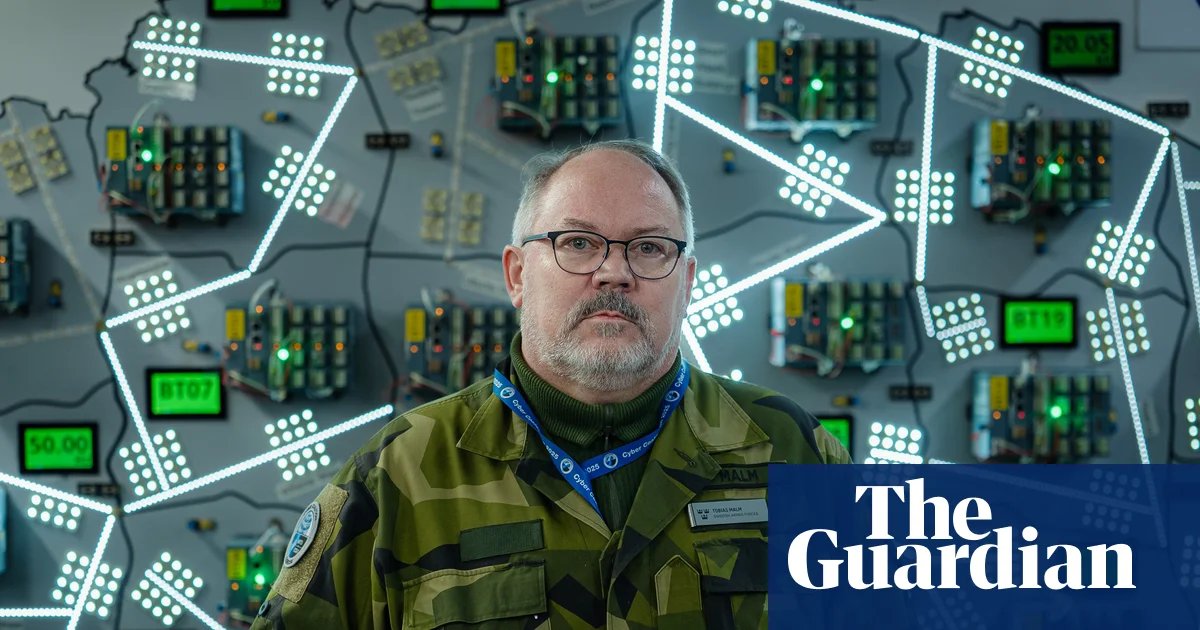
Russia and China were barely mentioned, but they were the threats in everyone’s minds in Tallinn this week, where Nato hosted its largest ever cyber war game.
The goal of the war game, conducted 130 miles from the Russian border in Estonia, was to test the alliance’s readiness for a rolling enemy assault on civilian and military digital infrastructure.
It involved hundreds of multinational troops, representing 29 Nato nations and seven allies, including Ukraine, hunkered down in CyberRange14, a facility established by the Estonian ministry of defence in the wake of a crippling Russian cyber attack in 2007, where Nato has run preparedness exercises since 2014.
Those involved looked drained as the seven-day cyberbattle ended. They had endured simulated sudden power blackouts, jammed satellites, blocked ports and public chaos. Their combat fatigues stayed spotless as they fought malware, not missiles. But even against a fictitious enemy, cyberwar was “very stressful” and “quite exhausting”, they said.
War doesn’t come much foggier than in the cyber realm, which, alongside space, is rapidly becoming as critical as land, sea and air to the security of Nato and its allies.
The players had to focus on responding to mysterious complex computer collapses in their own countries while also sharing fixes globally with more than 1,000 other military and civilian personnel engaged from Tokyo to Texas. It was, said one participant, like “juggling a football, solving a Rubik’s cube and talking with your neighbour” all at the same time.
The event was set using storylines premised on Nato’s northern defence forces responding to threats to an ally, Andvaria, from its belligerent neighbour, Harbadus. The struggle was over an imaginary island called Icebergen in the north Atlantic, but the theatre of war was international because Harbadus supported its hostile aims by weaving a complex web of global cyber-mischief.
As the game reached its denouement, the Nato secretary general, Mark Rutte, accused Moscow of “increasingly reckless behaviour … such as violating our airspace, conducting cyberattacks”. Russia increased cyber-attacks against Nato states by 25% in the year to June, according to analysis by Microsoft, whose widely installed software affords it considerable insight into digital threats. Most of these were intended to allow espionage but Russia has also been targeting vulnerable small businesses to create bridgeheads for larger attacks.
Meanwhile, Nato has attributed attacks against allies and Ukraine to Russia’s GRU military intelligence, and has accused China of “malign hybrid and cyber operations”. Last weekend the chair of the alliance’s military committee, Adm Giuseppe Cavo Dragone, said it was considering “being more aggressive or being proactive instead of reactive” to Russian hybrid warfare.
In Tallinn, where rows of monitors and big screens are clustered around large racks of neon-flashing microprocessors, the scenarios started small but quickly snowballed. The Swedes began by dealing with an injection of malware into an unclassified email system used in their military’s base in Lithuania; soon they were unable to support logistics to the forward operating position. Worse was to follow for them and many other players.
“Other allies had similar, parallel attacks,” said Maj Tobias Malm, from Sweden. “[Next] we had the satellite system.”
Next, the storyliners – whose task it is to monitor the process and introduce new challenges for the participants as the game unfolds – triggered a multistage attack on a satellite internet provider, the kind offered by Elon Musk’s Starlink. That knocked out communications between space and Earth, with cascading crippling effects on intelligence and surveillance, power-grid monitoring, military and civilian GPS, banking and military coordination. When it began, some participants detected unusual behaviour on the network, while others picked up intelligence – but no single country had the full picture.
They started seeing anomalies on the dashboard controlling satellites, connections going on and off, and events spiralling, said Ezio Cerrato, a deputy exercise director. “They completely lose control … right to the point of the wiping of the system,” he said. “It shows how a problem in space can quickly affect every domain on Earth.”
In another scenario the enemy uploaded malware into fuel management systems, forcing the war gamers to scramble to ration remaining supplies and disconnect networks to cauterise the digital wound. Resisting the human urge to narrowly focus on the cyber-attack in front of each country was part of the challenge. It was vital for the participants to rapidly communicate with allies, raise warnings and share fixes.
“There is no boundary in cyberspace,” said the exercise director, Commander Brian Caplan, a US naval officer. “Adversaries can go into one nation and pivot into another nation. Something that affects one nation can have a second- or third-order effect in other nations. So it’s really important that these nations are communicating, building that trust, that relationship.”
Nato also revealed it was experimenting with an AI-powered chatbot to help human cyberwarriors cope with the sheer complexity of cyberwar. It is being built using an OpenAI model to provide commanders with a rapid way to understand what is happening in a rapidly developing scenario and even suggests steps they could take.
It was not yet in use, even in the war games, but had shown “very strong potential to support decision-making, for situational awareness and command and control”, said Alberto Domingo, the cyberspace technical director at Nato’s strategy and military command. He stressed it was undergoing careful checks on the accuracy of its outputs.
As the exercise continued, big screens displayed rolling feeds styled as online news headlines about the shifting crisis, with alarming headlines detailing the mayhem the fictitious enemy was sowing.
“Fake train schedules cause chaos,” read one headline. Multiple states of emergency were declared in regions hit by power blackouts. A tranche of classified Nato documents had been “dumped”, while allied military rotations had been disrupted by power grid outages in Denmark. Then a leak revealed a plan for a secret naval base, destabilising the picture further. The participants were faced with a challenge wholly unfamiliar to their predecessors a generation earlier: what happens when a conflict involves the spread of fake news on social media?
Military lawyers were on hand to advise on the legality of what Nato and its allies could do in response to cyber-attacks, which are often launched not directly by hostile militaries but by shadow proxies and target civilian, not solely military, assets.
“How do you cross those streams?” said US air force’s Maj Tyler Smith, one of the lawyers involved. “We are working through those problems now … [to see] can we put agreements in place beforehand and … not have to do things on the go?”
But after a week of wrestling with the waves of cyber-aggression, a crucial question remained: was Nato winning? The answer was yes, but with bumps along the way, one official said.
Another offered a little more reassurance, for now at least: “I see people surviving at the end of the day.”