dailynewsnblog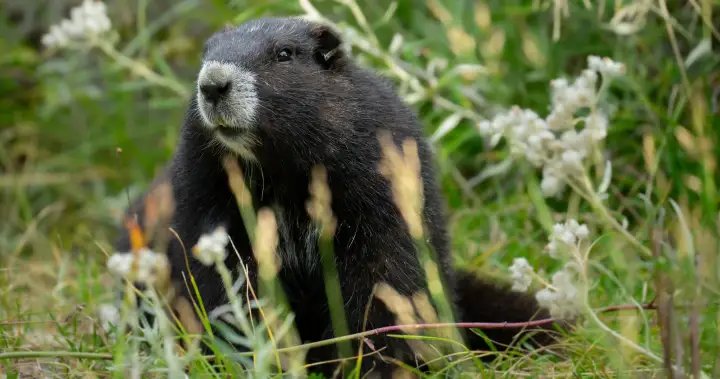
Every year, Vancouver Island marmots are released after spending the winter at the Marmot Recovery Foundation.

“Often in about five minutes, certainly within half an hour, they are out of their box,” Adam Taylor with the foundation, told Global News.
“They’re sampling the local plants and it’s amazing how quickly they transition to exploring this brand new environment.”
But one little marmot had another plan.
Gob, named after George Oscar “Gob” Bluth II, a character played by Will Arnett on Arrested Development, decided he didn’t want to be away from his friends anymore.
Just two months after being released on Mount Washington, Gob returned to the facility.
The little social animal spent time interacting with the other marmots still in the facility for several weeks before setting up a hibernation den underneath.
“That’s a bit of a no-no, so we decided to re-trap him and bring him back inside,” Taylor said.

The Vancouver Island marmot, found only on Vancouver Island, is still making its way back from extinction after reaching a low of fewer than 30 animals in 2003.

Get daily National news
Get daily Canada news delivered to your inbox so you’ll never miss the day’s top stories.
“At that point, the Marmot Foundation had already started bringing some marmots into captivity, fearing that the species were going to go extinct, and they had been breeding them, and finally, in 2003, when the population reached that low, they had started releasing captive-bred individuals back in the wild to recover,” Dr. Jamie Gorrell, an associate professor at the University of Northern B.C. said.
“In the last 20 years, it’s been this boom where the population went from less than 30 and now is over 400 marmots. So it’s, as a conservation strategy, it’s extremely successful at getting more marmots to come back into the population.”
But Gorrell said they are not out of the woods yet, as they are still vulnerable and there’s only about 400 across Vancouver Island.
“Vancouver Island actually is pretty unique from geological history and the biological history of the island,” he added.
“There’s only about half of the mammal species that exist on the mainland of Canada that are occurring on Vancouver Island. So we’re already missing a lot of species as it is, and we tend to be missing a lot of the high-elevation species. So things like sheep and goats. So marmots are really it. Marmots have the only sort of natural, endemic, high-altitude mammal species on the island.”
Gorrell said that marmots are good for plants and the soil and carbon capture of the environment.
He said he is not surprised Gob made his way back to his friends and it has happened before.
“It does speak to the fact that when they’re born in captivity, they’re sort of raised in that environment, right?” he said.
“And then you can almost imagine being thrown out into the world might be a bit of a shock to them, and just like other animals or other individuals or even humans in this case could be sort of acclimatized to a certain environment and where they want live.”
For now, Gob is still hibernating and he’s in good health, Taylor said.
In the summer, they will release him again to see if he finds his wild side.
“This time we will be putting him a little bit further away from the facility,” Taylor said.
“We’re really hopeful that with a little bit of an extra push, he will make that transition.”
© 2026 Global News, a division of Corus Entertainment Inc.