dailynewsnblog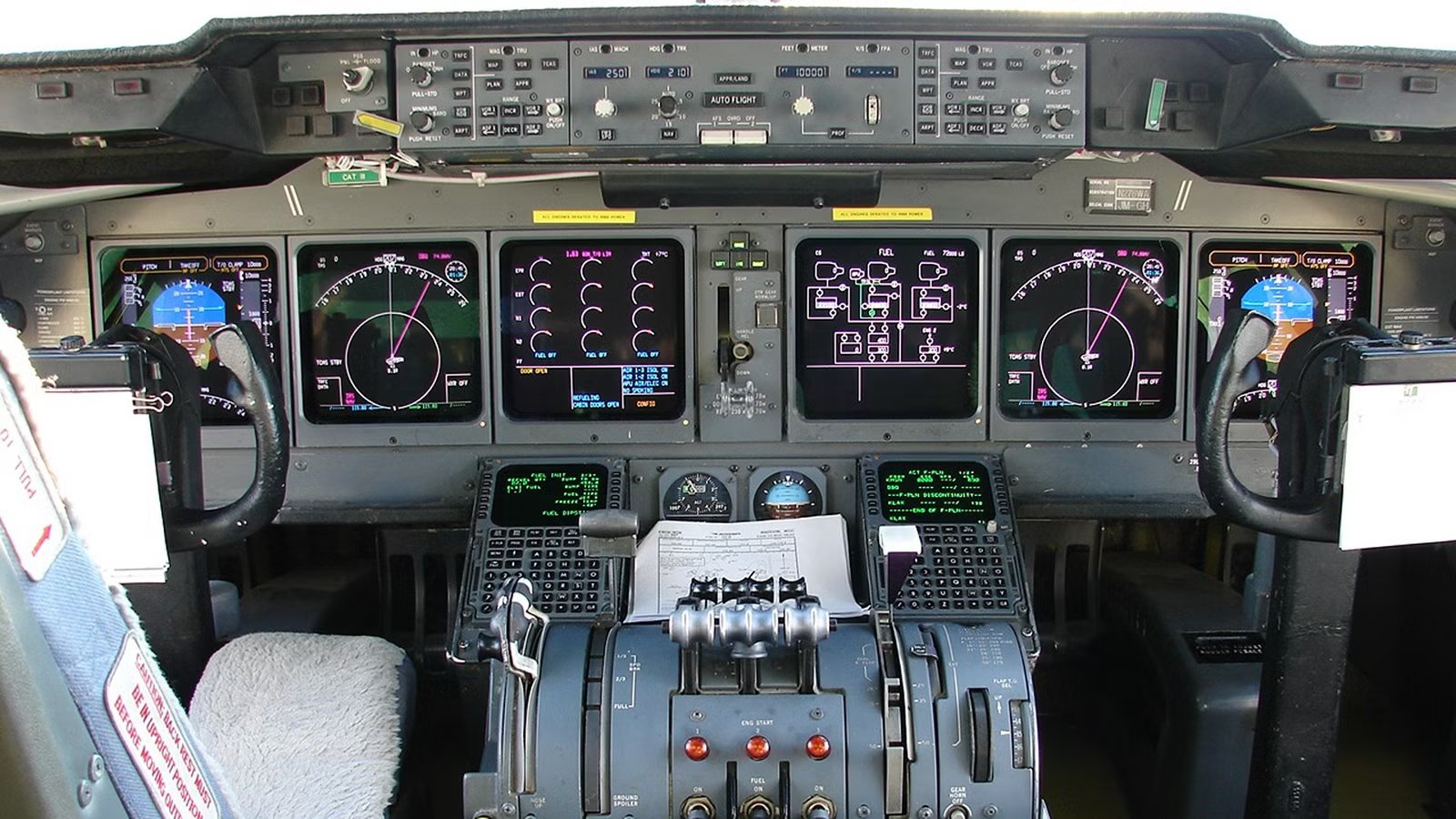
At a distance, the McDonnell Douglas DC-10 and the McDonnell Douglas MD-11 looked almost identical. Both were long, elegant tri-jets with unmistakable tail-mounted center engines and widebody proportions built for intercontinental work. For many passengers, the difference was barely noticeable. Window spacing looked similar. The flight deck windows shared the same angular geometry. Even the cockpit silhouette from the outside felt familiar.
But stepping through the cockpit door, the resemblance ended. What separated these two aircraft was not simply the presence of digital screens. It was a philosophical shift in how airlines approached complexity. The DC-10 was designed at a time when widebody flying was still new, and redundancy meant more crew and more hardware. The MD-11 entered service in a market driven by cost pressure, fleet commonality, and advancing computer logic. One cockpit distributed responsibility across people and panels. The other consolidated information into software-driven systems. Examining them side by side revealed not just technological progress, but a turning point in commercial aviation thinking.
Instrument Panels: From Mechanical Transparency To Digital Synthesis

If you sat in the cockpit of a DC-10, you were surrounded by an instrument panel saturated in analog instruments, embodying late-1960s engineering logic. Every parameter had its own physical gauge. Airspeed, altitude, vertical speed, engine pressure ratios, fuel flow — each parameter lived on a dedicated dial. The captain’s and first officer’s panels were dense with round gauges and annunciator lights, and this design created a particular kind of discipline. Monitoring the aircraft required a deliberate and continuous scan pattern.
Pilots built situational awareness by mentally integrating dozens of independent data points. Trends revealed themselves physically: a needle drifting upward, a vibration indicator fluctuating, a fuel gauge edging lower than expected. There was no abstraction layer. Information was immediate and tangible. The MD-11 abandoned that philosophy almost entirely. In place of analog dials, large cathode-ray tube displays presented structured, layered data. Primary flight information was consolidated on digital attitude indicators.
Crucially, not all information was shown at once. The MD-11 allowed pilots to call up system synoptic pages, graphical representations of hydraulic circuits, electrical flows, or fuel networks, only when required. The result was a cockpit that felt calmer, but also more abstract. Instead of scanning hardware gauges, pilots interpreted synthesized digital summaries. The aircraft filtered complexity before presenting it. Navigation appeared on a moving map with route overlays, waypoint sequencing, and weather radar integration.
Engine parameters were grouped logically rather than distributed spatially. The change altered how pilots processed information. In DC-10, situational awareness was built by mentally integrating dozens of independent data points. In MD-11, it was curated by the system itself. Instead of scanning a forest of gauges, pilots interpreted layered digital displays. The result was reduced clutter but increased abstraction. Where the DC-10 was tactile and mechanical, the MD-11 felt organized and computational.
Crew Composition: Three Minds Versus Two

The DC-10’s cockpit was designed around three crew members. The captain and first officer managed flight path and navigation. The flight engineer occupied a substantial systems station, overseeing fuel distribution, electrical load balancing, pneumatic systems, and environmental control. The engineer’s role was continuous. In the DC-10, cockpit scanning was wide and physical. The pilot’s visual scan traveled laterally across multiple independent gauges, then up to a densely populated overhead panel, then back to engine instruments. Meanwhile, the flight engineer maintained vigilance over an entirely separate systems console.
The MD-11 compressed that experience. Primary flight data, navigation mapping, and engine parameters were clustered within defined and predictable display blocks directly in front of each pilot. System synoptics could be summoned as needed, instead of permanently occupying space. While the overhead panel remained substantial, the logic behind it was more automated.
During demanding phases such as low-visibility approaches or complex arrival procedures, this difference becomes particularly meaningful. The DC-10 required a broad physical scan to maintain energy awareness. The MD-11 allowed pilots to keep most critical data within a tighter visual field. The shift was subtle, but it reflected a broader industry movement toward minimizing unnecessary head and eye movement in high-workload environments.
By the time the MD-11 entered service in 1990, the three-crew structure had been eliminated. Advances in digital monitoring and system automation allowed fuel balancing, electrical distribution, pressurization management, and system diagnostics to be handled by onboard computers. Instead of a dedicated systems console, pilots accessed digital synoptics through central displays.
The engineer’s panel disappeared, replaced by a system of synoptic pages accessible from the main displays. Removing one crew member from every long-haul flight significantly reduced operating costs. Airlines such as KLM transitioned from three-crew DC-10 operations to two-pilot MD-11 fleets as part of broader efficiency programs.

The Striking Differences Between The McDonnell Douglas DC-10 & MD-11
Discover how the DC-10 and MD-11 reshaped wide-body design, defined the trijet era, and why their legacy still lingers in today’s skies.
Automation Philosophy: From Pilot-Led To System-Orchestrated Flight

The DC-10 featured capable autopilot systems for its time, but automation functioned largely as an assistant. The accuracy of oceanic routing relied heavily on radio aids and inertial systems, and autopilot systems could maintain altitude and heading. However, vertical profile management and performance optimization often require careful manual planning. Performance optimization depended on charts, experience, and coordination between pilots and the engineer.
The MD-11 introduced a fundamentally different hierarchy. Its integrated Flight Management System allowed pilots to program an entire route, complete with performance targets, cost index values, and fuel reserves into control display units. Climb profiles, cruise efficiency, and descent paths could be optimized dynamically. Fuel predictions were updated continuously, providing real-time planning confidence on ultra-long-haul routes. Vertical navigation was calculated continuously rather than manually estimated. The aircraft itself became an active participant in flight planning.
This level of integration reshaped cockpit culture. In the DC-10, automation supported pilot judgment. In the MD-11, pilot judgment increasingly involved supervising automation modes. The emphasis shifted toward understanding system logic and maintaining mode awareness.
Early in its service life, the MD-11 developed a reputation for being less forgiving during landing if energy states were mismanaged. That perception was less about instability and more about how pilots interacted with automation. As training programs evolved and software refinements were implemented, the aircraft’s operational reputation stabilized.
Cockpit Context: Where They Sat Among Their Peers

Understanding the DC-10 and MD-11 becomes even clearer when viewed alongside the aircraft that surrounded them historically. The DC-10 shared its era with the early Boeing 747-100/200 and the Lockheed L-1011 TriStar, all three designed around three-crew operations and expansive analog panels. In that company, the DC-10 was conventional rather than radical. It reflected the prevailing assumption that widebody aircraft demanded visible redundancy and dedicated system guardianship. The cockpit philosophy was evolutionary from earlier narrowbodies, simply scaled upward in size and complexity.
By contrast, the MD-11 entered a landscape already reshaped by the Boeing 767 and Airbus A310, both of which demonstrated that digital systems and two-pilot certification could safely handle long-haul complexity. The Boeing 747-400, introduced shortly before the MD-11, offered a telling comparison: it retained the 747’s physical scale while eliminating the flight engineer and introducing full glass instrumentation. In that sense, the MD-11 was not leading a revolution alone — it was part of a decisive industry migration toward software-managed oversight.
Yet the MD-11 also differed from Airbus philosophy emerging at the time. Unlike the A320’s fly-by-wire architecture and envelope protections, the MD-11 maintained a more traditional control feel, blending digital management with conventional pilot authority. It became a transitional aircraft, neither purely analog nor fully envelope-protected, sitting between generations.
Viewed this way, the DC-10 represents the apex of late-analog widebody design, while the MD-11 serves as a hinge point between mechanical-era cockpits and the integrated, highly automated environments that define aircraft such as the Boeing 777, 787, and Airbus A350 today. One concludes a chapter, and the other opens the next.

How Many McDonnell Douglas MD‑11s Were Built?
Though only a small number were built, the MD-11 remains one of the most iconic airplanes ever built.
Maintenance & Diagnostics: Interpretation Versus Data Logging

When a DC-10 landed with a minor system anomaly, troubleshooting often began with pilot and engineer observations — a fluctuating oil pressure reading, a transient caution light, an unusual vibration trend observed during cruise. Maintenance teams relied heavily on crew reports, followed by systematic testing and inspection. The process required interpretation and experience.
The MD-11 introduced centralized fault memory and automated digital logging of flight parameters. System anomalies were recorded digitally, creating retrievable histories that ground crews could analyze after landing. Instead of relying solely on interpretation, technicians accessed structured fault codes and recorded performance data. The cockpit became a data source, feeding information directly into airline maintenance networks.
For operators such as  UPS Airlines, this proved deeply significant. High-cycle cargo fleets depended on reliability and predictable turnaround times. The MD-11’s digital architecture reduced ambiguity and accelerated diagnostics, aligning cockpit design with operational economics.
Legacy: A Line Drawn Between Eras
![8360243 - KC-10 Travis to Wright-Patt [Image 7 of 9]](https://static0.simpleflyingimages.com/wordpress/wp-content/uploads/2024/06/8360243.jpg?q=49&fit=crop&w=500&dpr=2)
The DC-10 represented the culmination of the classic tri-crew, analog widebody — alongside aircraft like the early Boeing 747 variants and the Lockheed L-1011. It embodied a philosophy in which complexity was confronted directly, with systems laid bare across expansive panels and a dedicated flight engineer constantly managing the aircraft’s mechanical health. Safety was reinforced through visibility, specialization, and continuous human oversight.
The MD-11 occupied a transitional bridge. It retained conventional control columns and a Boeing-style automation hierarchy, yet it embraced digital display consolidation and two-crew certification. It stood between the analog giants and the fully networked flight decks of the Boeing 787 and Airbus A350. Its cockpit reflected growing confidence in computers to monitor, prioritize, and present information rather than simply display it.
What ultimately separated the two was not glass versus gauges, nor three pilots versus two. It was where authority resided. In the DC-10, control was exercised through constant human management of distributed systems. In the MD-11, control increasingly flowed through integrated software that organized complexity before the crew ever saw it. They shared a silhouette and a lineage, but inside the cockpit they expressed two distinct ideas about how humans and machines should share responsibility.