dailynewsnblog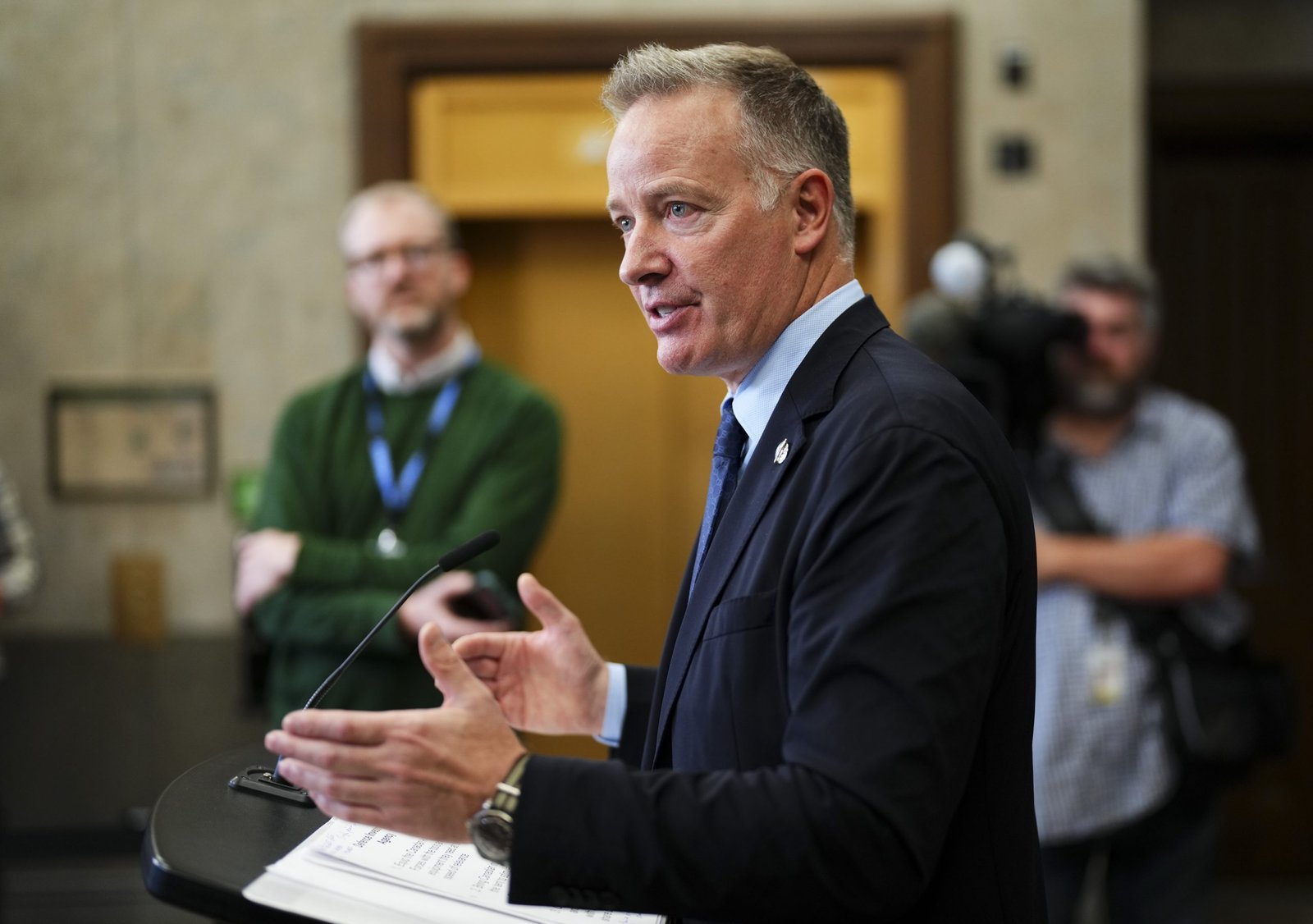
“They’re very aware sectoral tariffs are hurting Canada right now. They’re working diligently to see where they can help us,” he said, adding that a company involved in Hanwha’s bid for the submarine contract, LIG Nex1, offered to start manufacturing torpedoes in Canada if selected.
Stephen Fuhr says Canada’s defence investments could create much-needed manufacturing jobs to help offset losses in sectors targeted by U.S. tariffs.
The secretary of state for defence procurement visited South Korea this week to meet with government officials and industry, as Canada prepares to make a series of major military purchases and ramps up defence spending to hit 2 per cent of its GDP by this spring.
South Korea’s Hanwha is seen as a leading contender to build Canada’s next submarine fleet. The company recently signed a deal with Ontario’s Algoma Steel that could pave the way for parts of its KSS-III Batch-II diesel-electric vessels to be manufactured in Canada, should it win the multi-billion dollar contract with the federal government.
Germany’s TKMS, another top bidder, has partnered with Vancouver’s Seaspan for its bid. Norway’s Kongsberg is partnering with TKMS to win the contract.
Fuhr said the submarine project could offer significant employment opportunities for Canadians, and noted that both South Korea and Germany boast major auto companies that design and build their own vehicles.
“They’re very aware sectoral tariffs are hurting Canada right now. They’re working diligently to see where they can help us,” he said, adding that a company involved in Hanwha’s bid, LIG Nex1, offered to start manufacturing torpedoes in Canada as part of the deal.
“We’ll see what these companies pull together, as far as what they’re prepared to offer to Canada in exchange for garnering this really important contract. But it’s pretty exciting. Both TKMS and Hanwha are really putting their best feet forward, and I’m excited to see what they’re proposing to Canada.”
Replacing the submarine fleet is one of the most high-profile active defence procurement projects, alongside the fierce competition to win the contract to build the country’s next jet fighters.
Canada’s pledge to increase defence spending to 2 per cent of GDP by end of this fiscal year has sparked a flurry of interest from defence firms eager to secure lucrative contracts with Ottawa. That will increase to 5 per cent by 2035, with 3.5 per cent earmarked for “core military capabilities.”
The Liberal government promised to release a defence industrial strategy detailing its plans for the defence sector but has missed its own self-imposed deadline of Christmas 2025.
A government source confirmed on Friday the strategy would be released next week. iPolitics isn’t identifying the source because they’re not authorized to publicly speak on the matter.
Postmedia’s David Pugliese first reported on the timeline for the release of the strategy.
Fuhr said South Korea “rolled out the red carpet” for his visit and touted the two countries’ close ties, including Canada’s contribution to the Korea war, which he called “very touching.”
The visit comes days after Canada and South Korea reached a memorandum of understanding to strengthen industrial cooperation, including working on “advancing a Korean automotive industrial footprint in Canada.”
South Korean vehicles made up about 12 per cent of sales in Canada in 2024, though none of its major automakers — Hyundai and Kia — make cars in this country.
Canada’s automotive industry has been one of the the hardest hit by tariffs imposed by U.S. President Donald Trump, alongside steel, aluminum and softwood lumber.
The federal government has responded by offering billions in relief funding and low-cost loans to convince producers to keep jobs in Canada.
But it hasn’t stopped companies from moving production out of the country or idling plants.
Stellantis announced in the fall that it was shifting production of a new Jeep line to Illinois from Brampton. GM said last week that it was eliminating the third shift at its Oshawa plant, laying off hundreds of workers.
Prime Minister Mark Carney said Canada needs to seek out new markets for its goods, and set a goal of doubling non-U.S. exports by 2035.
In a widely-publicized speech at the World Economic Forum in Davos last month, he also urged middle powers to band together to blunt the influence of powerful hegemons.
Fuhr said the bidders for the submarine procurement are also middle powers like Canada and are all “feeling the pinch from the biggest economy in the world deciding to do things differently.”
“They feel that as well [that] we’re here trying to work together with them,” he said.
The group representing Canada’s defence industry said Ottawa’s investments could help absorb losses in other manufacturing sectors but only if a “large proportion” is spent within our borders.
“There’s opportunity for tremendous growth — in manufacturing jobs and beyond,” Nicolas Todd, vice president government relations and communications at the Canadian Association of Defence and Security Industries (CADSI), said in an emailed statement.
“The sector already has two-and-a-half times more jobs in STEM fields than the broader manufacturing average. Growing exports can also contribute to job creation.”
He pointed out that CADSI’s latest numbers show the defence sector was responsible for 81,200 direct or indirect jobs in 2024. That was when Canada was spending $44.3 billion on defence, according to figures from NATO.
Ramping up to 2 per cent of GDP this year works out to roughly $63 billion.
A big test
The proposals for the submarine project are due in the first week of March.
It will act as a major test of Canada’s new Defence Investment Agency, which the Carney government has promised would fast-track and streamline defence procurements by centralizing the decision-making process and offering better engagement with industry.
The agency officially launched last year, taking the lead on defence purchases previously managed by different departments.
Fuhr said the DIA is “up and running” and starting to scale, boasting a staff of about 83, though that “number is changing rapidly.”
He said defence procurement in the past has been slowed by “diversified authority” amongst departments and “no one real single point of accountability,” but the DIA “would cut through all that.”
Thomas Juneau, a professor with the University of Ottawa’s graduate school of public and international affairs, said he doesn’t share Fuhr’s optimism about the agency and would wait to see some successful major procurements before coming to a conclusion.
“I hope to come to support it, since it is urgent for Canada to be able to manage defence procurement — for major projects, but also for a large number of smaller, less visible projects — much more effectively,” he told iPolitics.
“But given Canada’s long tradition of failure in defence procurement, any serious optimism can only be justified by successful examples of procurement.”
Juneau said there are still many questions about the role of the agency, but it’s clear that defence procurement needs “structural reform.”
This goes beyond reorganizing authorities, he said, and includes grappling with the “significant shortage of skilled procurement staff” and the lack of political will to “make difficult decisions much faster than in the past.”
Todd said it was “too early to tell” if the DIA was a success story, while industry members told CADSI leadership they “have not seen an impact on their day-to-day business.”
“We’ve long cautioned that there are no silver bullets in defence procurement. Creating a single centralized agency may solve some problems, but not all, and it can take a decade for new, large and complex structures like this one to gel.”
Todd warned that as spending ramps up, the agency’s work needs to be “aligned” with the federal government’s Buy Canadian policy that prioritizes using domestic suppliers.
The agency, he said, needs a “better understanding of what Canada’s defence industry offers.”
Todd added that he hopes the upcoming defence industrial strategy will “clarify how the government sees all these elements working together.”
Right now, the DIA is a special operating agency under Public Services and Procurement Canada.
Fuhr said the government would take the next 8 to 12 months to determine its “final form” but even right now, it “will be much more effective” than previous channels.
So far, it has completed two procurements, tapping Bombardier’s Global 6500 to replace the Challenger fleet and partnering with Telestat to deliver satellite voice communication for the military.
Fuhr said the DIA has already shaved a few years off of the timeline for the submarine project.
Originally, the contract was set to be awarded in 2028 and delivery would start in 2035.
But now, Fuhr said he expects Canada to announce a winner later this year and have subs in the water by 2032.
“We’re already showing that the DIA can move things faster than the legacy system could.”
with a file from the Canadian Press
*This story has been updated with comment from CADSI