dailynewsnblog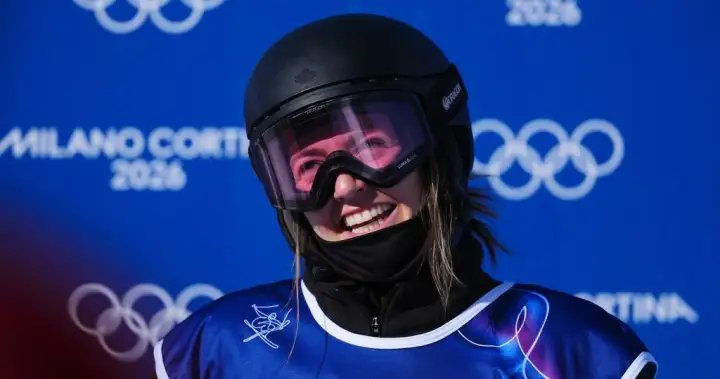
LIVIGNO – Canadian Amy Fraser, still dealing with the after-effects of a nasty injury suffered in training last March at the FIS World Championships, just missed the podium Sunday in women’s freeski halfpipe at the Milan Cortina Olympics.

The 30-year-old from Calgary finished fourth, landing three clean runs with the best earning a score of 88.00.
“That’s some of my best skiing,” said Fraser. “I think there’s always some room for improvement clearly, being 4.5 points off the podium. Whatever. Someone’s got to come fourth.”
Fraser’s performance was all the more impressive given she broke her shoulder in last year’s crash at Engadin, Switzerland.
“Obviously fourth stings for us. It stings for her,” said Canadian halfpipe coach Trennon Paynter. “But really what she did today to ski her best in this situation, she needs to be super-proud.”
Paynter said the crash left Fraser “smashed up.”
“It was kind of a full-body beatdown. But the shoulder was definitely the worst of it and the one that lingered the longest and required the most management. Even now she’s still dealing with it somewhat.”
“I’m stoked I’m here,” Fraser said with a laugh.
Defending champion Eileen Gu of China won gold with a score of 94.75, adding to the two silvers she won earlier in the games in slopestyle and big air.
Chinese teammate Li Fanghui earned silver at 93.00, with reigning world champion Zoe Atkin of Britain taking bronze at 92.50.
The 22-year-old Gu won gold in both halfpipe and big air as well as silver in slopestyle four years go in Beijing, where she became the first freestyle skier to win three medals at a single Winter Games.
Related Videos

Gu’s six career medals move her past Canadian moguls star Mikaël Kingsbury (two golds and three silvers) as the most decorated freestyle skier in Olympic history.

Get daily National news
Get the day’s top news, political, economic, and current affairs headlines, delivered to your inbox once a day.
Born in San Francisco, to an American father and Chinese mother, Gu began skiing at three years old.
A quantum physics student at Stanford University who is fluent in English and Mandarin, Gu has three million followers on Instagram and more than seven million on the Chinese social media platform Weibo.
In December, Forbes magazine listed her as the fourth-highest-earning female athlete in 2025 — behind tennis players Coco Gauff, Aryna Sabalenka and Iga Swiatek — with off-field income of US$23 million thanks to lucrative endorsements from the likes of Red Bull, Porsche, IWC Schaffhausen and addition, TCL electronics.
The competitors did three runs, with only their best effort counting.
Canadian Rachael Karker, a bronze medallist four years ago in Beijing, placed seventh at 79.50. A chronic knee injury limited her training and competition in advance of the games and two falls Sunday didn’t help.
The 28-year-old from Erin, Ont., who now makes her home in Calgary, required the help of two ski poles as she slowly left the competition site alongside fiancé Brendan Mackay, who won bronze in the men’s halfpipe final Friday.
“I’m quite sore, but I’ll be all right,” said Karker, fighting to control her emotion. “I can’t really handle that many heavy runs in a row. Nearing the end of training I was feeling pretty sore and then that first run, I couldn’t take that heavy landing.”
“I’m very proud I did everything I could with what I had today,” she added.
Paynter said it was heartbreaking to see Karker “in that much pain.”


“It’s also just so impressive that she was out there, going for it, putting it all on the line like that,” he said. “And she knows the risks. It’s what she wanted to do and we, of course, supported her through it.”
He marvelled at her performance.
“She wasn’t just skiing injured. She was charging as hard as she could injured.”
The final, rescheduled due to poor weather Saturday evening, was held late morning Sunday in glorious sunshine. It was 5 C with not a cloud in the sky, with some spectators stripping down to a T-shirt for the final event in Livigno.
Competitors soared high above the halfpipe, which measures some 198 metres long, 22 metres wide with walls 7.2 metres high.
Fraser led the first run with an 85.00 before Atkin, skiing last as the top qualifier, recorded a 90.50.
Karker’s second effort was clean, earning a 79.50 for the third-best score of the run. But Gu and Li stole the show with runs of 94.00 and 91.50, respectively, taking over the No. 1 and 2 spots with Atkin and Fraser — who did not improve their scores — dropping to third and fourth. Karker was seventh.
While Karker fell on her third run, Fraser improved her score to 88.00. But it was not enough to move up.
Gu also bettered her score, laying down a 94.75, with Li and Atkins still to come. Both improved their scores but remained in the same spot on the podium.
Fraser, who was eighth in Beijing, started skiing at age two but didn’t take up freestyle skiing until she was 21. Fraser, who holds a degree in biology from the University of Calgary, won bronze at the X Games in Aspen before the Olympics.
Canadian Cassie Sharpe, who won gold in 2018 in Pyeongchang and silver four years ago in Beijing, had to withdraw after a heavy crash in qualifying Thursday. The 33-year-old from Comox, B.C., was not cleared to compete, still dealing with a heavy concussion, facial contusion and some lingering dizziness after two nights in hospital.
Sharpe still qualified third with Fraser seventh and Karker ninth. Dillan Glennie of Courtenay, B.C., missed the final in qualifying 14th.
“I’m so proud of how she was skiing,” Fraser said of Sharpe. “I haven’t see her ski like that in years. And I’m glad she’s OK.”
—
This report by The Canadian Press was first published Feb. 22, 2026.