dailynewsnblog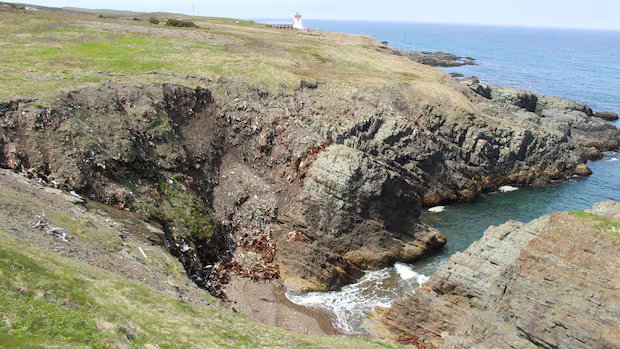

Listen to this article
Estimated 4 minutes
The audio version of this article is generated by AI-based technology. Mispronunciations can occur. We are working with our partners to continually review and improve the results.
A volunteer group on Newfoundland’s Burin Peninsula is calling on the provincial government to clean up a former dump situated near a world-class fossil site.
Located 1.6 kilometres from the town of Fortune, the Fortune Head Ecological Reserve showcases the Cambrian Explosion from 540 million years ago, when organisms began to rapidly develop. In the cliffs are trace fossils, a geological record left behind by ancient life.
But within view of the fossils is the old dump, which had been used by the town for decades.
“It’s just embarrassing,” Carl Slaney told CBC Radio’s The Broadcast.
Slaney is a former board member with the volunteer-led Fortune Head Eco Friends Incorporated.
He said the earth in the area is eroding, and old garbage is coming to the surface and falling into the ocean.

The ecological reserve was created to protect this part of the coast.
Slaney said the old garbage site, which was remediated decades ago to the standards of the day, is harming the efforts of people on the Burin Peninsula to promote the region’s tourism sector.
‘Geological significance’
Shauna Brennan, chair of Fortune Head Eco Friends Incorporated, said site visitors can see the trace fossils in the rocks, but they’re unable to go see them up close or touch them.
They can learn about the expansive history at the Fortune Head Geology Centre, which includes the Cambrian Explosion the reserve shows off.
“That is when we transformed from that bacterial life to more complex life. Life that’s able to breed and life that’s able to eat and move around,” said Brennan.
But the old dump and burying garbage, she said, was the norm of the day.
“There is a history to that as well, because it was a point in time when our community was here and was unaware of what was there in terms of this geological significance,” she said.

A volunteer group on Newfoundland’s Burin Peninsula is calling on the provincial government to clean up a former dump situated near a world-class fossil site. The Fortune Head Ecological Reserve showcases the Cambrian Explosion from 540 million years ago, when organisms began to rapidly develop. In the cliffs are trace fossils, a geological record left behind by ancient life. The CBC’s Todd O’Brien has the story.
Brennan wants to see the dump cleaned up, and said it would be a boost for the reserve.
“It would mean that when we have visitors that are coming here, and they’re asking questions and they’d like to go up and see the site, that we’re sending them to a place that’s clean,” she said.
Clean up efforts
Slaney said the different groups he’s been involved with over the years have looked into ways to clean up the dump, but it’s the responsibility of the province. Even if they had the funds to clean it up, he added, they wouldn’t be able to do it.
He said the Department of Environment and Climate Change, previously led by the former Liberal government, had hired engineering firm Stantec to create a site assessment report.
The 104-page final report, released in April, laid out two options: completely clean up the old dump for an estimated $10,967,604 or do a partial extraction for $3,034,411.

Stanley said the consultant needs to be listened to, and there is a moral obligation to clean up the site.
“This type of treatment — to be dumping garbage or to be aware that garbage is going into the ocean — it needs some intervention. We put it here and we need to clean up our act here,” he said.
CBC News asked Environment Minister Chris Tibbs for an interview. Instead, in a statement, spokesperson Sherri Breen said the department is aware waste management is important to communities but didn’t commit to action in Fortune.
“We are aware of the situation regarding the decommissioned Fortune Head disposal site and are considering options,” she wrote.
Download our free CBC News app to sign up for push alerts for CBC Newfoundland and Labrador. Sign up for our daily headlines newsletter here. Click here to visit our landing page.