dailynewsnblog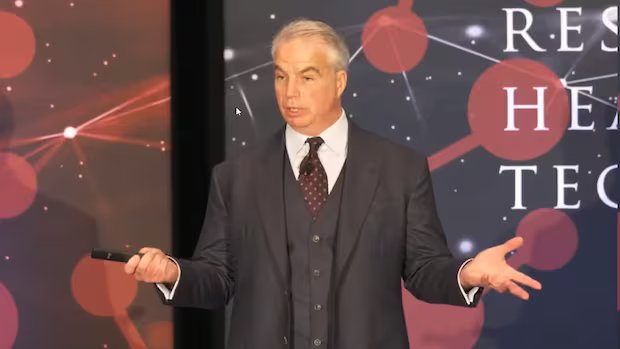
The founder of the controversial Dr. Goodenowe Restorative Health Center has announced he’s in the final stages of building a drug manufacturing lab and a clinical trials centre in Moose Jaw, Sask., as part of a plan that will inspire a “health revolution” — an “Alzheimer’s eradication program.”
Dayan Goodenowe made the announcement on Feb. 13, at a five-star golf and spa resort in southern California where his associate introduced him as “an incredible genius” and “our real life superhero.”
“I like to call him the disease Pokémon hunter,” the associate said. “Because he’s developed technology to truly catch them all.”
Goodenowe then took to the stage, proclaiming that “Alzheimer’s can be beaten.”
“We know what causes it. We know who gets it and we know who does not get it. Alzheimer’s is not to be feared,” he said, quoting from his 2021 book, Breaking Alzheimer’s: A 15 Year Crusade to Expose the Cause and Deliver the Cure.
“We must now continue on to identify and break the barriers that pertain to the implementation of an Alzheimer’s eradication program.”
His audience was there to learn about the benefits of signing up for membership in Goodenowe’s Elite Practitioner Program.

He told them this was their chance to get in “on the ground level” with a treatment that will become “the standard of care” around the world.
That treatment is his supplement: ProdromeNeuro.
Goodenowe announced he is launching a process which he thinks will lead to its approval by the U.S. Food and Drug Administration (FDA) as a drug treatment for Alzheimer’s.
He said ProdromeNeuro will be manufactured at his pharmaceutical plant and will be tested at his clinical trials centre, both of which are in their final stage of construction in Moose Jaw.
“And there’s really no reasonable expectation for us not to have a fully FDA-approved drug by 2029,” he told the crowd.

“I’ve been pretty good at predicting the future in the past.”
He said that there is one infuriating fact at the heart of this story: “this really should have been on the market almost 10 years ago.”
But he said his previous company which was leading that effort, Phenomonome Discoveries Inc. (PDI), was blown up by some of his former investors and employees, who he has described as “greedy, soulless bastards.”
He told his California audience that even though PDI was “worth between $500 million and a billion dollars at fire sale prices,” it was unjustly snatched from him for less than $10 million.
“So for 10 years, life saving technologies have been basically lost,” he said.
‘He’s in his own reality’
Goodenowe’s announcement is just the latest in a series of claims he has made over the years about supplements he has invented and the impact they can have on preventing, treating and curing diseases, from ALS to cancer to Alzheimer’s.
While he makes these claims with great certainty, those who have worked with him believe he can’t be relied on to speak truthfully.
Peter Blaney, who invested $12 million in PDI, holding 25 per cent of its shares, is one of the people Goodenowe described as “greedy, soulless bastards.” Goodenowe made that statement in a letter he sent to all of the company’s investors on Nov. 11, 2015.
Blaney said he has a very clear memory of reading that letter, in which Goodenowe also said “it is extraordinarily clear that the only intent of these players is to destroy this company by any and all means possible up to and including criminal behaviour.”
“We were questioning his sanity,” said Blaney, speaking about himself and other PDI investors.

In that same letter, Goodenowe also claimed that he had the cure for Alzheimer’s and cancer, saying “this is not some mythical or theoretical time in the future. This is NOW.”
“They’re nonsense claims. I mean that’s snake and oil salesman,” said Blaney.
Goodenowe also claimed he was conducting a clinical trial, at that very moment, on a life-saving drug for another exceedingly rare disease.
“He’s not right,” Blaney said. “He’s in his own reality.”
Investigations and lawsuits
Goodenowe and ProdromeNeuro have been prominent in the news for months now.
Earlier this year, the FDA issued a warning letter, saying Goodenowe put the health of research subjects at risk when he ran a study of Alzheimer’s patients, published in 2022, using ProdromeNeuro without FDA approval.
Goodenowe and his supplement were also the focus of a series of CBC investigations last year. ProdromeNeuro is part of a program that he claimed had a 100 per cent success rate in stopping and reversing ALS symptoms. However, the ALS Society of Canada says there is no known cure or treatment that appreciably slows the progress of the fatal disease.
Goodenowe is not a medical doctor and his facility, the Dr. Goodenowe Restorative Health Center, is not regulated by any government entity.
ALS patients or their families, who paid him tens of thousands of dollars to be in the program, told CBC their ALS symptoms continued to worsen while in the program and afterward.

Following CBC’s reporting, Moose Jaw city police and the province’s consumer affairs authority launched investigations into Goodenowe’s organization in response to complaints.
Goodenowe is suing CBC for its reporting, alleging it is defamatory.
He has also sued one of the people featured in CBC’s stories, Geoff Sando, an ALS patient from California. Goodenowe alleges Sando and his wife defamed him and drove potential clients away from his business.
Geoff Sando died this past Thursday. He was 66.
In addition, he has threatened to sue the Saskatchewan NDP and the ALS Society of Saskatchewan for defamation.
In a letter to supporters earlier this year, he said that the NDP and the CBC were likely conspiring with the ALS drug industry and the ALS association to discredit his business because it is a “direct threat to the ALS industry.”
Blaney, who lives in Ontario, said watching this unfold from a distance has brought back painful memories.
“I was disappointed to hear that he was still going forward with a new clinic and new lies and new promises and new victims,” Blaney said.
He describes his investment in PDI and the trust he placed in Goodenowe as “one of the biggest mistakes of my career.”
He said he lost all $12 million — money he placed on behalf of clients.
“You wear that forever,” Blaney said.
‘It’s not that complicated’
At his Feb. 13 announcement, Goodenowe told his audience that even though the path ahead seems daunting, it’s really not. It will all be handled through his new drug development company, Dietary Therapeutics.

“The FDA approval process is not that complicated. OK?” he said.
The first step, Goodenowe said, will be to file an Investigational New Drug (IND) application with the FDA, which he said is also “not a big deal, OK?”
In an IND, researchers are required to provide data showing the drug won’t expose subjects to unnecessary risk.
It was Goodenowe’s failure to file an IND prior to launching his 2022 study of the effects of ProdromeNeuro on Alzheimer’s patients, that led the FDA to issue its warning letter.
The letter said Goodenowe’s failure raised concerns about the safety of the research subjects and the “validity and integrity of the data collected.”
Those concerns led the journal which published his research study, Frontiers in Cell and Developmental Biology, to launch its own investigation and post a correction on the article, flagging it with an “expression of concern.”

When asked about this in January, Goodenowe said this was all based on a miscommunication that will “be resolved in the near future.” The FDA warning remains on its site.
Goodenowe said he has decided to go down the FDA-approval path with ProdromeNeuro because it’s the only way to legitimately and ethically be able to claim that your product can treat or cure disease.
He said FDA approval is also crucial for getting consumer buy-in.
“I don’t care if it’s FDA approved or not. I’ll just look at the data, I’ll look at the papers, I’ll do whatever the hell I want,” he said. But most people don’t see it that way, he added.
“People will not take a supplement that could save the life of their child because it’s not FDA approved. That’s the real tragedy right there,” he said.
From Moose Jaw to China?
The California announcement seems to be the latest step in his “$100 million Community Health Investment” announcement, which he made last April.

At that time, he promised to build a series of facilities in Moose Jaw that would “build community health by combining advanced technology with hands-on community engagement to make real and measurable differences in the lives of everyday people.”
Goodenowe’s focus goes beyond Alzheimer’s and ALS.
In December he launched a program with Autism Health Inc. in the United States to provide education, community support and “subsidized nutritional supplementation” for children with autism. And in February he launched a neurosupport program to support people with ADHD, anxiety, depression and brain injuries.
In October, he announced he had partnered with a Chinese firm on 1,000 rehabilitation centers and 100 “Dr. Goodenowe-branded blood testing and digital brain imaging centers” across China.
In that news release, he said his “manufacturing facility in Moose Jaw will produce the plasmalogen precursors (Goodenowe’s supplements) for importation into the Chinese market.”

As part of his California talk, he continued reading from his 2021 book, Breaking Alzheimer’s, in which he suggested that the tendency of the public to follow the received wisdom of experts may be a mistake.
“We rely on expert opinions because we assume they are based on facts. But what if they’re not?” he asks. “What if all the experts are only lemmings repeating the views of previous lemmings? Whom can you believe?”
The book answers, “trust yourself.”
But it also offers readers another alternative.
He says the discoveries he has made were just sitting in plain view.
“This obviousness, in turn, creates a natural reaction of incredulousness,” he wrote. “How is it that all our trusted experts missed this? Easily. I am more than just any expert.”

Goodenowe or Goodnough?
Goodenowe was born in 1969 as Dayan Goodnough, and raised in Moose Jaw.
In his book, he says he was a bit unusual from the beginning.
“My parents like to joke that I was born grown up. I don’t remember ever being treated like a child,” he wrote. “I could drive a standard truck when I was four and a half years old.”
It was under the Goodnough name that, in 1994, he received his Ph.D in medical sciences with a focus on psychiatry from the University of Alberta.
Then, in October 1995, just over a year after receiving his degree, he declared bankruptcy. He said he had $66,000 in liabilities and $16,500 in assets.
Court documents reveal that some of that debt was from Alberta, Saskatchewan and Canadian student loans — at least $20,000.
In 2002, he began publishing under the name Goodenowe, according to ScholarGPS. From that point, that’s the name he used on all of his academic work.
Blaney said when he first invested with Goodenowe, he didn’t know he used to do business under the Goodnough name and didn’t know about the bankruptcy.
He said if he had known about the bankruptcy, “it might have actually scuppered the deal.”
Attracting investors and building trust
In the early 2000s he created Phenomenome Discoveries Inc. Its 2001 website shows that from the start, the company had big goals: “actively discovering new technologies and applying these proprietary technologies to begin to solve the most formidable scientific task of all time — the understanding of life.”

Early on, the firm tackled a wide range of research, from beer and strawberries to cancer and neurodegenerative diseases.
PDI caught the attention of Saskatchewan’s Golden Opportunities Fund Inc. (GOFI), which put $1M into the company. GOFI investors were supported by the Saskatchewan government through provincial tax credits.
A 2002 Saskatoon StarPhoenix newspaper story noted that GOFI was attracted by the fact that PDI, which at the time employed eight researchers and technologists, was using technology known as a mass spectrometer “to analyse metabolic pathways in plants to see how genetic manipulation has affected the plants’ performance.”
That technology also caught the attention of Blaney, who ran an investment firm in Ontario focused on biotech startups.
He told CBC that at the time, PDI was doing contract research for some of the most recognizable companies in the U.S. and around the world.
After due diligence, he concluded Goodenowe and his team were “pretty gutsy” and “really believe in what they’re doing,” so he decided to invest more than $2 million on behalf of his clients.
“State-of-the-art technology. Expensive. Very few people were doing things with it. We expected breakthroughs,” he said. “We weren’t swinging for the bleachers. We weren’t trying to get home runs, we were trying to get on base, to use a Money Ball analogy.”
He said he was wowed by Goodenowe, who was charming, seemed to know his stuff and projected supreme confidence by the way he carried himself.
“He wasn’t the smartest man in the room, he was the smartest man in the province. Or possibly the country,” Blaney said. “You really got the feeling he was standing on a mountain looking down.”
A June 2008 article in The StarPhoenix said PDI had 50 employees, “most of whom have advanced science degrees.”
“If you were to poll insiders with Saskatoon’s biotech cluster and Innovation Place and ask them what life sciences company is the one to watch, the name Phenomenome Discoveries Inc. will surely be on the list,” the article said.

Saskatchewan taxpayers buy in
In 2007, PDI grabbed the attention of a private investment company, Victoria Park Capital, which had recently signed a contract with the Saskatchewan NDP government to invest millions of taxpayers dollars in Saskatchewan ventures.
At that time, PDI was focused on research support for clinical trials and programs related to the diagnosis of diseases ranging from cancer to Alzheimer’s to multiple sclerosis.
Victoria Park put $5 million into Goodenowe’s company.
After the Saskatchewan Party took power in the 2007 election, it ended Victoria Park’s investment contract.
However, in 2009 government officials who took over from the private company decided to invest another $1.7 million in PDI. A government spokesperson told CBC no politicians were involved in that decision.
It wasn’t long before things went south. In 2011, the government cut its fair market assessment of the company in half, from $6.9 million to $3.8 million.
The next year, the government concluded its investment was worthless — $0.

When asked about the province’s move, Goodenowe’s lawyer declined to comment. However, he did point out that at that time and even later, “other investors saw significant and growing value in the company.” He said that in a 2015 report, GOFI carried PDI at a fair market value that implied the company was worth $133.5 million.
Though the province was devaluing its PDI investment, it continued to partner with the company.
The New York Times takes note
In a 2011 news release, the Saskatchewan government announced that it was the first province in the country to license a diagnostic blood test developed by PDI.
It said a clinical trial showed “the test led to the diagnosis of 87 per cent of early stage cancers, making it the most sensitive blood test available for colorectal cancer.”
“This is an encouraging development right here in Saskatchewan that will help with the early detection of cancer,” then-premier Brad Wall was quoted as saying.

However, the technology never did catch on in a widespread way across the country.
By 2015, PDI was coming to prominence for another one of its developments: a drug that it believed could be a cure for an exceedingly rare disease, rhizomelic chondrodysplasia punctata (RCDP). It’s a disorder that stunts the normal development of many parts of the body.
In September 2015, an article in The New York Times featured PDI and its discovery under the headline Flicker of Hope.
The newspaper said PDI “had developed a set of compounds that might restore a crucial missing ingredient in the bodies of children with RCDP,” noting answers were “still a long way off and a number of hurdles remained before a clinical trial could begin.”

From the outside, it looked as though PDI was about to hit the bigtime.
But under the surface, investors were becoming increasingly worried about the company’s financial state and Goodenowe’s management style.
Two months after that newspaper article, things blew up.
Investors lose trust in Goodenowe
The conflict is outlined in a series of affidavits that were filed in a bitter Court of Queen’s Bench fight in which investors attempted to force PDI into receivership.
In his Nov. 23, 2015 affidavit, Gavin Preston, an investment manager with Golden Opportunities Fund Inc. (GOFI), said his company had lost trust in Goodenowe’s management of PDI.
“PDI is insolvent and is unable to meet its payroll obligations or to fund its ongoing business operations,” the affidavit said, adding that “the pattern of conduct of Mr. Goodenowe gives rise to significant risks and uncertainty in regard to the preservation of the value of the assets of PDI.”

GOFI, which, he said, had invested $3.6 million in PDI, asked the judge to appoint a receiver to run the company.
The concern about Goodenowe and his management style had been growing for some time, according to an affidavit from Saskatoon investor Craig Bell. He said Goodenowe was making big promises but failing to deliver.
Bell said Goodenowe promised commercialization deals that never happened, distribution and sales agreements that failed to meet promised timelines and “liquidity events promised by PDI [that] never materialized.”
“I cannot find one milestone that has ever been met by PDI,” said Bell in his Nov. 23, 2015 affidavit. “I have never before seen the breadth and depth of issues that appear to be present at PDI.”
In his Nov. 23, 2015 affidavit, Peter Blaney said that for the past year and a half, Goodenowe “has refused to provide the board of directors of PDI with budgets and cash flow forecasts.”
A ‘shocking and disgusting’ conspiracy
According to a Nov. 11, 2015 letter written by Goodenowe to his investors, he had recently begun to have concerns about the loyalty of his longtime chief operating officer/chief financial officer John Hyshka.
Goodenowe said he believed Hyshka was conspiring against the company with investors. So in early November 2015, Goodenowe asked his IT department for all of Hyshka’s emails.
“What I discovered was shocking and disgusting,” he wrote.
He said he had uncovered a conspiracy to force the company into bankruptcy.
“Mr. Hyshka has fraudulently manufactured emails supposedly coming from me to him. In those emails he attempts to frame me for embezzlement and/or other illegal activities,” Goodenowe wrote. “I have irrefutable evidence that these emails are fake. He used some sort of foreign Russian website to accomplish this.”
In his letter, Goodenowe appealed to his investors for their support, saying the company was on the verge of transforming the world of medicine — cures for Alzheimer’s and cancer.
“I lost my mother to cancer and my grandmother to Alzheimer’s as well. These are the very diseases that we can prevent, treat and cure,” he wrote in the letter.
“This is not some mythical or theoretical time in the future. This is NOW. Our Alzheimer’s drug is currently being manufactured in Saskatoon and is scheduled to enter clinical trials here in Saskatchewan in the next 3-4 months.”

Goodenowe said his opponents were standing in the way of both the Alzheimer’s drug and his RCDP drug.
“These children are literally dying while they are waiting for us to get our drug to them,” he wrote, adding “these greedy, soulless bastards” conspiring against him “are all fully aware of this.”
He added that there was “no reason or excuse for PDI to go bankrupt,” saying that he was working on financing options.
‘Misleading and inaccurate’
That letter became, for some investors, the final straw.
In his affidavit, Craig Bell wrote “the Nov. 11 letter demonstrates that the ability of Mr. Goodenowe to lead PDI has clearly been compromised.”
“Mr. Goodenowe has lost the trust of most of the largest partnership shareholders, creditors, investors and employees of PDI. He makes serious undocumented accusations and has and potentially will cause serious harm to his own organization,” Bell said.
In his affidavit, Gavin Preston of GOFI went further, alleging Goodenowe, in his affidavit, had spread falsehood.
Goodenowe’s Nov. 20, 2015 affidavit makes the following claim about PDI’s RCDP drug: “The clinical trial for this life-saving drug is going on right now in the laboratory of PDI. It is crucial that the clinical trial and work by PDI in developing this life-saving drug continue without interruption.”
Preston said that claim that there was a clinical trial “going on right now” is “misleading and inaccurate” — a fact, Preston said, that is demonstrated in Goodenowe’s New York Times interview from just two months earlier.
That September article reported that “a number of hurdles remained before a clinical trial could begin” and it said Goodenowe was hoping to start the ball rolling by filing an IND with the FDA sometime in the following year.
By email, CBC asked Goodenowe how he reconciled these two statements, but he didn’t reply.
In his affidavit Blaney raised alarm about Goodenowe’s unilateral decision to remove key leaders from PDI.
He said Goodenowe fired CFO/COO John Hyshka without consulting the board and he fired in-house counsel Tamara Harasen without informing the board.
He accused both of them of insubordination, Blaney said, but he did not provide the board any evidence of misconduct. Blaney said Goodenowe also fired PDI’s external legal counsel without telling the board.
In his affidavit, Preston added that another in-house lawyer for PDI, Christine Johnston, went on leave “as a result of the stress involved in working under the supervision of Mr. Goodenowe.”
PDI assets sold
In the end, the judge approved GOFI’s request and put PDI into receivership as of February 2016.
The judge concluded that PDI was insolvent and Goodenowe had “lost the confidence of the majority of the board.”
According to a September 2016 court ruling, Goodenowe stayed with PDI until his resignation on July 5, 2016.
The court judgement said that after a lengthy process of attempting to sell PDI’s assets around the globe, only one company put in a bid — Saskatoon-based Med-Life Discoveries LP. It hired some employees who previously worked at PDI.
According to the receiver, Med-life’s bid of $9.6 million was the “best realizable value that could reasonably be obtained for the assets.” The judge agreed.
After that decision, Goodenowe filed a lawsuit against some of his investors, directors and former employees alleging they conspired to harm him financially. He asked the court for a $400 million judgement against them — the amount Goodenowe said the company was actually worth.
The judge said no. He said the court had concluded that the company was actually worth $9.6 million.
“If the court had concluded these assets were in fact worth more,” the judge said, “it would not have approved the sale.”
Med-Life acquired all of PDI’s assets. It is currently in the process of seeking approval for a Phase II clinical trial of the RCDP drug.

In his talk at the California hotel earlier this year, Goodenowe presented his view of the current owners of PDI’s assets.
“Unfortunately, their ability to build the company did not match their ability to pillage the company. All of the assets have been neglected to the point of worthlessness,” said Goodenowe.
The battles continue
The road has continued to be rocky for Goodenowe. He told his audience that after the receivership, he determined he was going to build back stronger.
In 2015, he purchased the Moose Jaw property where his Dr. Goodenowe Restorative Health Centre is located, through his company Yolbolsum Canada Inc..

That property’s title tells the story of conflict that has continued to dog Goodenowe through a series of court judgements, lawsuits and liens against his companies since 2016.
- CRA has a judgement against the property for $36,000 in unpaid taxes.
- A law firm, Bennett Jones LLP, has registered a $260,000 judgement against Yolbolsum for unpaid legal bills.
- Safe Self Storage has two liens against the property for mortgages it says still owed by Yolbolsum — one for $825,000 and another for $241,000. In response to the company’s lawsuit filed in court, Goodenowe said he denies “the existence of every debt alleged by the Plaintiff.”
- P3 Architecture has a $32,000 lien on the property for what it says is unpaid work performed for Yolbolsum.
- Former in-house PDI lawyers Tamara Harasen and Christine Johnston have a $5,800 judgement against Yolbolsum.
- Former investors, including Craig Bell and GOFI, have a $7,200 judgement against Yolbolsum.
Another of Goodenowe’s former lawyers, WMCZ Legal Professional Corporation, has a $60,000 judgement against Yolbolsum.
The CRA also has an order against Goodenowe and his company, Goodnough Farms Ltd.
It is seeking a payment of $464,800 and has directed the sheriff in Alberta to “seize and sell the real property or immovables and the personal property or movables within your jurisdiction of Goodnough Farms Ltd.”
In addition, the Attorney General of Canada has issued a writ of seizure and sale against Goodnough Farms for $67,000.
Peter Blaney told CBC that when he first learned of these debts Goodenowe had accumulated he was taken aback.
But on further reflection, he said, “What else can we expect from this guy? That’s all you’re going to get.”
In response to Blaney’s claims about Goodenowe, his lawyer said his client “categorically rejects this flagrant and generic smear.”
His lawyer went on to say that regarding the “alleged” debts owed by Goodenowe or his companies, CBC has misunderstood them.