dailynewsnblog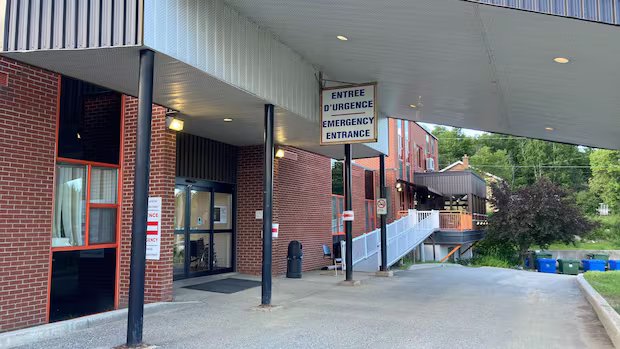
Michael Smith hasn’t slept through the night in weeks.
The resident of Kipawa, a small Quebec village near the Ontario border, has been sitting upright in pain, his arm locked in a sling, waiting for a call that hasn’t come.
After a snowmobile accident on March 1, Smith went to the emergency department in the nearby town of Témiscaming, where doctors told him he needed an ultrasound to assess internal damage.
The wait time: four months.
“I don’t know what’s wrong with my arm,” he said. “I’m in constant pain… and I’m just waiting.”
Weeks later, he still has no diagnosis — and no idea if he’ll fully recover.
“I’m doing self-diagnosis at this point,” he added. “But the worst part is not knowing”
As the health authority in Quebec’s Abitibi-Témiscamingue region pushes for official bilingual status for its southernmost health facilities to improve access for English speakers, residents say bigger accessibility issues stem from a policy change implemented last year that created a barrier to accessing health care in Ontario.
For years, many relied on hospitals in nearby North Bay, Ont., for faster access to tests, specialists and follow-up care. But that cross-border access has been cut off, forcing patients to seek services deeper within Quebec and often hours away.
The change is the result of a shift in Quebec’s billing policies. As of Aug. 1, 2025, the province — through regional health authorities like the CISSS de l’Abitibi-Témiscamingue — stopped acting as an intermediary between Quebec’s public health insurance board and doctors for medical services provided by Ontario doctors.
Officials say the move is meant to align with interprovincial practices and ensure the responsible use of public funds.
Smith says that shift has overwhelmed an already strained system.
“An ultrasound should happen the same day, or within days,” he said. “Not months later.”
‘They didn’t consider the human factor’
Gérard Whissell, a retired resident and municipal councillor in Kipawa, says the closure of the Ontario health-care corridor has created ripple effects across the community, especially for older residents.
“I had a urologist in North Bay. It was a 45-minute drive,” Whissell said. “Now I have to go to Rouyn-Noranda — that’s about two and a half hours — for a 15-minute appointment.”
The added distance isn’t just inconvenient, it’s costly. Travel expenses, overnight stays and time off add up quickly, he said, and government reimbursement often falls short.
Whissell recently accompanied his 87-year-old mother to an appointment in Val-d’Or, a trip that required an overnight stay.
“My expenses were close to $600,” he said. “She got maybe half of that back.”

Beyond the financial burden, he says the travel itself can be physically taxing.
“An elderly person can’t handle four or five hours on the road,” he said. “They’re already stressed about their health, and now they have to deal with this too.”
Whissell also questions how the decision to end the corridor was made.
“They didn’t consider the human factor,” he said. “People in the middle of treatment, people waiting for surgery — none of that was taken into account.”
In a statement to CBC News, the CISSS de l’Abitibi-Témiscamingue said it has the capacity to meet the region’s needs and that urgent diagnostic requests — those requiring care within three to 10 days — are handled within recommended timelines. However, it acknowledged that delays can occur for less urgent exams, with wait times varying depending on the type of service.
The health authority also pointed to a temporary measure introduced in January allowing some residents in Témiscaming, Kipawa and Kebaowek to seek care in Ontario, provided they notify the CISSS in advance. Officials say the measure is meant to help document demand while a longer-term solution is developed in collaboration with the Quebec government and regional partners.
But Whissell says some patients trying to navigate that temporary authorization have been unsuccessful. He says some Ontario hospitals have been declining Quebec patients until a formal agreement is in place.
The uncertainty is pushing some residents to consider leaving the region altogether, he says.
Language isn’t the problem, mayor says
Meanwhile, health authorities in Abitibi-Témiscamingue are seeking official bilingual status for its facilities in Témiscaming and Kipawa — a move intended to improve access for English-speaking residents.
But Kipawa Mayor Norman Young says that, while language access is important, “that’s not what people are complaining about.”
“We’ve never really had problems with language here,” Young said.
He says the loss of access to Ontario health services is the region’s most urgent challenge.
“It’s created havoc,” he said.

Young says even his own follow-up care was delayed.
“I was supposed to be seen in six weeks,” he said. “It took almost four months.”
While he supports the push for bilingual designation, he says it risks overlooking more pressing gaps in care.
“I’m pleased we’re moving toward services in both languages,” Young said. “But there are more important issues that need to be addressed to provide decent health care.”
For residents like Smith, the solution feels urgent.
“There’s no short-term fix,” he said, “other than letting people here access health care in Ontario again.”
In the meantime, he says, the uncertainty is becoming part of daily life.
He describes standing outside with a neighbour who was injured months ago and is still waiting for an MRI.
“He’s got a cane, I’ve got my arm in a sling,” Smith said. “We just stand there wondering what’s going on.”