dailynewsnblog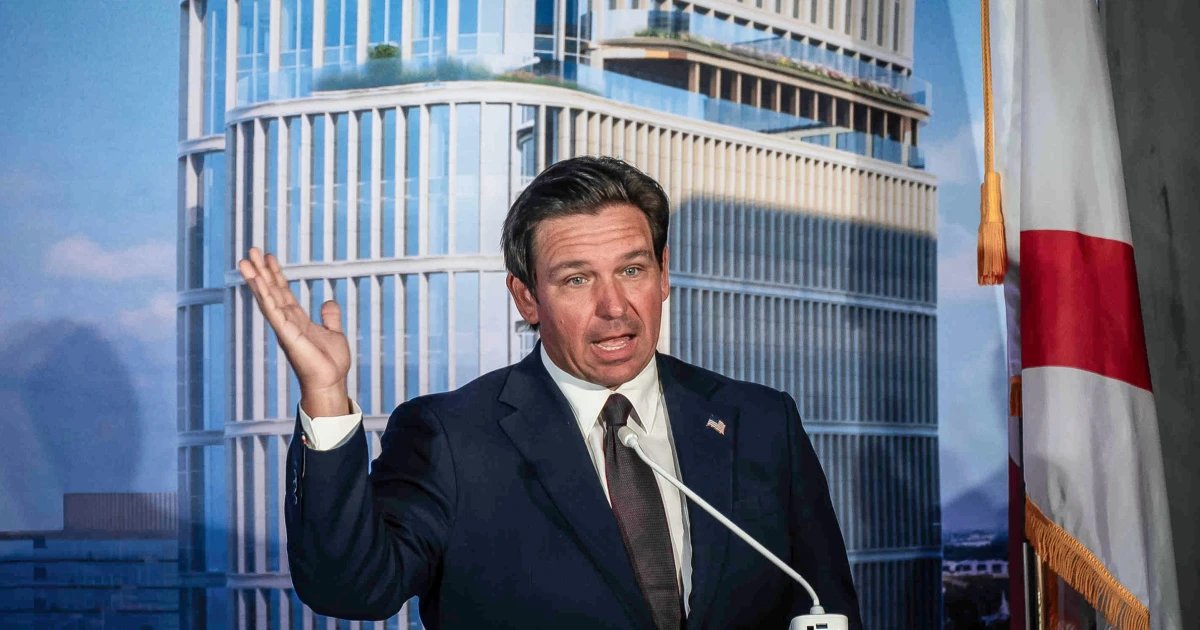
Florida Gov. Ron DeSantis isn’t sold on the massive expansion of AI.
And that belief might be his way back to national political relevance.
The Republican governor is appealing to a growing number of people who have concerns that AI’s rapid build-up, fueled in part by taxpayer dollars, could displace jobs, increase energy costs and hurt the environment. DeSantis’ positions stand in direct contrast to the embrace of the AI industry by President Donald Trump and the two likeliest potential candidates to snag his 2028 presidential endorsement: Vice President JD Vance and Secretary of State Marco Rubio.
“We don’t want to see them building a massive data center and then sending you the bill,” DeSantis said this month when asked about AI companies. “Data centers take up the power equivalent of a half a million-person city. We feel very, very strongly about protecting the consumer.”
For DeSantis, the embrace of AI skepticism is rooted in both personal policy preference and a 2028-focused political calculation as the term-limited governor plots out his political future, according to eight sources, most of whom have either worked in his administration or for his past campaigns at both the state and national levels. Many of them requested anonymity to speak candidly.
“It’s kind of a no-brainer, right? You’ve got JD Vance and Marco Rubio, the top two contenders for 2028 big time in the pro-AI lane,” a longtime DeSantis adviser said. “The infrastructure is lining up behind JD and to some extent Marco. So, DeSantis’ challenge is to stay relevant.”
Taryn Fenske, a DeSantis political aide, said the governor is a skeptic because of AI’s potential societal dangers.
“The governor is an AI skeptic because chatbots are convincing children to commit suicide,” she said.
DeSantis also leads a state the AI industry is likely to target, making it a focus of the broader fight between AI skeptics and proponents.
NBC News reported this month that Leading the Future, a pro-AI super PAC, is spending $5 million on TV ads boosting Republican Rep. Byron Donalds’ Florida gubernatorial campaign. Donalds is the only state-level politician the group has spent money to help, and officials there said it’s an indication AI companies will look to expand their footprint there in the future.

Recent polling suggests that AI could be a pertinent issue in the upcoming midterm elections and the 2028 presidential race. A poll conducted this month by The Economist and YouGov found that 63% of the U.S. citizens surveyed — including 60% who voted for Trump in 2024 — believe that advances in AI will reduce the number of jobs available in the country. A plurality of respondents, 33%, said that AI would have a “more negative than positive” impact on the U.S. economy.
And a Morning Consult poll in November found that a 41% plurality of registered voters favored banning the construction of data centers near their homes; 36% opposed such a ban, while 22% said they didn’t know or had no opinion.
DeSantis and the Trump administration have already been at odds on the issue.
Trump’s AI czar David Sacks and other administration allies have directly lobbied against DeSantis’ push to get Florida’s GOP-dominated Legislature to implement state-level regulations on AI and the massive data centers needed to accommodate the industry’s boom. Those bills remain alive, but as Florida’s legislative session comes to a close, their passage has become increasingly unlikely.
“There are some people … who almost relish in the fact that they think this just displaces human beings and then, ultimately, you’re going to have AI run society, and that you’re not going to be able to control it,” DeSantis said at an AI roundtable earlier this month. “Count me out on that.”
DeSantis and Trump themselves have publicly buried the hatchet, including golfing together this month, after a brutal 2024 GOP presidential primary. But as the jockeying begins to become the first post-Trump Republican nominee for president, it does not mean the notoriously politically sharp-elbowed DeSantis will not look to use the fight over AI regulation as a political cudgel against Trump allies such as Vance and Rubio.
“You know the story of the scorpion and the frog? Ron DeSantis is looking for his moment to stab the White House on something, and that might very well be AI,” said a longtime DeSantis political adviser who currently represents AI industry clients.
“And you know why he’s going to do it?” the person added. “Because he’s Ron DeSantis. It’s what he does.”
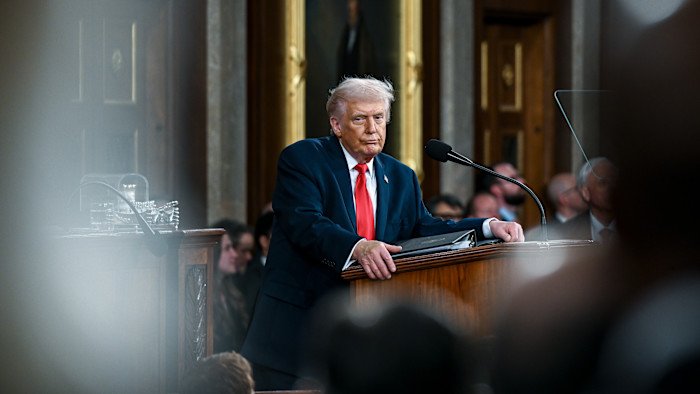
During his State of the Union address Tuesday night, Trump said his administration had struck a deal with major tech companies to require them to pay for more of the energy costs associated with building massive data centers.
“We’re telling the major tech companies that they have the obligation to provide for their own power needs — they can build their own power plants as part of their factory, so that no one’s prices will go up — and in many cases, prices of electricity will go down for the community,” the president said.

For now, DeSantis’ AI strategy would likely to some degree center on Vance, who in most public polling has been the overwhelming leader for the 2028 Republican presidential nomination, even as Rubio has picked up momentum in recent weeks.
Vance, with his background in Silicon Valley venture capital and relationships with leading Big Tech figures, is known as one of the Republican Party’s biggest AI champions.
At last year’s Artificial Intelligence Action Summit in Paris, the vice president warned that excessive regulation “could kill a transformative industry” and pledged the Trump administration’s support for “pro-growth AI policies.”
At the same time, Vance has attempted to reassure those on both sides of the debate.
Last fall, in an interview with Fox News’ Sean Hannity, Vance compared a rise in AI-related jobs to the arrival decades ago of cash-dispensing ATMs. Human bank tellers, Vance noted, still exist. He also linked his pro-AI stance to his anti-immigration views. Using home construction as an example, Vance described robots as complementary to “blue-collar” workers and immigrant laborers as an outright threat to replace them on job sites.
“No robot can replace a great blue-collar construction worker,” Vance said. “You see some of the houses, some of the things they do, the trim that they’re able to do. There’s an art there that I don’t think a robot is ever going to be able to replace.”
Vance has more recently expressed concerns about AI, telling Fox News’ Martha MacCallum last week that he worries specifically about it being used to surveil Americans or to advance invasions of privacy and political bias. In that same interview, Vance also illustrated the differences between him and DeSantis when it comes to regulating AI. DeSantis has pushed for state-level regulation, while Vance, along with the Trump administration more broadly, has supported the industry-backed idea of Congress passing a national regulatory bill.
“I think that eventually you’re going to have some standard applied, whether it’s a federal standard or whether it’s one state standard dominating,” Vance told MacCallum when pressed for his thoughts on regulation. “I think, frankly, the worst possible outcome would be to have far left California dominate the entire AI regulatory map.”
Representatives for Vance did not return requests for comment.
An official close to the DeSantis administration said that the governor sees an opportunity with the growing number of average people who feel elbowed out and negatively impacted by AI’s growth.
“Look at all these many trillions of dollars being spent on AI and data centers. They have no clue how it will ever benefit them,” the person said. “This stuff is more for enterprises than the individual person, and they see it as something that will jack up costs and replace them.”
“For DeSantis’, it’s a populist play,” the person added. “And that’s perfect for him.”
The former official said there are, to some extent, broader geopolitical concerns to consider as the U.S. engages in an “arms race” with China over AI expansion — and the almost inevitable change to the modern world that fight will usher in.
“The reality is this is an arms race, this is a cold war arms race against China dumping tons of money into AI,” the person said. “If you are on Team Trump, the only way you dig out of debt right now is to radically enhance productivity and grow production.”
“International investors I talk to are perplexed on how anyone in the U.S. could be anti-AI right now,” the person said. “That just makes things easier for China.”
Across the country, people are heavily pushing back on efforts to put massive data centers in their cities and towns. Most national polling is favorable to building data centers, but the numbers crater when people are asked if they would like one in their backyard.
“Nationally, when you talk about data centers, it polls at roughly 60%,” said an adviser who works with pro-AI groups. “But when you say to people in Loudoun County, if they want one in Loudoun County, the numbers are really, really bad,” the person said, referring to the Virginia county.
“Nationally it all sounds good and gravy,” the adviser added. “But when you get to the local stuff, you’re f—–.”