dailynewsnblog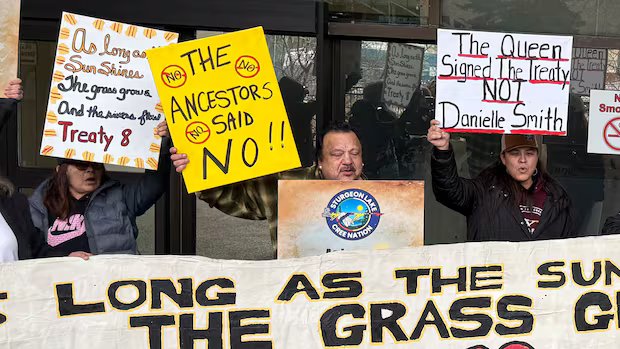
The argument First Nations groups made this week in an Edmonton courthouse wasn’t only aiming to block Alberta separatists’ petition drive toward a referendum, even if that was the specific, narrow goal of an injunction and a related hearing.
Sturgeon Lake Cree Nation and other litigants are challenging the very idea that a province can split from Canada, and in doing so sever their constitutionally protected First Nations treaties.
Athabasca Chipewyan First Nation (ACFN) is centred in northeast Alberta, but its ancestors followed caribou throughout what’s now Saskatchewan and Northwest Territories — and members today freely cross those boundaries to hunt, fish and trap, lawyer Kevin Hille told the court this week.
“Any constraint on those activities by an international border would violate those [rights],” Hille said.
After all, a newly independent Alberta would inherently draw a new international boundary within the territory of Treaty 8 (which ACFN is part of), which includes parts of Alberta, NWT, Saskatchewan and British Columbia. Separation stands to physically and legally harm this treaty and the other treaties within Alberta, the lawyers for First Nations argued.
ACFN and the Blackfoot Confederacy in southern Alberta appeared before Leonard this week seeking a judicial review of Alberta’s chief electoral officer’s decision to authorize Stay Free Alberta’s citizen initiative petition toward an independence referendum. Sturgeon Lake was requesting an injunction to block processing the more than 177,800 signatures Stay Free claims it has received, but doesn’t have to submit until a May 2 deadline.
But the next step will be paused, by court order.
On Friday, Leonard granted a one-month stay to ensure Elections Alberta doesn’t begin certifying the signature sheets before she has ruled on ACFN’s case. While her seven-page decision on a stay doesn’t answer many of the broader questions, Leonard wrote that First Nations “have provided evidence of harm from lack of consultation and harm to treaty relationships.”
Lawyers for the provincial government, along with ones for the separatist group, had asked the judge to not fully block the petitioners’ democratic process because of treaty questions at this early stage before a referendum, a potential yes result or the negotiations that would have to stem from it.
Section 35 of the Canadian Constitution states that Indigenous representatives must be part of discussions on amending the Constitution (which provincial independence would require), but signature gathering doesn’t breach that guarantee, they argued. Nor do other steps.
“A vote does not in and of itself change the status of those rights,” said Jennifer Keliher, representing the government. The duty to consult First Nations is not triggered at this point, she added.
“Nobody’s rights have been infringed, not even the tiniest little bit, by the gathering of signatures,” said Jeffrey Rath, who represented separatist leader Mitch Sylvestre in court and is a leading advocate for the movement himself.

Shortly after Quebec almost voted to separate in the 1995 referendum, Ottawa asked the Supreme Court to clarify the rules around provincial independence. The high court’s 1998 secession reference decided that unilateral separation would be unlawful, but if a clear separation question received majority support in a referendum, that would require the rest of Canada to negotiate that province’s departure and amend the Constitution.
From the bench this week, Leonard acknowledged that some argue the law on Indigenous rights has evolved, and the answer today may be different from what it was 28 years ago.
That’s a point constitutional expert Emmett Macfarlane makes.
“The 1998 Supreme Court reference simply didn’t wrestle with this question directly enough,” he told CBC News in an interview.
Macfarlane, a University of Waterloo political science professor and author of books on the Constitution and courts, contended that rulings on Aboriginal title, duty to consult and other matters have evolved in Canadian law to the point that a province’s First Nations would have to consent to secession, something the Supreme Court did not explicitly state 28 years ago.
“It’s just hard to see how any province could separate from Canada with its existing borders attached if Indigenous people of that province are opposed,” he said.
It’s not a formal veto, Macfarlane said, “but it would flow from an application and a recognition of the treaty system as part of the Constitution. And if a province can’t unilaterally tear up a treaty, which we know they can’t, then they are at the very least indirectly prevented from secession.”
As Leonard wades through such matters, she does so a few months after a counterpart on King’s Bench wrestled with them — relating to the same Alberta separatist petition bid.
In December, Justice Colin Feasby considered the chief electoral officer’s formal questions on Sylvestre’s proposed referendum to determine if it would contravene the Constitution. Feasby determined it would, but that ruling was made moot after the province amended the Citizen Initiative Act the same month, letting the separatists file their petition anew.
Despite the fact Feasby’s ruling does not appear to be precedent-setting, much of it came up during the First Nations’ hearings.
“This decision has concluded that the transformation of provincial and territorial borders into international borders would contravene the numbered treaties by significantly impairing the exercise of treaty rights by First Nations,” he wrote in his December opinion.
But he also made points used in arguments by the other side: “This case has not decided that First Nations have a veto over Alberta independence,” Feasby wrote. Also: “Nothing in this decision should be understood to mean that the Constitution cannot be amended or that Alberta cannot hold a referendum on separation.”

In weeks, the First Nations, the provincial government and Alberta separatists will learn how Leonard weighs in on these matters. The ambitions of Quebec separatists may also be affected by how the court newly considers how provincial independence and Indigenous treaties interact, Macfarlane said.
On the first of three hearing days this week, dozens of separatist supporters logged on to the court’s web feed. Some used the message feature as a sort of chat room for their commentary, before court staff curtailed that live forum.
One separatist supporter despairingly made a reference to the Eagles’ big hit to bemoan the argument of First Nations treaties standing in their group’s way.
“Welcome to the Hotel Canada,” that person wrote — implying that separatists may check out, but they can never leave.
That wasn’t exactly the argument First Nations made this week in court. But they cautioned that the treaties Canada and Indigenous people signed aren’t Alberta’s to disrupt.