dailynewsnblog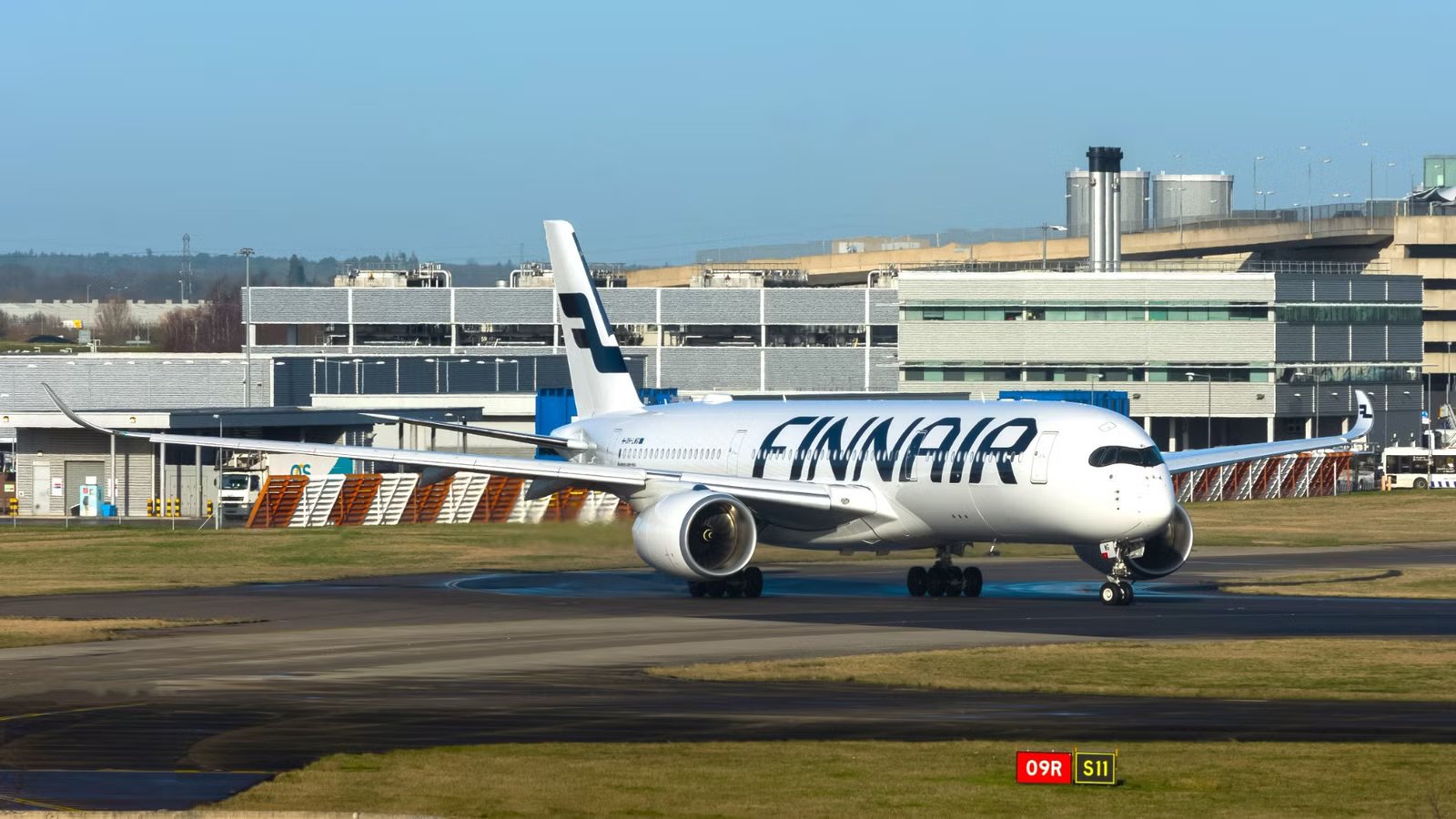
Finnair is an interesting airline as far as its long-haul operations are concerned. For instance, unlike many of its fellow European flag carriers, it places a relatively minimal emphasis on North American traffic, instead concentrating its intercontinental efforts in the Asia-Pacific market, where it is currently seeing more organic demand. However, arguably the most interesting quirk of its long-haul operations is the usage patterns of the jets involved.
Specifically, the Airbus A350 widebody twinjets that ply many of the Finnish flag carrier and oneworld member’s long-haul routes in the evening and overnight are sometimes used on morning rotations from its main hub at Helsinki Vantaa Airport (HEL) to short-haul European destinations. At a recent Finnair media event, Simple Flying’s Tom Boon was able to ask several of the airline’s executives about this interesting fleet strategy.
Lots Of Factors At Play

According to Cirium, an aviation analytics company, Finnair has scheduled 851 flights with its A350s this March. While most (695) serve long-haul routes to Asia and North America, a not-insignificant 156 of these flights (18.3%) operate within Europe. Simon Large, Finnair’s Chief Customer Officer, told Simple Flying’s Tom Boon that the use of the A350 here is a fun quirk “because it gives people a chance to experience that product.”
However, aircraft deployment boils down to much more than novelty value. Indeed, responding to a question from Simple Flying, Christine Rovelli, Finnair’s Chief Revenue Officer, said that, with the A350 flights to London, “Heathrow is a constrained airport, [so] you want to use the biggest airplane you can.” She added that the UK capital “is a hub for [oneworld partner] British Airways,” and that “there’s a lot of cargo on that route,” meaning that:
” When you have the cargo and the connections from your big partner, it all starts to come together, and [there’s] enough [motivation] to put a bigger airplane on that route.”
Different Markets Appeal For Different Reasons

Ultimately, when it comes to choosing which aircraft types operate on which routes, there always needs to be a business case, with Rovelli noting that, each time, this analysis starts with the question of “where the revenue is going to come from.”  London Heathrow Airport (LHR) is a perfect case study in this regard, with the combination of slot-constrained operations and high passenger and cargo demand making the Airbus A350 a good fit.
However, the capital city of the United Kingdom is not the only short-haul destination where Finnair flies its modern widebody twinjets in between long-haul sectors. Indeed, Rovelli highlights that Brussels Airport (BRU) in Belgium had a different appeal when it came to sending the A350 there from Helsinki, namely that “in our cargo facility, we have the ability to handle pharmaceuticals, so we [transport] a lot of pharmaceutical cargo to Brussels.”
As such, the A350 is a good fit for the Belgian capital in this regard due to its increased belly capacity compared to the narrowbody twinjets that might otherwise be expected to operate on such a route within Europe. While the passenger experience benefits of flying on a widebody within Europe are certainly an added bonus, they are rarely the driving force behind such deployments: instead, there are many more moving parts than meet the eye.

Finnair Doubles Short-Haul Widebody Schedule
Finnair’s Intra-Europe March Airbus A350 Operations In A Nutshell

As previously noted, Cirium data shows that Finnair has scheduled 156 intra-Europe Airbus A350 flights this month. These, as seen in the map above, will serve five different European short-haul destinations from Helsinki Vantaa Airport, and London Heathrow is the most popular, with 31 round trips planned.
While this equates to a daily frequency on average, the reality is a little different, as some days have two, and others have none. Still, it is definitely the most consistent European route for Finnair’s A350 coverage. Elsewhere, Gran Canaria (LPA) will see 30 round trips, compared to 14 in Amsterdam (AMS), two in Munich, and one in Brussels. Per aeroLOPA, Finnair’s A350s have three classes, and space for either 278 or 321 guests on board.