dailynewsnblog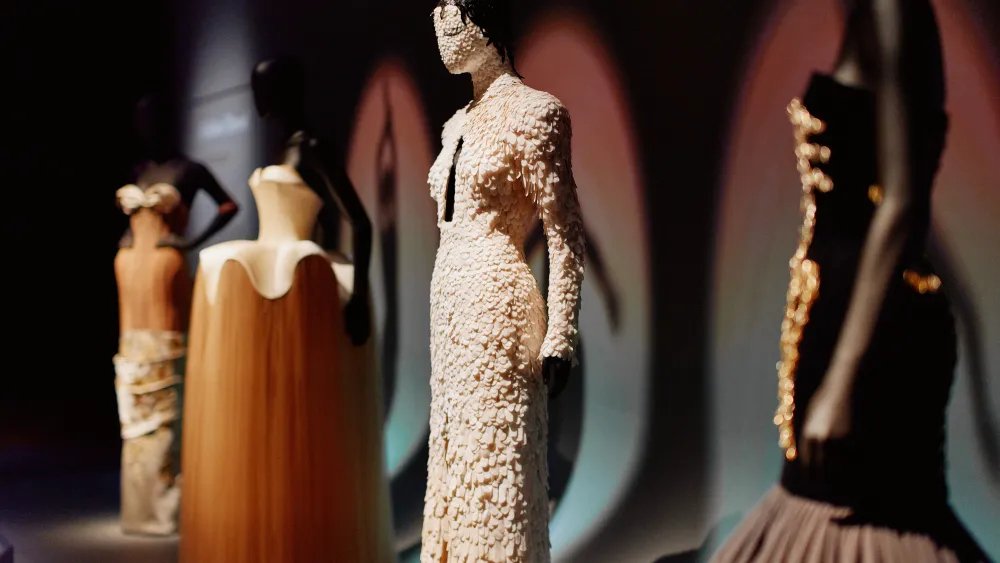
LONDON — Like young lovers, fashion and art are drawn to each another, but the romance fades quickly because they are so different. Art is cerebral, and meant to endure, while fashion is commercial, seasonal and fundamentally fickle.
The rare exception was Elsa Schiaparelli, the rule-breaking Roman designer who built a business sparking off Surrealist artists including Salvador Dalí, Alberto Giacometti and Jean Cocteau, and working closely with other 20th-century creatives, including the jeweler Jean Schlumberger, to push the limits of fashion.
The Victoria & Albert Museum is swiveling the spotlight onto Schiaparelli and that exceptional moment in history when art and fashion collided to create something new.

Maggie Mauer in Schiaparelli.
Jamie Stoker/WWD
Changing the Paradigm
“Schiaparelli: Fashion Becomes Art,” which opens Saturday, and runs until Nov. 8, is the U.K.’s first exhibition dedicated to the house, its founder and how she was able to change the fashion paradigm in the shell-shocked, straitened years following World War I, and break up the cozy relationship between fashion and beauty.
The show also paints a picture of the difficult inter-war period in Europe through the designs of Schiaparelli, a wealthy, art- and science-loving aristocrat, and original work by her artist and photographer friends.
“Elsa Schiaparelli was at the center of a constellation of creatives, and a key protagonist in the Surrealist movement,” said Sonnet Stanfill, senior curator of fashion at the V&A, who has been working on the show for the past two-and a-half years.
Stanfill said that new research by the V&A shows that Schiaparelli “wasn’t simply appropriating Surrealist images and sticking them on her clothes. She was embedded with the artists, and they referenced her couture salon in Paris as the beating heart of their movement. On any given day, her office saw a steady stream of the greatest creatives of 1930s Paris.”
The Skeleton dress embroidered with ribcage bones at the back and front is a prime example of the intimate — and fruitful — relationship that Schiaparelli had with her artist friends.

Inside the Schiaparelli exhibit at the V&A Museum.
Jamie Stoker for WWD
The black silk dress from 1938 belongs to the V&A and is the only known surviving example of the Skeleton style.
It has “bones” stitched onto the back and front “almost like the wearer’s insides have come outside,” Stanfill said. Next to the dress in the exhibition are sketches by Dalí of three female skeletons in different fashionable poses, with a note at the bottom saying how much he likes the idea of the “bones” being on the outside.
“You get the sense from looking at the dress, the sketches and the note that we have entered into the middle of a conversation between the designer and the artist, and there’s a flow of information going back and forth,” Stanfill said.
A similar conversation is happening around the Lobster dress, which Schiaparelli co-created with Dalí — her silhouette, his painting. According to Stanfill, the collaboration gave Dalí the idea for the lobster telephone, which he created a year later. The two are displayed side-by-side in the show.
Other Schiaparelli-Dalí collaborations include a Tears dress from 1938, with images of violently torn strips of fabric, and a hat resembling an upside-down shoe. What crazy kids they were.
There are more than 400 objects on display in the show at the V&A’s Sainsbury Gallery. It includes 100 fashion ensembles and 50 artworks — by Pablo Picasso, Jean Cocteau, Man Ray and Eileen Agar — as well as accessories, jewelry, paintings, photographs, furniture, perfumes and archive material. What is most impressive the exhibit is how wearable and modern her designs remain.
Schiaparelli wasn’t just working alongside the artists — she was putting their dream-fueled ideas into action, adding trompe-l’oeil designs to her charming knits and jackets; popping utilitarian zippers onto slinky evening gowns, and transforming the humble button into a conversation piece — flying acrobats for an embroidered jacket, or gilded Giacometti sculptures for a coat.
She broke other rules, too, working with alternative textiles such as cellophane and woven glass and working out methods to waterproof her tweed suits. She also designed women’s beach wear, sewing bra cups into the inside of bathing suits, and clothes for skiing and active sport. In fact, she began her fashion career by designing sports clothing rather than couture.

Inside the Schiaparelli exhibit at the V&A Museum.
Jamie Stoker/WWD
Her prints were innovative, as well as self-promoting. A scarf at the beginning of the show features a collage of newspaper articles with headlines about her, in a masterstroke of self-promotion that came decades before Andy Warhol started talking about the nature of fame.
“She created clothes that were slightly disobedient and not necessarily concerned with creating conventional glamour,” Stanfill said.
Creating an Image
Current Schiaparelli creative director Daniel Roseberry — whose dramatic designs worn by a host of celebrities including Ariana Grande and Dua Lipa appear in the final room of the show — said that while Schiaparelli may have been a rule-breaker, she was also an image-maker.
Her work “wasn’t about reimagining silhouette. It was about image making. There’s something very pre-social media, very pre-digital age about her work. It was very attention grabbing at a time when people were dressmaking, and creating quiet, soft clothing,” he said.
Roseberry pointed to a room in the show that’s filled with embellished or colorful tailored jackets, each in its own case and displayed like a precious jewel.
A black one has a round collar, chunky buttons and goldwork embroidery on its big “cash and carry” pockets. There are also two blazing pink embroidered jackets, and a black one with silvery sequins arranged in the shape of muscle groups on the chest.
“All of those jackets were meant to be viewed at a dinner table with the embroidery sitting right above the waistline,” Roseberry said. “They were like a siren song at a restaurant calling you across the room to go engage with whoever was wearing it. There’s this eye candy quality to her work, which was so different from that of her peers.”

Inside the Schiaparelli exhibit at the V&A Museum.
Jamie Stoker for WWD
Schiaparelli and Coco Chanel — who was also breaking the rules — were rivals, although they didn’t need to be, according to Stanfill.
“If you take a prototypical Chanel gown from the 1930s and juxtapose it with a quintessential Schiaparelli, I don’t think you would confuse the two. They had their own aesthetics and clients, and I don’t think they were in competition with each other,” she said.
Stanfill added that both women started small, with Schiaparelli making trompe-l’oeil sweaters and Chanel doing hats. “They both expanded out and were quite adept at making clothes that were wearable, comfortable and stylish,” she said.
Both women were also dedicated, and disciplined.
Actress Marisa Berenson, Schiaparelli’s granddaughter, recalled that she “liked [Yves] Saint Laurent and [Cristobal] Balenciaga. She dressed very classically, in tailoring and black, except for the evenings when she would change every night for dinner.”
Berenson, who lived with her grandmother at one point in 1970s Paris, said that even if Schiaparelli dined alone, on her sofa, in front of her television, “she would change into these beautiful old kimonos that she’d bought in China over the years. She’d come down to dinner with her hair up, and covered in these incredible necklaces, and wearing a kimono. Then she’d sit in front of the television, by herself, and have dinner.”
Schiaparelli was disapproving of Berenson’s free and easy 1970s attire. “She was quite severe and did not approve of my going out dressed the way I did. She thought it was absolutely scandalous,” Berenson added.
Schiaparelli’s rigor, creativity and disruptive approach to style live on.
Delphine Bellini, chief executive officer of Schiaparelli, which is now by Diego Della Valle and his family, said the exhibition “is not about nostalgia, but about continuity. Reviving Schiaparelli has never meant rebuilding the past; it has meant proving that Elsa’s radical vision still belongs to the present. At Schiaparelli, we don’t preserve a legacy, we activate it, as a cultural and artistic force that continues to challenge and inspire our time.”
Roseberry said he loves the freedom that comes with designing for the house — and insisted that he’s never short of ideas. “We’re not bound to a silhouette, a color story or a material like other brands are, but you know something is a Schiaparelli from the moment it walks over,” he said.

Inside the Schiaparelli exhibit at the V&A Museum.
Jamie Stoker/WWD
He’s not the only one keeping the flame alive. This week, Harrods plans to unveil a series of window installations inspired by one of Schiaparelli’s most recognizable emblems: the keyhole.
Large, keyhole-shaped screens will turn the store’s windows into “portals of discovery” with viewers able to look at images of “Anglomaniac,” a newly published book showcasing the house of Schiaparelli’s influence on the work of British artists.
Published by Skira and edited by Thierry‑Maxime Loriot, “Anglomaniac” spotlights British creatives whose work resonates with that of Roseberry and the house.