dailynewsnblog
Mr. Andersen wrote this letter to Canadian Prime Minister Mark Carney.
December 6, 2025
The Right Honourable M. Carney, Prime Minister
House of Commons, Ottawa, Ontario, K1A 0A6
Ref. F 35 aircraft
Dear Prime Minister;
Having been an RCAF pilot on the F-86 and an air transport economist, I have nothing good to say about the F-35.
An important measure of the use of financial capital is the usefulness of the aircraft one selects to buy. Military measures of capital in use is the effectiveness of the aircraft as a weapon and its 24/7 availability for deployment.
It is at this second requirement that the F-35 falls flat on its undercarriage. To help appreciate this condition, I have enclosed a copy of an article, dated January 24, 2025, titled “F-35 Fighter Readiness Challenges Exposed: GAO Report Reveals Troubling Trends”. The letters GAO stand for Government Accountability Office, USA.
This report brings to mind the F-104 Canada got stuck with in the early 1960s, also built by Lockheed. This jet was rejected for front-line use by the USAF at that time because the maintenance required to get and keep it airworthy was outrageous. The USAF gave them to “weekend” reservists.
In response to the “Second Berlin Crisis”, we had an F-104 squadron based nearby, and those pilots were restricted to 10 flying hours a month, when we were booking +30. That was when we used the term “Hanger-Queens” a lot. That piece of Lockheed aviation junk was well known throughout NATO.
I examined commercial aircraft extensively in the 1970s, and one of my first tests was the productivity to be had from each competing design per unit of capital invested, along with the records of maintenance cost per flight-revenue hour.
Sincerely, Erik Andersen
What GAO Found
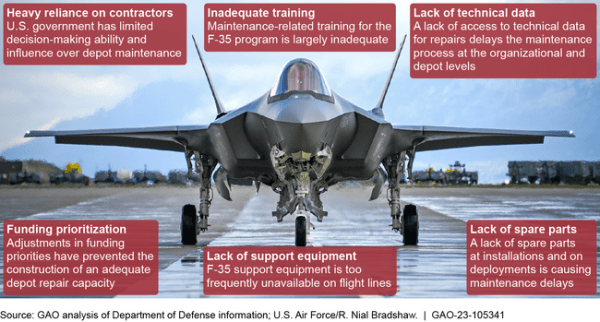
Maintenance challenges negatively affect F-35 aircraft readiness. The F-35 fleet mission capable rate—the percentage of time the aircraft can perform one of its tasked missions—was about 55 percent in March 2023, far below program goals. This performance was due in part to challenges with depot and organizational maintenance (see fig.). The program was behind schedule in establishing depot maintenance activities to conduct repairs. As a result, component repair times remained slow with over 10,000 waiting to be repaired—above desired levels. At the same time, organizational-level maintenance has been affected by a number of issues, including a lack of technical data and training.