dailynewsnblog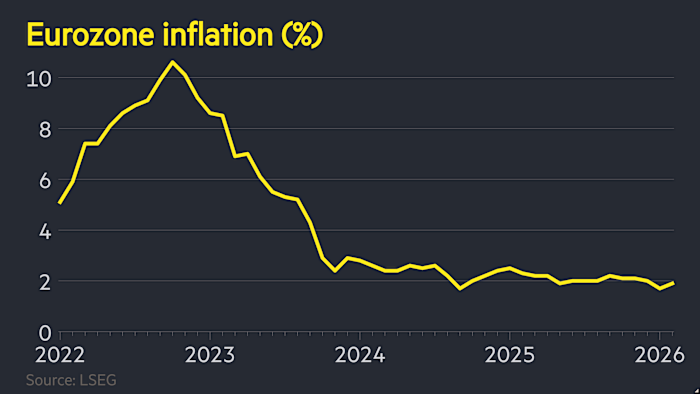
Unlock the Editor’s Digest for free
Roula Khalaf, Editor of the FT, selects her favourite stories in this weekly newsletter.
Eurozone inflation unexpectedly rose to 1.9 per cent in February before the widening conflict in the Middle East sent gas and oil prices surging.
The figure was slightly above economists’ forecast of 1.7 per cent and was 0.2 percentage points higher than in January, although it marked the first time since April 2021 that annual inflation remained below the European Central Bank’s 2 per cent target for two months in a row.
Diego Iscaro, an economist at S&P Global Market Intelligence, said the surprise reading was “certainly not good news” and reinforced concerns linked to the war in the Middle East.
“The inflation picture is now significantly more uncertain,” he said.
Commerzbank economists said February’s inflation numbers were partly influenced by the Iran war “already casting its shadow” as heightened tensions had already driven up energy prices last month.
But Riccardo Marcelli Fabiani, an economist at consultancy Oxford Economics, stressed that while the events in the Gulf “will raise energy prices”, the overall impact “should not be overstated” as oil supply was on track to grow faster than demand. Energy prices are one of many drivers of overall inflation.
The ECB next meets on March 19. Its chief economist Philip Lane told the FT in an interview published earlier on Tuesday that persistent disruption in oil and gas supplies from the Middle East could result in a “substantial spike” in inflation and a “sharp drop in output”. The ECB “will be closely monitoring developments”, Lane said.
Swaps traders are now ascribing a roughly 50/50 chance of a quarter-point rate rise by the European Central Bank by the end of the year, according to levels implied by market pricing. That is a reversal from last week, when traders were putting a modest chance on further cuts from the current level of 2 per cent.

That shift in expectations has helped fuel a global sell-off in short-term government debt. Two-year German bond yields, which are sensitive to rate expectations, are now up 0.2 percentage points so far this week to 2.2 per cent.
In December, the central bank estimated that inflation would average 1.9 per cent this year after hovering at 2.1 per cent in 2025.
Core inflation, which excludes volatile food and energy prices, rose by 0.2 percentage points in February to 2.4 per cent. Analysts had expected it to remain at 2.2 per cent.
The closely watched figure for services inflation — a gauge for domestic price pressures that has remained well above the ECB’s 2 per cent target for more than three years — was up to 3.4 per cent from 3.2 per cent in January.