dailynewsnblog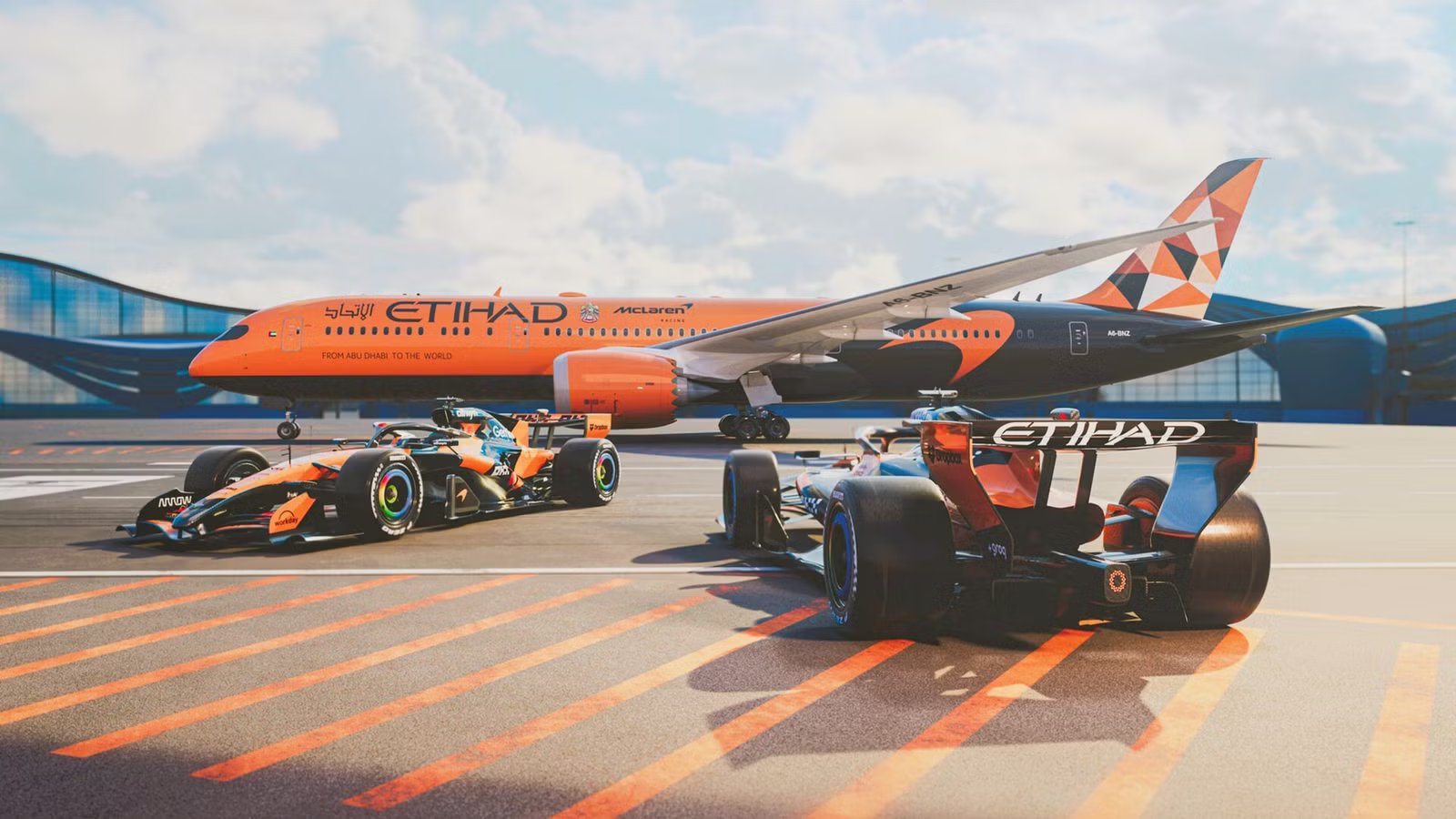
McLaren Racing has added a new airline brand to its ever-expanding commercial roster, announcing  Etihad Airways as an official partner for the upcoming 2026 season and beyond. The tie-up is notable not just because it links one of Formula 1’s most visible teams with Abu Dhabi’s flag carrier, but because it’s multi-series — covering McLaren’s Formula 1 operation and its World Endurance Championship (WEC) Hypercar program.
For aviation enthusiasts, the partnership lands with a clear hook: Etihad says it will introduce a McLaren–branded Boeing 787 livery later this year, turning one of its flagship long-haul types into a flying billboard for ‘Team Papaya’. In an era where airlines increasingly lean into high-impact brand moments rather than just logo placement, a special-livery widebody offers something far more tangible — and photogenic — than yet another patch on a driver’s firesuit.
Celebrating A Global Partnership

At its core, the agreement makes Etihad an official partner of the McLaren Mastercard Formula 1 Team and the McLaren United Autosports WEC Hypercar Team, positioning the airline alongside McLaren across a calendar that hops continents and time zones. That global footprint is precisely the point: McLaren races in markets that map neatly onto Etihad’s network ambitions, and Etihad gets a premium, internationally distributed platform that travels week to week — from Asia-Pacific to Europe to North America — without needing to create an event of its own.
Etihad will also benefit from a high-visibility tie-up with the team that has dominated the Formula 1 Constructor’s Championship for the past two seasons, as well as last year’s Formula 1 Drivers Championship with Lando Norris, who clinched the title at the Etihad Airways Abu Dhabi Grand Prix in December. Zak Brown, the CEO of McLaren Racing and ever-present protagonist in Netflix’s “Drive to Survive” series, was highly enthusiastic about the new partnership:
“As we travel to more races around the world, working with a global airline that shares our passion for excellence is a natural fit. Etihad’s commitment to delivering high‑quality experiences aligns strongly with our values, and we look forward to working closely together across both Formula 1 and WEC.”
The partnership language leans heavily into shared brand values: premium experiences, hospitality, and international travel. That’s corporate-speak, but there’s a practical logic underneath it: F1’s audience skews affluent and global, and WEC’s Hypercar resurgence has similarly become a magnet for high-income enthusiasts and destination events. For an airline selling premium long-haul journeys via Abu Dhabi International Airport, those are attractive demographics.
Then there’s the visual payoff. In a sport where partners compete for attention, a special-livery Boeing 787-9 offers Etihad a way to stand out beyond the track with an attention-grabbing asset that generates earned media every time it’s spotted. Antonoaldo Neves, group CEO at Etihad emphasized this when he shared the news of the partnership:
“Today, we are thrilled to team up with McLaren Racing to begin an extraordinary partnership. In celebration, we will also unveil a stunning new aircraft livery designed with McLaren branding, which will fly across the fast-growing Etihad network, engaging with fans around the world.”
Where You’ll See It: Car Placement, Helmets, And Even A McLaren 787

McLaren and Etihad have been explicit about where the branding will land in Formula 1: the rear wing and halo of the team’s car, plus the drivers’ helmets. Those are premium placements. The halo is constantly in-frame during onboard shots and TV replays, and the rear wing is one of the most photographed areas of any F1 car — especially in braking zones and rear-facing trackside angles.
The partnership also spans McLaren’s endurance racing effort, with Etihad supporting the McLaren United Autosports WEC Hypercar Team across its global calendar. While WEC doesn’t deliver F1-level reach week-to-week, it offers deeper event engagement, manufacturer storytelling, and destination endurance races such as the legendary 24 Hours of Le Mans that pair naturally with travel brands.
|
Etihad’s Sponsorship Elements At A Glance |
||
|
Sponsorship element |
Where it appears |
Why it matters |
|
Official Partner status |
McLaren Racing (multi-series) |
Gives Etihad broad rights and association across platforms |
|
Branding on rear wing |
McLaren F1 car |
High visibility in photography and broadcast |
|
Branding on halo |
McLaren F1 car |
Constantly in-frame on onboard/TV angles |
|
Branding on drivers’ helmets |
McLaren F1 drivers |
Close-up visibility; high social amplification |
|
WEC Hypercar partnership |
McLaren United Autosports WEC Hypercar |
Extends reach into endurance racing’s premium audience |
|
Digital and experiential rights |
Content and fan activations |
Enables campaigns, hospitality, and event experiences |
|
McLaren-branded Boeing 787-9 |
Etihad fleet (special livery planned) |
Largest aviation-facing asset; global airport visibility |
And then there’s the centerpiece for aviation fans: Etihad says it will add a McLaren Racing–branded livery to one of its Boeing 787-9s later in the season. The 787 is a smart choice, being Etihad’s long-haul workhorse and a type that regularly appears in major global hubs, making the livery a roaming ad unit that can generate attention well beyond a single race weekend.

Over 7,400 Miles: Charlotte’s Longest-Ever Nonstop Flight Takes Off Next Month
Etihad Airways is about to commence its newest US route, a 7,407-mile journey from Abu Dhabi to Charlotte
Etihad’s Long Formula 1 Runway

Etihad isn’t new to Formula 1. It’s one of the category’s most entrenched airline brands thanks to its longstanding position as title sponsor of the Formula 1 Etihad Airways Abu Dhabi Grand Prix, a relationship dating back to 2009. That consistency matters. While many F1 sponsorships rotate with budget cycles, Etihad has spent nearly two decades tying its name to the sport’s season finale in Abu Dhabi, effectively owning a piece of the calendar’s most globally marketed destination race.
While airlines are no strangers to F1 sponsorship, but from a strategy standpoint, Etihad’s leap from event sponsorship to team partnership is also a logical next step. The Abu Dhabi Grand Prix puts Etihad at the center of one week in one place, albeit a massive one. A team deal turns that into year-round visibility, week after week, across multiple continents, and across multiple racing series.
It also helps explain why the aviation activation is so prominent here. The McLaren 787 livery gives the airline something it can deploy far beyond its home race at Yas Marina: an asset that can taxi into major hubs, appear on social feeds via plane-spotters, and keep the partnership visible even when the sport isn’t on TV. That’s the real takeaway — this isn’t just a logo placement; it’s a multi-year marketing move where the sky’s the limit.