dailynewsnblog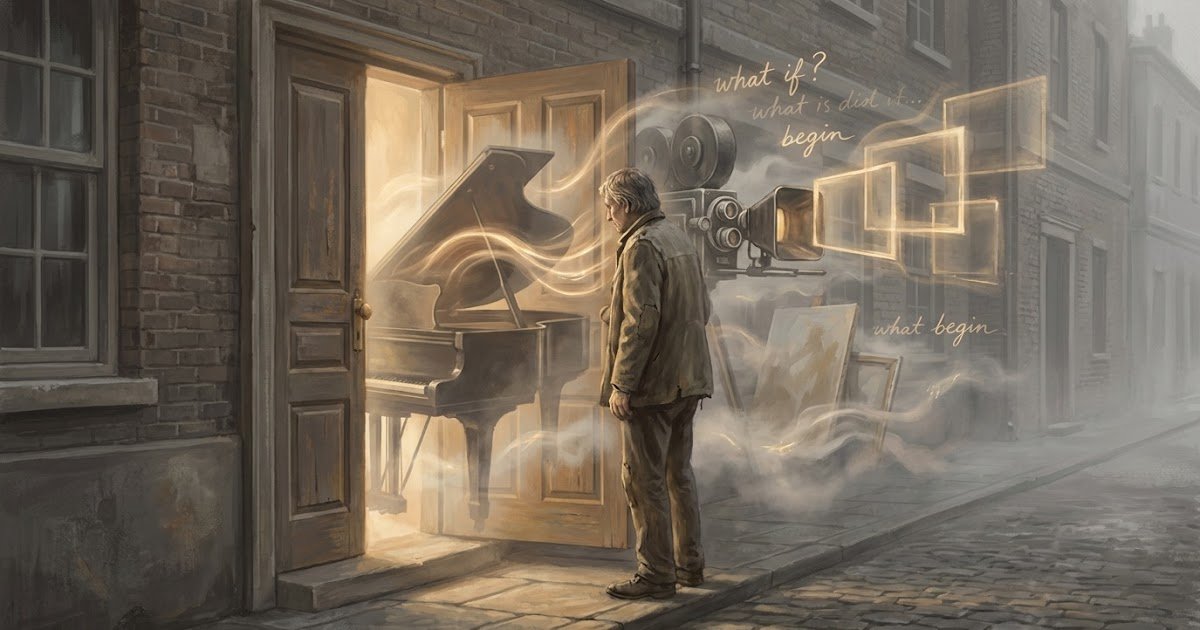
How AI is reshaping who gets to create — and what creation now asks of us.

For most of human history, creative practice has been gated
by thresholds that were invisible but decisive. You didn’t simply decide
to become a musician, a filmmaker, a visual artist, or a writer. You needed
time, money, training, access to institutions, and—often most
critically—permission. Not explicit permission, perhaps, but the slow
accumulation of signals that told you: yes, you belong here.
What we are witnessing now, with tools like Suno and Higgsfield
Cinema Studio, is not merely a technological acceleration. It is a quiet
reconfiguration of the cultural entry points into creative worlds.
AI is not making everyone an artist. It is making it easier
for people to enter the studio.
That distinction matters.
From Mastery to Entry
Consider the difference between mastery and entry. Mastery
is slow, embodied, and unforgiving. It still matters, and it always will. But
entry is something else entirely. Entry is the moment when a person discovers
whether a domain resonates with them at all.
Until recently, many people never reached that moment.
You might have had a musical sensibility but never learned
an instrument. You might have thought cinematically but never touched a camera.
You might have felt stories gathering inside you but lacked the stamina—or the
solitude—to write long enough to find out what they were.
AI tools collapse the distance between curiosity and first
expression. They allow someone to move from “I wonder” to “listen to this” or
“look at this” in hours rather than years.
That shift alone changes developmental trajectories.
Music Without the Conservatory
Music has long been one of the most exclusionary creative
fields—not because of elitism, but because of friction. Instruments are
difficult. Theory is abstract. Production is technical. Recording is expensive.
Platforms like Suno do something deceptively simple: they
allow people to externalize musical intuition without first translating it into
technique.
This does not replace musicianship. It reorders the path
toward it.
Someone can now discover:
- whether
they think melodically, - whether
rhythm organizes their emotions, - whether
sound is a medium through which they want to make meaning, before investing years in skill acquisition.
Many will stop there. Some will go further. But the door has
been opened.
Cinema Without the Crew
Filmmaking once required coordination, capital, and
infrastructure. Even short films demanded teams, equipment, locations, and
post-production expertise.
AI-driven cinematic tools—Higgsfield among them—make it
possible to prototype scenes, moods, and visual narratives without assembling a
small army. What emerges is not cinema in the traditional sense, but something
closer to storyboarding as expression.
This invites a new class of creators:
- writers
who think visually, - photographers
who think temporally, - philosophers
who think in scenes rather than arguments.
Again, the result is not an erosion of film craft. It is an
expansion of who gets to discover whether they have cinematic intelligence at
all.
Visual Art, Writing, and the End of the Blank Page
The same pattern repeats across domains.
Visual art tools reduce the intimidation of the empty
canvas. Writing assistants reduce the paralysis of the blank page. These
systems do not supply meaning; they supply momentum. They lower the
activation energy required to begin.
This matters most for people who are not young, not
credentialed, not embedded in creative subcultures—people who grew up in an
analog world and were told, implicitly or explicitly, that certain forms of
expression were not for them.
AI doesn’t make them experts. It makes them participants.
The Real Democratization Is Not Output
The common critique is familiar: floods of content,
aesthetic sameness, shallow experimentation, algorithmic sludge. All of this is
real. But it misses the deeper shift.
The true democratization here is not the democratization of output.
It is the democratization of exploration.
People can now ask:
- What
kind of creator might I be? - Which
medium responds when I touch it? - Where
do I feel coherence rather than friction?
These are developmental questions, not market questions.
And they matter profoundly in a world where identity is
increasingly fluid, careers are unstable, and meaning must often be
self-authored rather than inherited.
A Higher Bar, Not a Lower One
Paradoxically, as tools become more powerful, the technical
bar drops—and the existential bar rises.
When anyone can produce competent artifacts, what
distinguishes work is no longer polish or novelty. It is coherence. Depth.
Continuity. Ethical relation to the world being shaped.
AI makes it easy to enter creative fields. It does
not make it easy to inhabit them.
Sustained creation still demands attention, care, judgment,
and the ability to live with unfinishedness. If anything, these qualities
become more visible, not less.
A Cultural Inflection Point
We are at a moment when creative identity is shifting from
something one earns permission to claim, to something one discovers through
use. The studio is no longer a destination at the end of a long road. It is
an environment people can step into and test.
Some will pass through briefly. Some will stay. A few will
build worlds.
AI does not decide which path anyone takes. It simply
removes the lock from the door.
And that, quietly, changes everything.