dailynewsnblog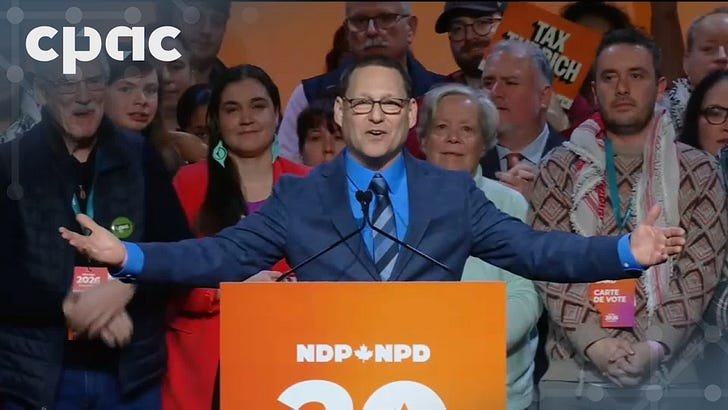
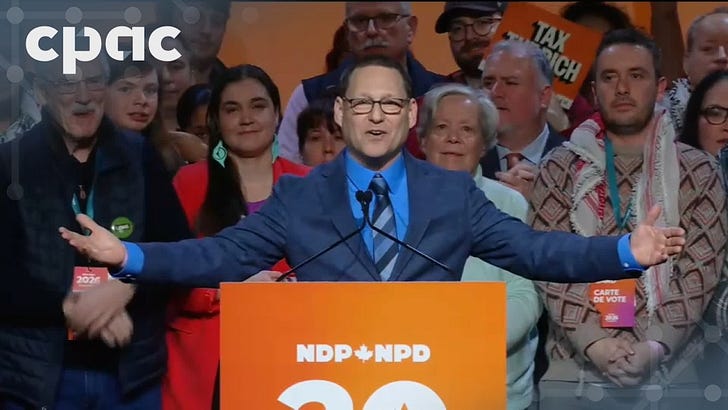
On first glance, Avi Lewis is the quintessential champagne socialist; a refined, well-to-do idealist who oozes Toronto elite, off-putting to the average voter, completely foreign to the rural one. But after two decades of chasing the middle and abandoning its core values, Lewis is unapologetically dragging the NDP back to its principled roots.
It will take him some time to connect with Canadians, if he can at all. First impressions matter. I have seen friends who have been long-time members of the NDP walk away since Sunday’s leadership vote in disgust, comparing him to the Waffle movement his grandfather, former NDP leader David Lewis, fought off half a century ago.
The NDP has largely lost its labour base. Unionised labourers, benefitting from years of the fair pay and benefits brought to them by organised labour, often support the Conservatives without a hint of irony, seeking only lower taxes. And on that side, Lewis will have an enormous hill to climb.
Avi and his partner, filmmaker and author Naomi Klein, were key to the launch of the Leap Manifesto going into the 2015 election. That manifesto is built around the statement: “We call for a Canada based on caring for each other and the planet, moving swiftly to a post-carbon future, upholding Indigenous rights, and pursuing economic justice for all.”
Reading the manifesto’s points objectively, as summarised far more clearly on wikipedia than on their own website, they seem logical, obvious even, as the path forward for Canada:
-
Fully implementing the United Nations Declaration on the Rights of Indigenous Peoples
-
A shift to a “100% clean energy economy” by 2050
-
A moratorium on new fossil fuel infrastructure projects
-
Support for community-owned clean energy projects
-
A universal program for energy efficiency and retrofitting, prioritizing low income communities
-
High-speed rail and affordable, nation-wide public transit
-
Re-training and resources for workers in carbon-intensive industries
-
A national infrastructure-renewal program
-
An overhaul of the agricultural industry, prioritizing local production
-
A moratorium on international trade deals that infringe upon democratic rights
-
Immigration status and full legal protection for all workers, including immigrants and refugees
-
Investment in expanding “low-carbon” sectors of the economy, including through the development of a national childcare program
-
A “vigorous debate” on the implementation of a universal basic income
-
An end to austerity and subsidies to the fossil fuel industry, paid for with cuts to military spending and robust progressive, wealth, and corporate taxation
-
An end to corporate funding of political campaigns and examination of voting reform
In the current threat environment, cutting military spending would not be wise for Canada, and so too each point has to be considered as a discrete debate from the point of view of reality. However many stop at the word ‘manifesto’ and assume it to be radical. One need not agree with every point to see the overall objective of taking power away from the ultra wealthy and returning it to the people, which upon looking south of the border at the opposite should not be considered terribly radical as a desirable outcome.
The real win for Canada though in Avi Lewis’s weekend victory is in what he offers that Pierre Poilievre does not: ideas. Agree with them or disagree with them, at least he has them.
In the 2016 election in the United States, Donald Trump turned the election into a referendum on the status quo. The Democrats fell for it, vigorously defending a status quo that more and more Americans saw as the problem. They pushed out Bernie Sanders and the “radical left” of their party who were and are advocating for what are largely common-sense policies that help the average citizen rather than the ruling class.
In what could have been a major policy debate for the United States on Sanders’ vs Trump’s vision for how to replace the status quo with something better, to deal with rising angst across their country, the ballot question Trump wanted triumphed, and the status quo was itself defeated. The Democrats, never understanding what happened, presented the status quo again in 2020 and 2024 and, sure enough, Americans said to the Democrats: no, you’re still not getting the point.
Mark Carney is seen as a reformer, but he is a completely different kind of reformer from Avi Lewis. He is a pragmatic centrist, crisis managing Canada away from the havoc and destruction Trump has brought to bear on the world since his return to office last year. Carney is getting it right on the macro points; he is setting up Canada to survive in a post-American world. In an environment where we are only a single misstep from finding ourselves at war with our American neighbours, he will make the tough and necessary decisions necessary to protect our sovereignty and our economy going forward.
In short, and fortunately for Canada, he is here at the right moment in our history. In the face of a functioning, stable, progressive United States, Carney would have been seen as the status quo candidate, there to protect the profoundly unradical centre, to keep the boring and stable boring and stable. In that world, he would not have been a reformer.
For his part, Lewis offers the NDP a chance to bring a conscience back to Parliament and to Canadian political discourse, a role the NDP has largely abandoned since Jack Layton and Stephen Harper worked together to polarise Canadian politics and squeeze out the centre, in the pursuit of mutually-beneficial left-right power swings as we see in so many other countries.
As we get past the pure survival mode that we are in as a country today, and start considering domestic policies to get rid of the voter angst that has given rise to the MAGA and Maple MAGA movements, there will be a need for serious, deep, structural policy discussions. The status quo remains untenable and Canadians will run out of patience if we do not materially address that fact.
Having Lewis at the helm of the NDP will give Canadians an opportunity to have a genuine debate on the path forward on each issue to come up, to gently start pulling the country back across the centre and toward the left, toward benefitting the many over the wealthy, to showing strength in unity over division. While Poilievre attacks Canada and its government, offering nothing of substance and never-ending regression, Lewis has an opportunity to be the voice in the House — once he figures out how to get there — to say: what about this, instead?
Canadians don’t have to agree with his ideas, but as a country we may find it refreshing to finally have an adult conversation around public policy. If Lewis brings that approach to his leadership — and avoids the many landmines that elements of his own party will place in his path — he may greatly exceed current expectations.