dailynewsnblog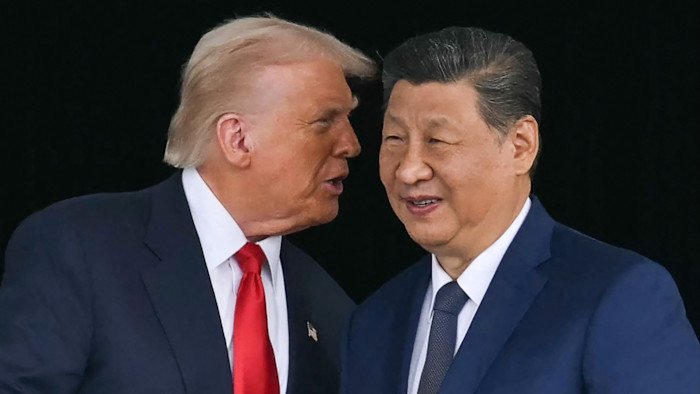
Unlock the White House Watch newsletter for free
Your guide to what Trump’s second term means for Washington, business and the world
Donald Trump said he had spoken to Xi Jinping about the Ukraine war, Taiwan and other issues, in a call that came two months before the Chinese leader is expected to welcome the US president on a state visit in Beijing.
“I have just completed an excellent telephone conversation with President Xi, of China,” Trump wrote on his Truth Social platform. The pair last spoke in November, shortly after they reached a trade truce at a summit in South Korea.
Trump said the leaders discussed many topics in a “long and thorough call” that included trade, possible Chinese purchases of US oil, gas and agricultural produce, the military and Iran. He said China had also agreed to buy more American soyabeans.
Trump said the pair had talked about his visit to China in April, which “I very much look forward to!”
“The relationship with China, and my personal relationship with President Xi, is an extremely good one, and we both realise how important it is to keep it that way,” Trump wrote. “There will be many positive results achieved over the next three years of my Presidency having to do with President Xi, and the People’s Republic of China!”
The call comes three months after Trump and Xi met in Busan, South Korea, and struck a trade truce that ended months of tit-for-tat tariffs and other measures, including Chinese export controls on rare earths.
China’s state-run Xinhua news agency said Xi told Trump they had “maintained good communication” since Busan and should continue to build trust so that 2026 would “be a year in which . . . China and the US move towards mutual respect, peaceful coexistence and win-win co-operation”.
Earlier, Chinese state media said Xi had also spoken to Russia’s President Vladimir Putin, telling him that “since the beginning of the year, the international situation has become increasingly turbulent”.
While Xi did not say which events he was referring to, the year kicked off with ruptures in the Nato alliance after Trump refused to rule out military action against Greenland, part of Denmark, a staunch US ally.
Xi said that China and Russia as “responsible major countries and permanent members of the UN Security Council” must promote “adherence to fairness and justice”. He also said the two needed to “firmly defend the achievements of the victory in World War II . . . and work together to safeguard global strategic stability”.
While Xi regularly hails Putin as a partner in maintaining international stability, he has never criticised Russia’s invasion of Ukraine.
In his conversation with Trump, Xi warned the US president over Washington’s arms sales to Taiwan, which he said was the “most important issue” in US-China relations.
The Trump administration in December approved an $11bn weapons package for Taiwan, infuriating Beijing, which claims the country as its territory.
“China . . . will never allow Taiwan to be separated from China. The US must handle arms sales to Taiwan with extreme caution,” Xi said.
After the Busan meeting, Trump told his cabinet not to take provocative actions that could derail the trade deal and jeopardise his trip to Beijing, which will be his first visit to China since 2019.
The US has since largely avoided anti-China actions with the exception of the arms package, which prompted the Chinese military to hold exercises around Taiwan.
According to Xinhua, Xi also noted that both countries would host summits this year — the Asia-Pacific Economic Cooperation forum in Shenzhen and the G20 in Miami — at which they are expected to meet. Trump has also invited Xi to Washington in a reciprocal visit following his trip to China.
In Busan, the two leaders agreed to a one-year trade truce. Beijing agreed to delay its sweeping export controls on rare earths and Washington said it would postpone placing thousands of Chinese companies on a trade blacklist.
Trump also reduced fentanyl-related tariffs from 20 to 10 per cent after Beijing pledged to stem the flow of ingredients used in the synthetic opioid that has triggered an overdose epidemic in the US.