dailynewsnblog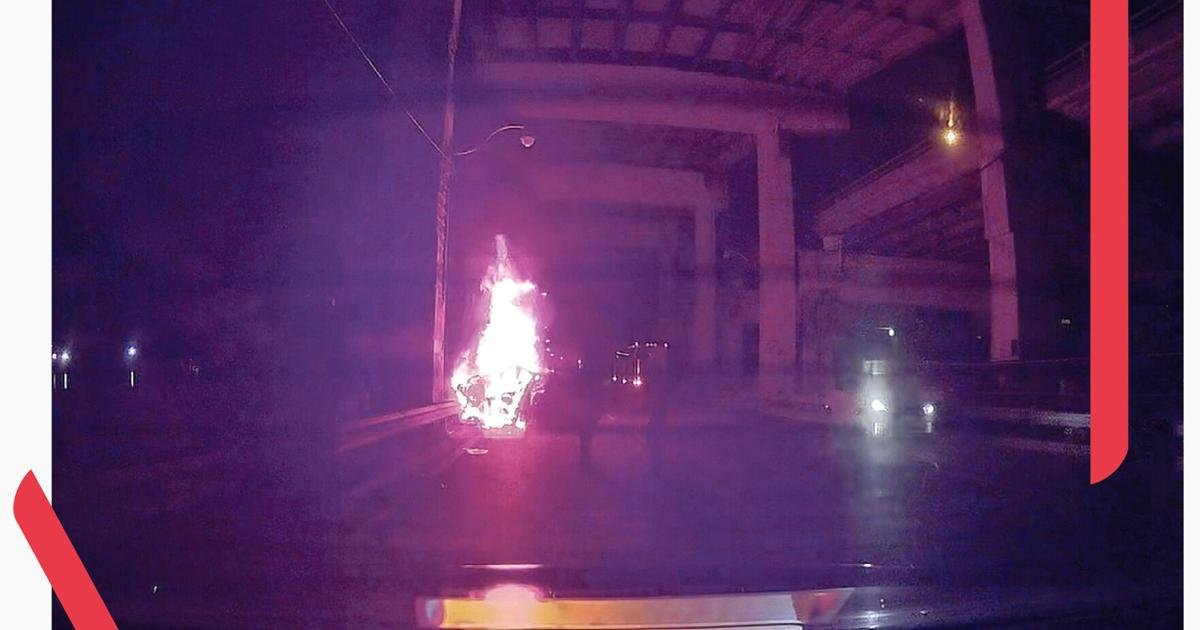
The traffic light at Cherry Street on Lake Shore Boulevard East turned green and Uber driver Sudhanshu Sudhanshu watched as a Tesla Model Y in the next lane accelerated rapidly away into the night.
Seconds later, he saw the Tesla hit uneven pavement. It bounced, lost control and slammed into one of the massive concrete pillars holding up the Gardiner Expressway, then burst into flames.
Sudhanshu stopped and jumped out to help. As the flames spread from the front end of the vehicle, he tried to open the Tesla’s doors, but they wouldn’t budge.
Returning to his car, he called out to his passenger in a panic: “They’re burning inside the car!”
Nearly a year and a half ago, four people died in one of Toronto’s most horrific crashes in recent memory. Soon, it became clear to all — from the people who stopped to the first responders, the news crews and professional investigators — that there was something different about this accident.
The Star has exclusively obtained a set of records that reveal both how the crash on Lake Shore unfolded in second-by-second detail, and why the investigation soon zeroed in on a Tesla’s electronic door handles that are being blamed for a growing number of fatalities in auto collisions across the continent.
The footage of the crash from Sudhanshu Sudhanshu’s Uber.
Teslas are considered some of the safest cars on the road, having earned a five-star safety rating from the U.S. National Highway Traffic Safety Administration (NHTSA) and top marks in crash tests by the Insurance Institute for Highway Safety. The EV manufacturer is held up by many in the emergency first responder community as a model company that takes safety seriously and works with firefighters and EMS to improve design to keep passengers and rescuers safe.
But evidence is emerging that a number of Tesla crashes have left occupants trapped in the vehicle because the electronic doors would not open, from inside or out.
The crash in Toronto on Oct. 24, 2024 appears to tell the same story.
The first seconds after the crash on Lake Shore
As flames rose from the front end of the crashed Tesla, Sudhanshu rushed back to his car to grab a shovel from his trunk. He tried to smash the Model Y’s window, but the shovel snapped.
“They’re in the car. The car is on fire,” his passenger told the 911 dispatcher. “They can’t get out. Send somebody now.”
“As soon as I broke the glass of the Tesla, I tried to open (the door) from inside,” he told the Star. “It didn’t work.”
“I just saw a hand, and I pulled a girl out,” he said.

The view from Sudhanshu Sudhanshu’s Uber, seconds after the crash.
Toronto Star Illustration. Source: Sudhanshu Sudhanshu
Sudhanshu walked the young woman a safe distance back to his car when she started yelling that there were other people inside. In video from one of the cameras on his Uber, she can be heard screaming their names as the car burns.
Meanwhile, Toronto fire Capt. Bernd Tragert was rushing to the scene. Fifteen minutes after the crash, the flames had grown so big, they were visible from 400 metres away.
“The fire rose approximately 5-10 meters above the vehicle and the passenger compartment was completely engulfed in flames,” he would later write in an incident report.
Three men and a woman, all in their 20s and 30s, were killed in the blaze; the woman Sudhanshu pulled from the wreck was taken to hospital with injuries that weren’t life-threatening.
The surviving victim and the families of those killed in the crash have not spoken publicly about the tragedy.
The collision caused the battery casing of the Tesla Model Y to rupture, according to a Transport Canada collision investigation obtained by the Star. The lithium-ion battery ignited, starting a chemical reaction known as thermal runaway.
This is a type of fire that cannot be put out, requiring no oxygen to burn. It spreads quickly, produces toxic gases that can explode, and can even continue to burn underwater.
Safe cars, dangerous doors?
Tesla is by far Canada’s top-selling EV brand, with more than 200,000 cars on the road. The Model Y has been the world’s best-selling car three years in a row, and there are now more than eight million Teslas worldwide. All Teslas share a common feature: electronic doors.
Instead of using a mechanical pull to open the doors, Teslas have a button or a handle that triggers an electric motor, which disengages the latch. The doors are not powered by the car’s main battery, relying instead on a second low-voltage battery. If that smaller battery fails, the doors will not open, noted Transport Canada in its collision investigation.
If Teslas lose power, passengers will have to use a manual release to open the doors, the owners’ manuals state. In most models, the manual release for the front doors is easily accessible — if you know where to look. The emergency latch is located on the armrest in front of the window controls. It is the same colour as the surrounding plastic trim and would be difficult to find if a passenger were unaware of its existence.
Tesla did not respond to questions about people who died after they were entrapped in their vehicles with inoperable doors.
In most Tesla models, the manual release for the front doors is easily accessible — if you know where to look. But the back doors are harder to open if the car loses power.
On its website, Tesla has an Emergency Response Guide for first responders that states: “Electrical and mechanical releases may be compromised after a collision … the doors and liftgate may not unlock from the outside.
“Extrication may be required.” (For first responders, extrication typically means using power tools to cut open a vehicle to pull out trapped occupants.)
Tesla’s electronic doors are not unique. Other manufacturers, including Audi, BMW, Chevrolet, Fiat, Ford, Genesis, Lexus, Lincoln, Maserati and Volvo, also have electronic door handles on some models, according to Consumer Reports.
Seventy-five firefighters were called to the scene in the early hours of Oct. 24, 2024.
It took them 45 minutes to extinguish the fire.
“Firefighter (David) MacIsaac thought there might still be occupants in the vehicle, but rescue was impossible due to the intensity and extent of the fire,” Tragert wrote. “Once the smoke and steam cleared, it was apparent that there were three, possibly four deceased occupants still in the vehicle.”
Of the four people who died in the crash, two were huddled together in the back seat, as if they were attempting to protect each other. The flames and heat were so intense that one of their legs was “held fast to the floor by melted and hardened material,” the incident report stated.
Firefighters had to use a Sawzall, a powerful reciprocating saw, to remove the doors and cut away the carbonized plastic and metal before their bodies could be recovered.
The investigation into the Lake Shore crash
Since 2018, Transport Canada has received at least 22 complaints from the public and first responders about issues involving Tesla doors that won’t open. Three of these complaints involved people trapped in vehicles on fire, leading to five deaths — including those in the Toronto crash. (Anyone can file a complaint with Transport Canada; the complaint about the Lake Shore crash appears to have been filed by Toronto Fire.)
Transport Canada did not respond to questions about these previous complaints and the new evidence uncovered south of the border by Bloomberg. The federal agency that oversees highway safety did not say whether it is investigating Tesla’s doors.
In September, Tesla’s chief engineer told Bloomberg that the company is working on a redesign of its door handles.
In its collision investigation into the Toronto crash, Transport Canada said the 2024 Tesla Model Y’s manual door releases were “unintuitive” and in a “concealed location.”
“Clearly, most people would not be aware of the location of the emergency release,” states the investigation. “The interior door release mechanism should be readily accessible and simple to operate.”

The wreckage. Seen in photograph from the records of the Transport Canada investigation.
Toronto Star Illustration. Source: Transport Canada/Access to Information Act
“As the location of the manual release is concealed under the plastic mat, it would likely require previous knowledge of its location. In an emergency, locating and operating the manual door release would likely be difficult, especially for occupants unfamiliar with its location or design, and particularly in the presence of panic, disorientation, or poor visibility.”
George Iny, director of the Automobile Protection Association, went further, saying: “Forget about unintuitive. It’s invisible.”
“The Tesla (manual release) is a joke. You’ll never know where it is. You’d never know how to get to it. It’s different from the front seat to the back seat. It is different for different models,” he said. “In a panic, you’re not going to find a mystery cable hiding behind a plastic door.”
More than a decade ago, Tesla CEO Elon Musk acknowledged that doors were failing without power.
“We’ve got quite a fancy door handle, and occasionally the sensor would malfunction,” he said on a May 2013 earnings call. “So you’d pull on the door handle, and it wouldn’t open. Obviously, it’s quite vexing for a customer.”
But, Bloomberg reported, Musk then suggested the issue had been addressed.
“Essentially, the door handle incidents have gone virtually to zero.”
Investigators combed through burned wreckage
As the sun rose over Toronto on Oct 24, 2024, a news helicopter captured footage of the burned and twisted wreck of a Tesla being loaded onto a flatbed truck beneath the Gardiner Expressway.
A large battery pack had been ejected from the EV and sat on the embankment of the Don River. Dozens of smaller battery cells were scattered on the pavement. Firefighters wearing full hazmat suits gathered them up and buried them under a foot of sand in a dumpster in case they spontaneously flared up — something Deputy Fire Chief Jim Jessop said has happened weeks after a collision.
Later that day, the Indian consulate in Toronto acknowledged the deaths of the four Indian nationals.
Indian media reported they were a brother and sister and two men, all with family in Gujarat; they had gone to a birthday party together, and were returning home.
While speed appears to have been a factor, the Toronto police conclusion on what directly caused the crash is fully redacted from the Transport Canada report — meaning it’s not clear whether a medical issue or intoxication played a role.
Transport Canada investigators concluded that it was unlikely that Tesla’s autopilot — called “full self-driving mode” — was activated, and instead zeroed in on what happened after the crash.
“A significant factor in this collision was occupant entrapment and the inoperability of the doors,” they wrote, adding the laminated glass used by Tesla is harder to break than standard auto glass and could have affected “egress after (the) crash.”
Three months after the accident, investigators from Toronto Police, Transport Canada and an insurance company met at a secure police facility on Jane Street, where the wreck of the Tesla had been towed after the accident.
“The windshield had been consumed, and the dashboard was melted,” they noted. “Burn damage extended through the interior to the rear seats.”

The wreckage of the Tesla Model Y, seen by a reporter the next morning.
Toronto Star Illustration, Star file photo
The people who died inside the Tesla all had their seatbelts fastened, and investigators were unable to determine if they were conscious after the collision or whether they made any attempt to escape. But they did note that the exterior latches were tried repeatedly.
“Witnesses that arrived on-scene were unable to open any of the doors, possibly due to the electronic door latches, which were no longer functional. While the impact damage was very severe on the left side, it is likely that the rear door on the right side could have been opened if first responders were able to release the door latch.”
“While it is impossible to know how events might have unfolded had the doors been operable from the exterior, the need to break the windows delayed access and reduced the critical time available for rescue. If the doors could have been opened from the exterior, less time would have been spent attempting to force entry, potentially improving the chances of survival for the rear occupants.”
Ultimately, because investigators could not tell whether the doors were left inoperable due to damage from the accident, it’s “not likely” they could be considered a defect by the Motor Vehicle Safety Act.
Transport Canada has nonetheless recommended opening a special investigation file to explore the egress and electric door entrapment issues, adding that “police really want to see some action related to the door latch.”
The incidents in the U.S. show the Lake Shore crash is not just a “one-off,” said Randy Schmitz, a captain with the Calgary Fire Department who runs training workshops for first responders on extracting people from EVs after collisions.
The solution is to return to a door that operates as people would expect, with or without power, he said.
“When you’ve been in an accident, your mind is in panic mode, so you’re scrambling to try and find your way out. You’re going to default always to what you’ve known your whole life on opening your door handle,” he said, noting that other companies use electronic door handles similar to Teslas that also incorporate a mechanical backup if power fails.
In other words, the door will open if you just pull on the latch harder.
Last month, China banned electronic door handles for safety reasons, requiring all cars to have handles that operate mechanically both inside and out starting in 2027.
‘I tried to save more people’
For months after the accident, Uber driver Sudhanshu would pass the crash site on his daily commute and would relive those panicked moments all over again.
“As soon as I pass that road, it kind of flashes in my mind what happened over there,” he said.
Speaking with the Star more than a year afterward, Sudhanshu said he was traumatized by what he saw. At a certain point, he couldn’t take it anymore and moved with his girlfriend to Winnipeg. But even there, thousands of kilometres away, the crash, the fire and the screaming woman still haunt him.
“I’m feeling lucky that I was able to save one girl at least,” he said. “I tried to save more people. Me and other people were there, but we were not able to save other people because the doors wouldn’t open.”