dailynewsnblog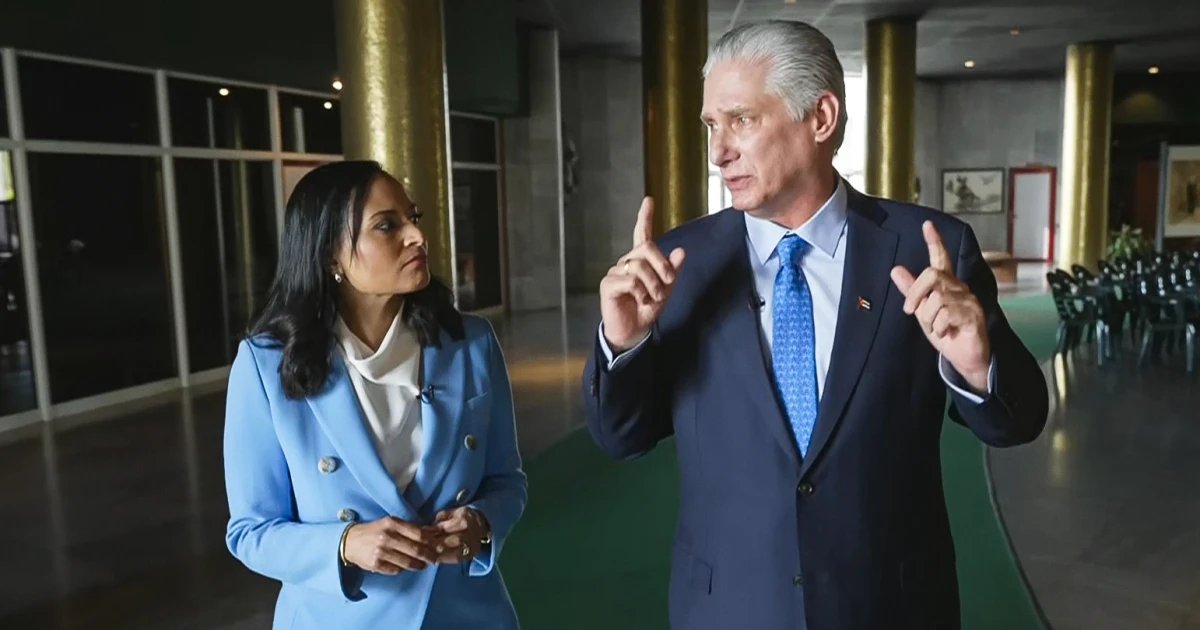
Cuba’s President Miguel Díaz-Canel insisted that he’s not “stepping down” in an interview with NBC News’ “Meet the Press” moderator Kristen Welker in Havana on Thursday.
Subscribe to read this story ad-free
Get unlimited access to ad-free articles and exclusive content.

The Cuban president bristled when Welker asked if he would be “willing to step down to save your country” during his first interview with a U.S. broadcast network.
“In Cuba, the people who are in leadership positions are not elected by the U.S. government, and they don’t have a mandate from the U.S. government. We have a free sovereign state, a free state. We have self-determination and independence, and we are not subjected to the designs of the United States,” Díaz-Canel said.
“Stepping down is not part of our vocabulary,” Díaz-Canel said.
Watch “Meet the Press NOW” Thursday at 4 p.m. ET on NBC News for this interview, and “Meet the Press” on Sunday for the extended exclusive interview and meetthepress.com for the full interview.
The Cuban president’s response comes as the Trump administration has been ratcheting up pressure on the communist country and calling for a change in its government, with President Donald Trump calling Cuba a “failing nation” and saying last month, it may be “a friendly takeover, it may not be a friendly takeover.”
Last month, Secretary of State Marco Rubio called Cuba a “disaster,” saying it’s because their “economic system doesn’t work.”
“Cubans can only be successful if they leave the country,” said Rubio, whose parents left Cuba in the 1950s, a few years before Fidel Castro’s communist takeover.
“That has to change, and for that to change, you have to change the people in charge,” Rubio said, adding that this required changing the country’s economic model.
Díaz-Canel took issue with being asked if he would step down, asking, “Do you ask that question to Trump?“ and whether the question was “coming from the State Department of the U.S.?”

Díaz-Canel insisted the country’s leaders “are elected by the people, although there’s a narrative trying to disregard that. Any one of us, before we become part of a leadership role, we need to be elected at the grassroot level in our electoral district by thousands of Cubans.”
Cuba’s communist government, however, is a one-party system that does not allow for an opposition party. Candidates to the country’s National Assembly are chosen in local elections, but critics point out that there is no credible opposition, little transparency and all candidates have to belong to the Communist Party.
For the past couple of months, Cuba’s government has carried out a media campaign, granting several news outlets, including NBC News, interviews with various government officials and addressing the mounting pressure from the U.S. amid a near economic collapse.
Cuban officials have denounced the Trump administration’s actions, which cut the flow of Venezuelan oil shipments to the country after the capture of Venezuelan President Nicolás Maduro. The U.S. also threatened tariffs against any country selling or supplying oil to Cuba. Oil reserves dwindled and created even more fuel shortages, resulting in more power outages across the whole country.

The conditions have further strained an island nation that for years has endured an economic crisis, rolling blackouts and shortages of food and medicine.
Trump recently said he had “no problem“ with the arrival of a Russian tanker with crude oil, saying he didn’t think it would help prop up the Cuban government. It was the first tanker to dock in three months. Russia said it is preparing a second oil shipment to the island.
But that wasn’t enough as the Cuban government and residents decry the current oil shortage and lack of other basic necessities, which Díaz-Canel and other officials have blamed on the more than 50-year-old U.S. economic embargo.
The Trump administration has pushed back on Cuba’s previous statements. Rubio said on March 27 that there “is no naval blockade around Cuba” and the reason Cuba doesn’t have any fuel “is because it wants it for free and people don’t give away oil and fuel for free unless it was the Soviet Union subsidizing them or Maduro subsidizing them.”
Díaz-Canel blamed U.S. policies for the current state of the countries’ relationship.
“I think the most important thing would be for them to understand and take this critical position, a sincere position, and recognize how much it has cost the Cuban people — and how much they have deprived the American people from a normal relationship with the Cuban people.”
Trump said Rubio has been in talks with Cuba, and Cuban officials have acknowledged talks without either government going into details.
Cuba’s Deputy Foreign Minister Josefina Vidal told Agence France-Press this week that talks between Cuba and the United States on de-escalating tensions are still at a “very preliminary” stage.