dailynewsnblog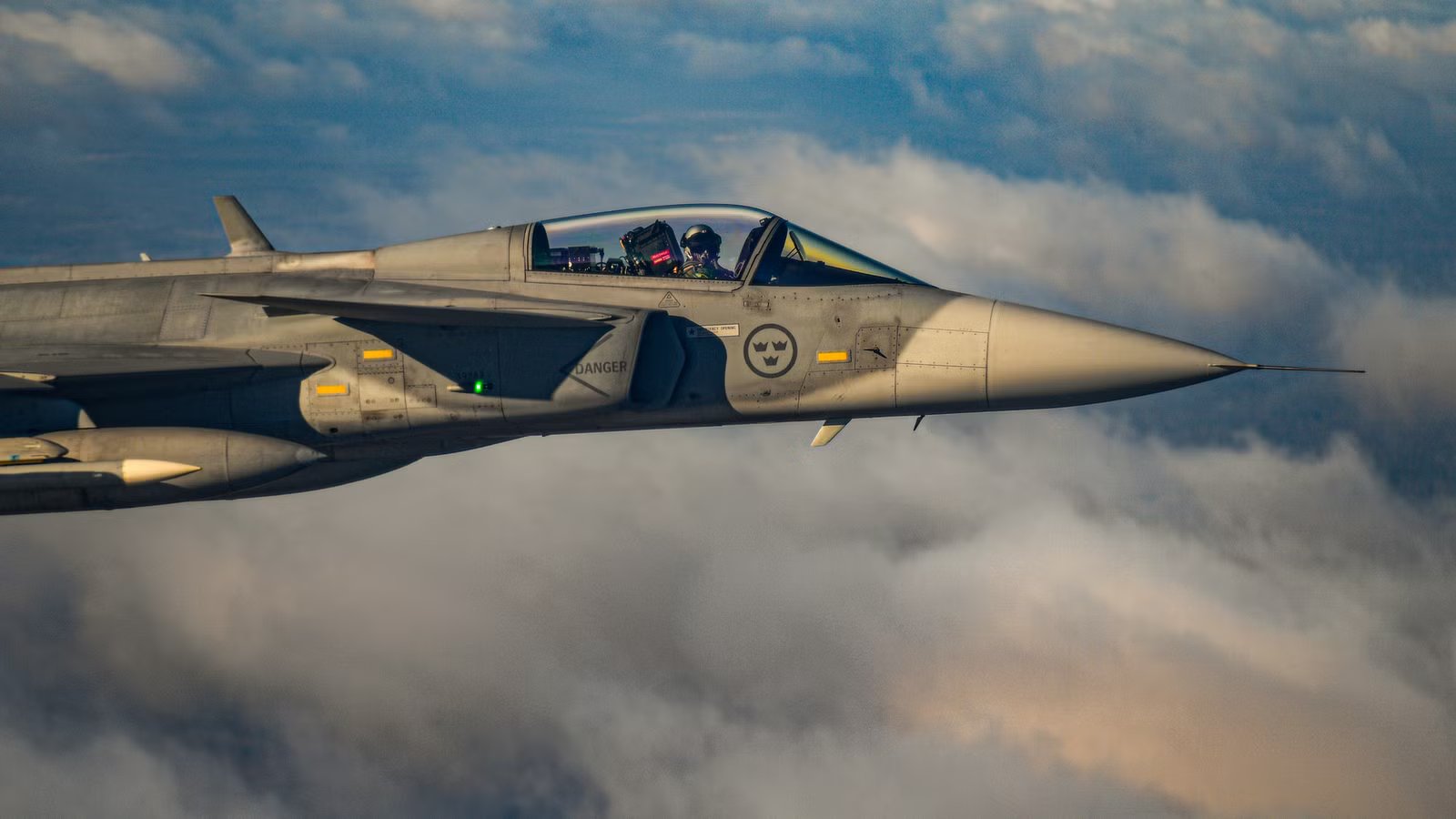
There are cold winds blowing from the Great North of Canada that threaten to freeze the Royal Canadian Air Force’s (RCAF) F-35 program in its tracks. The government of Canada has already committed to a small batch of its total order for 88 of the American fifth-generation stealth fighters. Rapidly growing political tensions, as well as disagreements over economic sharing, have opened an opportunity for the Saab JAS 39 Gripen E to rise as a contender.
Despite the fact that the Lockheed Martin F-35 Lightning II vastly outclasses the Saab light fighter in terms of technology and performance on the battlefield, the steadily growing rift between the world’s closest allies, driven apart by President Donald Trump, threatens the RCAF’s future F-35 fleet. Although the American stealth fighter is a powerhouse of weapons technology, the smaller, lighter, simpler, and more ruggedized Saab offers its own qualities, not the least of which is a renewed domestic defense industrial aerospace sector for Canada.
The Question Of Canadian Sovereignty

The Gripen offers Canada full sovereign control over mission data and software. Relying on the F-35 means relying on ALIS/ODIN, a cloud-based logistics system hosted on US servers. If the US decides to ‘lock out’ Canada during a trade dispute, Canada’s entire air force could be grounded. Relying 100% on the American defense industrial base makes Canada a ‘vassal’ to US domestic politics.
The Trump administration’s threats to annex territory or impose 25% tariffs on Canadian aerospace components have changed the math. The Saab deal includes a Canadian Production Centre. This allows Canada to re-learn how to build entire fighter jets, a skill lost since the Avro Arrow. Choosing the Saab Gripen for the immediate future and joining the Global Combat Air Programme (GCAP) for the long term represents a fundamental shift from integration to autonomy.
By partnering with the UK and Japan, Canada aligns itself with other international powers that share its concerns about the threat of American isolationism. Joining GCAP as a Tier 1 partner would give Canadian firms a seat at the design table for 6th-generation technologies. This ensures that the IP stays in Canada, preventing the ‘brain drain’ of engineers to the US that suffered when the Arrow was axed.
The American Hangar Queen

One of the primary grievances that the different service branches of the US Armed Forces had with the introduction of the F-35, all three variants, was the vast investment required in infrastructure for the complex and highly classified fighter jet. Despite the fact that the program is meant to simplify the logistical supply chain for the US and its allies by sharing a single platform across many Armed Forces, its incredibly sensitive technology and high maintenance requirements are also a significant burden both financially and logistically.
Having originated in Sweden, the Gripen is purpose-built for harsh northern climates. It can be refueled and rearmed in roughly 15 minutes by a small crew with a limited logistical footprint. The Gripen was engineered for austere environments. It can take off and land on regular highways, frozen lakes, or short, improvised runways of less than 2,000 feet. In contrast, the F-35A requires 8,000-foot runways and secure hangars for maintenance.
The Saab Gripen E offers distinct advantages in deployment and maintenance, particularly when operating in the harsh, remote environments characteristic of the Canadian Arctic. The Gripen is designed to operate from short, unpaved runways, frozen lakes, or even 800-meter stretches of public highway. The Gripen fleet generally maintains an availability rate between 70% and 80%. The F-35A has historically struggled with lower availability, often cited between 35% and 55%.
Made For The Fight

The Gripen features an ‘IKEA manual’ approach to maintenance, utilizing modular components for rapid engine or weapon swaps in the field. It does not require the specialized, climate-controlled hangars needed to maintain the F-35’s sensitive stealth coatings. A single qualified technician and a few non-specialized ground crew can fully service a Gripen. The F-35A typically requires a larger, highly specialized ground crew for maintenance. The Gripen E can be refueled and rearmed in roughly 15 minutes.
Because it requires less specialized equipment and fewer people, the Gripen can be deployed to remote Forward Operating Locations (FOLs) with much less support than the F-35A, which depends on a heavy, centralized logistics network. Having been developed in Sweden, the Gripen is natively optimized for Arctic-like conditions, including operations in sub-zero temperatures and high-latitude environments.
The Gripen’s software can be updated rapidly and independently without affecting flight-critical systems. This allows for continuous technology upgrades in the field, whereas the F-35’s monolithic software often requires lengthy recertification cycles. This is an important factor overall because one of the primary concerns for the long-term viability of the RCAF F-35 fleet is the American chokehold on the software for its incredibly complex electronics.

Disaster? Why The F-35 Program Is Under Fire Again
A storm of controversy surrounds the F-35 program, but what’s really behind the criticism?
Head-To-Head

In direct combat performance, the F-35A Lightning II and Saab JAS 39 Gripen E represent a clash between fifth-generation stealth-first design and 4.5-Gen electronic warfare (EW) system focus. The F-35A significantly outperformed the Gripen E in the RCAF evaluation, scoring 95% (57.1/60 points) versus the Gripen’s 33% (19.8/60 points) in operational capability, according to AeroTime.
The Gripen relies on the Arexis EW suite to jam and deceive enemy sensors rather than physical stealth. A notable strength of the Saab is that it is actually a more maneuverable aircraft than a dogfight. The Swedish fighter has a superior thrust-to-weight ratio, which gives it better acceleration as well as a higher top speed and makes it a superior interceptor from a perspective of pure performance.

The World’s Largest Air Forces By F-35 Numbers
How the top F-35 flyers compare.
No Escape From The Gripen

An important point of technical comparison between these two aircraft is their armament. The No Escape Zone (NEZ) is the distance at which a target cannot kinetically out-maneuver a missile. Because it can save fuel and re-accelerate during its final approach, its NEZ of the Meteor is reportedly three times larger than that of the AIM-120D. It maintains high maneuverability even at the edge of its ~200 km range.
Unlike standard rockets, the Meteor uses a solid-fueled ramjet. It acts more like a ‘cruise missile,’ using atmospheric oxygen to burn fuel longer and at controlled rates. This allows the missile to throttle its engine based on the target’s distance and maneuvers. The AMRAAM uses a traditional ‘boost and glide’ method. It burns its fuel in a short, intense burst for roughly ten seconds to reach top speed and then coasts toward its target.
While the ‘D’ variant has improved range, which is estimated at 160+ kilometers through GPS-aided navigation and trajectory shaping, its ability to chase a maneuvering target drops significantly beyond 50 km as it loses its initial ‘boost’ energy. As it maneuvers at high altitudes, it rapidly bleeds kinetic energy.
As of early 2026, the Meteor is not yet operational on the F-35. While ground integration tests for the F-35A were completed successfully in December 2025, full operational capability as part of the Block 4 upgrade has been delayed until the early 2030s. This means Canada would rely solely on the AIM-120D for its F-35s for the first decade of service, whereas the Saab Gripen can deploy the Meteor immediately.

What Countries Operate SAAB JAS 39 Gripen Fighter Jets?
The SAAB JAS 39 Gripen, a versatile, multi-role fighter jet, is a highly admired piece of military technology in the world of aviation.
Resurrecting Canada’s Defense Aerospace

The F-35 program was expected to provide a long-term underpinning for Canada’s aerospace industry, which is the world’s fifth-largest. Canada’s initial 2022 plan was to acquire 88 F-35 fighter planes for 19 billion Canadian dollars. However, the changing political climate has forced a major re-evaluation. To date, the Canadian F-35 program has also exceeded its original budget by $8 billion, according to The Independent.
On February 1, 2025, the Trump administration launched a trade war, imposing almost universal tariffs on Canadian and Mexican imports. In early 2026, Trump threatened to ‘decertify’ any Canadian-made aircraft, including Bombardier business jets, as reprisal for Canada’s failure to certify specified Gulfstream models.
According to reports, Canada has started paying for long-lead components for 14 more F-35s than the initial 16 in order to keep its place in the manufacturing sequence, even though the deal has been officially reviewed. Canada’s aerospace sector is diverse enough that losing F-35 contracts, while painful, would not destroy the industry. The capacity to pivot toward civil aviation, drones, and European defense contracts is a viable ‘Plan B.’
Canada is more than just a customer for the American defense industrial complex; it is an aerospace superpower in its own right, with a history that rivals any other great power. According to 19fortyfive, Sweden has suggested constructing these jets in Canada, which might result in the creation of 12,600 jobs domestically. Saab suggests constructing a domestic production line in Canada, in contrast to the F-35, which is put together in Texas. In Ontario and Quebec, regional sustainment and upgrading hubs will be established as part of this.
Despite the incredible technological superiority of the F-35 over the Saab Gripen E, the Canadian government is seriously considering reinvesting in domestic aerospace and defense, given the instability of the American supply chain under the administration of Donald Trump. Canada once built the most advanced interceptor in the world, the CF-105 Arrow. Its controversial cancellation in 1959 remains a bitterly contested point of national pride to this day.