dailynewsnblog
Early on, Stevenson was mostly aided by his mother, though she eventually needed to return to work. His grandmother then stepped in to help — and that’s when his perspective started to change. She stayed with him for a few months and the two would play cards and go on short walks together around the neighborhood.
“Those things brought me so much joy when I was in my darkest times,” Stevenson said. “I realized you don’t need a lot to be happy.”
After five months of rehab, feeling better both physically and mentally, he put skis back on for the first time. Even though he was supposed to take it easy, he did a double cork 1080, which involves two full flips and a spin, “to prove to myself that it was going to be all good.”
Even at his lowest, Stevenson said, he never gave up the dream of being a competitive skier. That was most evident at a FIS World Cup slopestyle event in the Italian Alps in 2017. All the anxiety he previously experienced in competitions went out the door. He was back living life.
With his father looking on, he dominated his run and took first place.
“We couldn’t really believe it,” Stevenson said. “It was totally out of a fairy tale.”
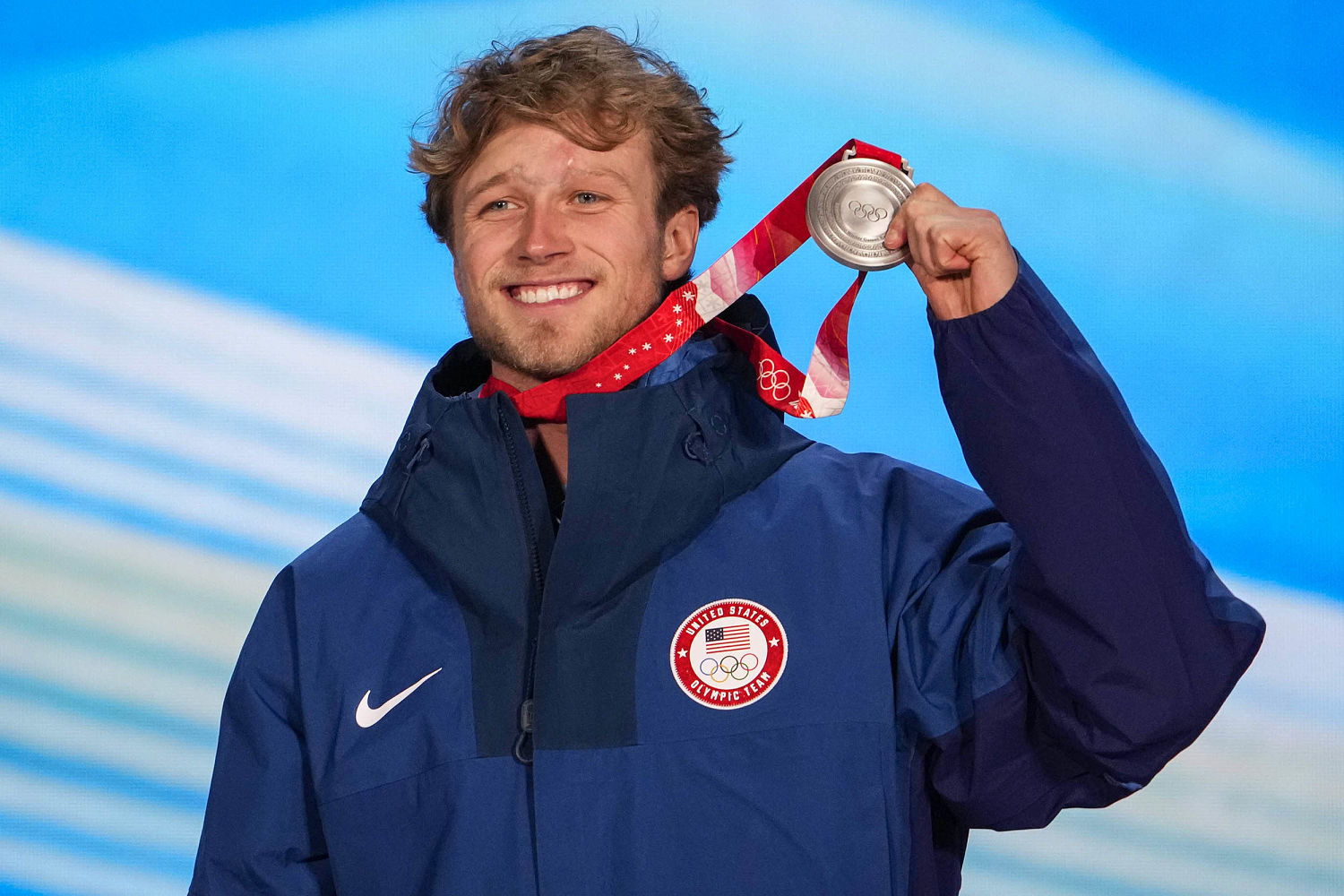
Stevenson began looking back on his accident as a positive and it showed in his skiing. In 2022, he made the U.S. Olympic team in Beijing. Though he finished in seventh place in slopestyle, his main event, he surprised everyone in Big Air.
On the bus to the finals, Stevenson had a set plan of what trick he wanted to do. Then “Fly Like An Eagle” by Steve Miller Band shuffled into his headphones. Stevenson took it as a sign to take a bigger risk, and pivoted to a trick he had never attempted in a competition: a “nose butter” triple cork, 1620 Japan grab.