dailynewsnblog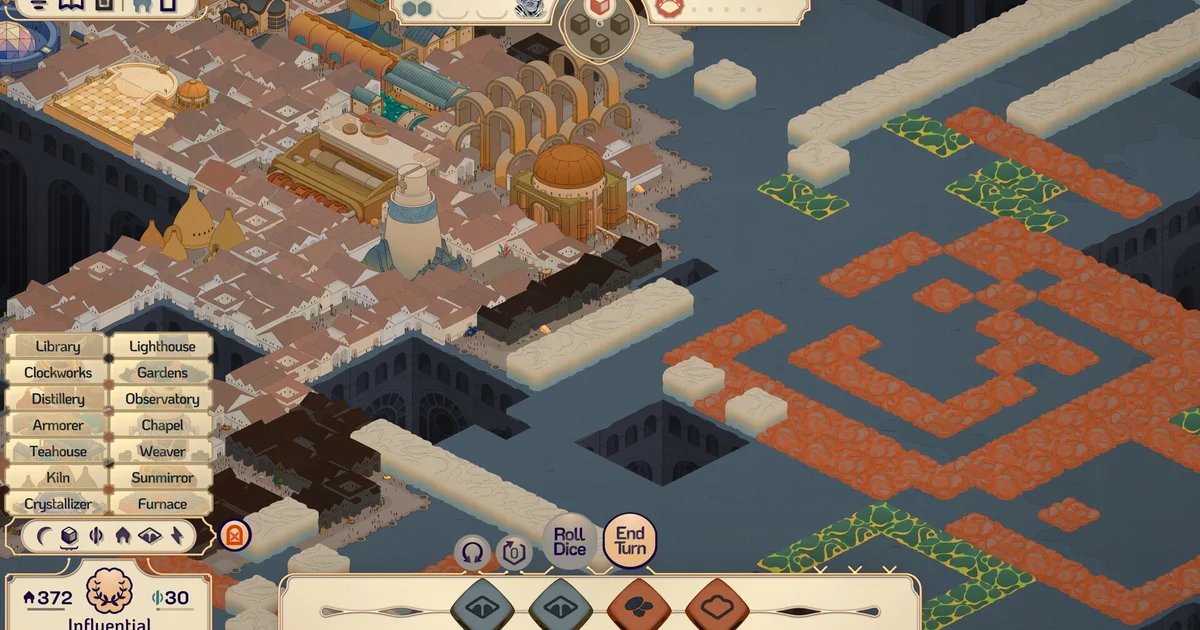
I am shocked to discover that this is the first time we’ve written about Amberspire, the new sci-fi city builder from Nic Tringali, developer of starfaring monastic strategy game The Banished Vault. Shocked, I tell you!
It’s set on a gas giant moon, looks a bit like isometric Sable, features dice with arcane symbols, and challenges you to “cohabit” with an ecology of ooze, silica and rust, rather than turning everything into a mall. It’s the kind of speculative fiction racket an eco-vibing hipster like myself goes crackers over, and here I am announcing Amberspire to you with the release barely a month away on 6th May. I can only hang my head in shame, and offer you this trailer.
Watch on YouTube
Perhaps the reason I haven’t written about Amberspire before is that I admired The Banished Vault more than I loved the game. It’s an exquisite strategy experience, but also a work of chilly arithmetic. “You’ll have an amazing time with it if you love numbers, stats and figuring out the most fuel efficient routes through its randomly generated cosmoses,” wrote Katharine (RPS in peace) back in 2023. “If you’re the kind of person who goes ‘YES MATE’ every time Star Trek breaks out its four-dimensional chess board, this is the game for you.”
Amberspire appears demanding – as one dev diary warns, “the game does not allow you to buy your way out of a situation, and the inertia of your past decisions is strongly felt”, but it’s also about growth and decay in a way that feels consoling. You will fail, but that’s fine, because your city’s misfortunes will produce a vast, beautiful marbling of crystal and gas.
The key difference with other city-builders at a glance is that buildings you construct don’t produce resources. They produce dice, which you roll to obtain resources. This appears to create a lot of uncertainty about your city’s gestation, which is matched by the ebb and flow of the moon’s ecology. “[V]iscous floodplains and rust blooms, dense fog and silica grass dominate the environment,” the Steam page comments. “They will impact your city’s growth and must be managed, but cohabitation is better than eradication.” Within the walls, you have to worry about factions and political incidents that “can dramatically affect your capabilities”.
The aforesaid dev diary digs into how the ecology works. The four terrain types above “are driven by weather dice, which cue the behaviors of the terrain tiles in the world by growing and spawning in specific patterns”. Tringali compares their operation to an L-system, a set of rules and symbols originally used by Swedish botanist Aristid Lindenmayer to model the development of simple multicellular organisms.
“The game has stored patterns for how each terrain moves, and patterns are applied over existing terrain, so a balance is struck between random growth in predictable patterns,” the developer goes on. “More exciting, when terrains touch one another, they ‘explode’ into large and unique patterns.” Yes, I am into it. Though I’m not sure my individual citizens will appreciate being treated like some algal art experiment. Anyway, if you enjoyed thinking about all this, you might also enjoy thinking about Civilization 7’s map generation.