dailynewsnblog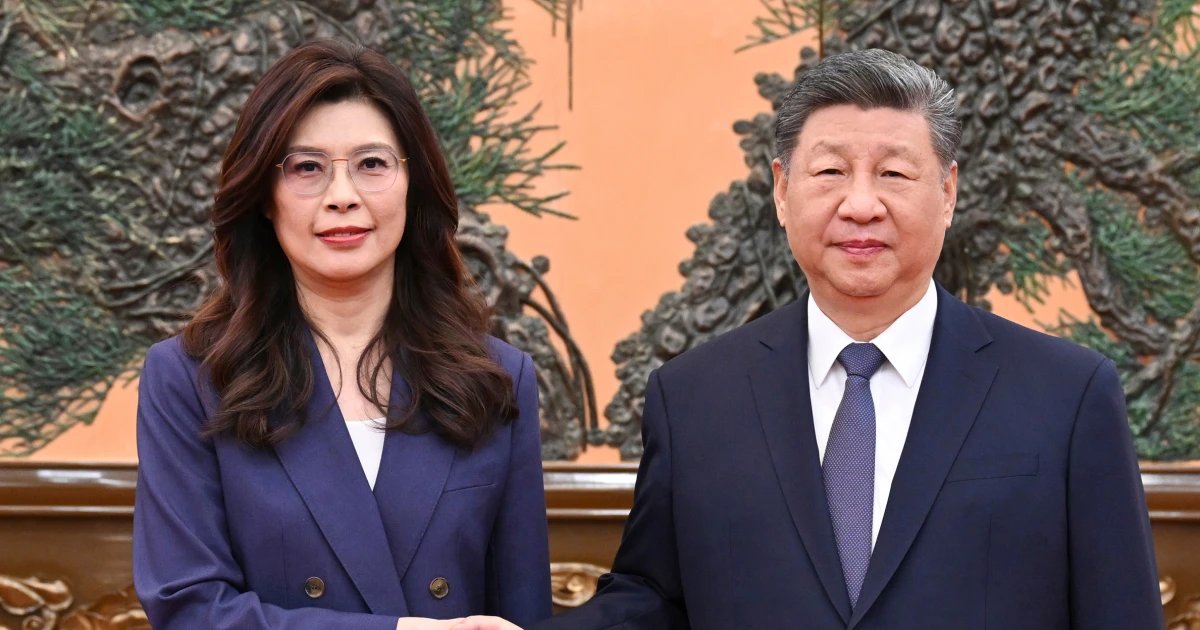
BEIJING – At an unusual meeting Friday, Chinese leader Xi Jinping talked with Taiwan’s main opposition leader about shared culture and bloodlines, before declaring that unification of the island with the mainland is a “historical inevitability.”
Subscribe to read this story ad-free
Get unlimited access to ad-free articles and exclusive content.

The meeting with Cheng Li-wun, chairwoman of the Nationalist Party, comes amid heightened tension in the Taiwan Strait over stepped-up military drills by China and Beijing’s disdain for American arms sales to the island.
While it did not produce a grand announcement, the timing of the meeting, just weeks before President Donald Trump is expected to visit Beijing, suggests that Xi is seeking to show that China can wield political influence in Taiwan as well as flex its might.

FORSUBSCRIBERS
Taiwan’s opposition leader making high-stakes visit to China
02:41
At a news conference Friday, Cheng neither fully embraced nor rejected China’s long-held goal of reunifying with Taiwan, a self-governed island of 23 million people, where fears of a future Chinese military incursion have been a specter haunting life for decades.
“We hope to consolidate a stable relationship,” Cheng told reporters. “This must be done step-by-step. General Secretary Xi and I are very pragmatic about this.”

Cheng’s pivot toward China has made her a divisive figure in Taiwan, where she was once a student activist pushing for the island’s independence. Back then, she was known for her criticism of the party she now leads, also known as the Kuomintang or KMT, because of its warm ties with Beijing.
The handshake with Xi in the ornate East Hall at the Great Hall of the People, a space normally used for meeting foreign heads of state, underscored the reversal in political beliefs for Cheng.
At a time when military support from the United States is in question, Cheng, 56, reiterated her view that Taiwan must forge a close friendship with Beijing if it wants to maintain peace and avoid a conflict.
“We must do everything in our power to prevent a war in the Taiwan Strait,” Cheng told NBC News in an interview last month in Taipei. “Instead of being a troublemaker, we need to be a peacemaker,” she said.
Opening her multiday visit to China on Tuesday, Cheng visited Nanjing, which was the capital of China when it was ruled by the Kuomintang. It was after their defeat by the Chinese Communist Party in 1949 that the KMT fled to Taiwan, which was never conquered by the Chinese Communist Party.
Xi’s outreach to Cheng came along with overt swipes at Taiwan’s current government under President Lai Ching-te, who is shunned by Beijing as a dangerous ‘separatist’ for rejecting China’s claim that Taiwan is its territory.

“’Taiwan independence’ is the chief culprit destroying peace in the Taiwan Strait,” said Xi, who was joined by key members of the Politburo Standing Committee, according to an official readout of his meeting with Cheng. “We absolutely will not tolerate it or allow it,” he added.
Not openly discussed at the meeting was a major flashpoint in China’s relations with the United States: arms sales.
In Taiwan, Cheng’s opposition to Lai’s proposed $40 billion increase in defense spending over the next eight years has stalled approval of the government’s budget. The delay could also jeopardize a $14 billion U.S. arms package that was already put on hold by the Trump administration to not irritate Xi before the May summit.
Asked by NBC News if U.S. arms sales to Taiwan came up in Cheng’s meeting with Xi, a KMT representative replied in a text message: “No.”