dailynewsnblog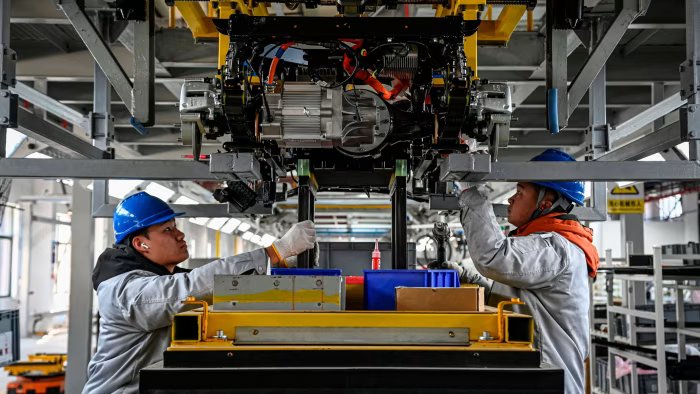
Stay informed with free updates
Simply sign up to the Chinese economy myFT Digest — delivered directly to your inbox.
China’s investment fell for the third straight month in November, official data showed, just days after President Xi Jinping called on officials to reverse a decline that threatens to undermine growth in the world’s second-largest economy.
Fixed asset investment for the year to date to November 30 declined 2.6 per cent on a year earlier, official data showed on Monday, a steeper fall than the 2.3 per cent decline forecast by a Bloomberg survey of analysts and October’s fall of 1.7 per cent.
The decline is expected to drive calls from China’s top leadership to “stabilise” investment in an economy that for decades has relied heavily on state financing for growth, particularly in infrastructure and property as well as high-end manufacturing.
Goldman Sachs analysts estimated that about 60 per cent of the recent falls in fixed asset investment up until October were due to statistical corrections of previously over-reported data.
But they said that 40 per cent of the decline could be attributed to a prolonged property market slowdown, infrastructure-related fiscal spending and Beijing’s “anti-involution” policies. These are measures by the top leadership to rein in sectors with severe price competition, which economists say is usually caused by overcapacity.

Since 2018, China’s statistics bureau from has discontinued sectoral breakdowns of fixed asset investment by value, leaving only growth rates across different sectors.
Last week, the central economic work conference, the Communist party’s top meeting on the economy presided over by Xi, said “China will work to stabilise and revive investment, [and] appropriately increase the scale of investment within the central government budget”.
Analysts believe this was the first official acknowledgment from the leadership of the investment slowdown.
Unlike other major economies, China does not publish full quarterly breakdowns of GDP under what is known as the expenditure approach, which include investment, consumption and net exports.
Instead, it publishes its own monthly data series, such as fixed asset investment and retail sales, which are closely watched in the absence of more detailed GDP data.
Chinese authorities have set a full-year growth target of about 5 per cent. In the third quarter, data showed the economy expanded 4.8 per cent, the slowest pace in a year. But economists still expect China to hit the 5 per cent target this year.