dailynewsnblog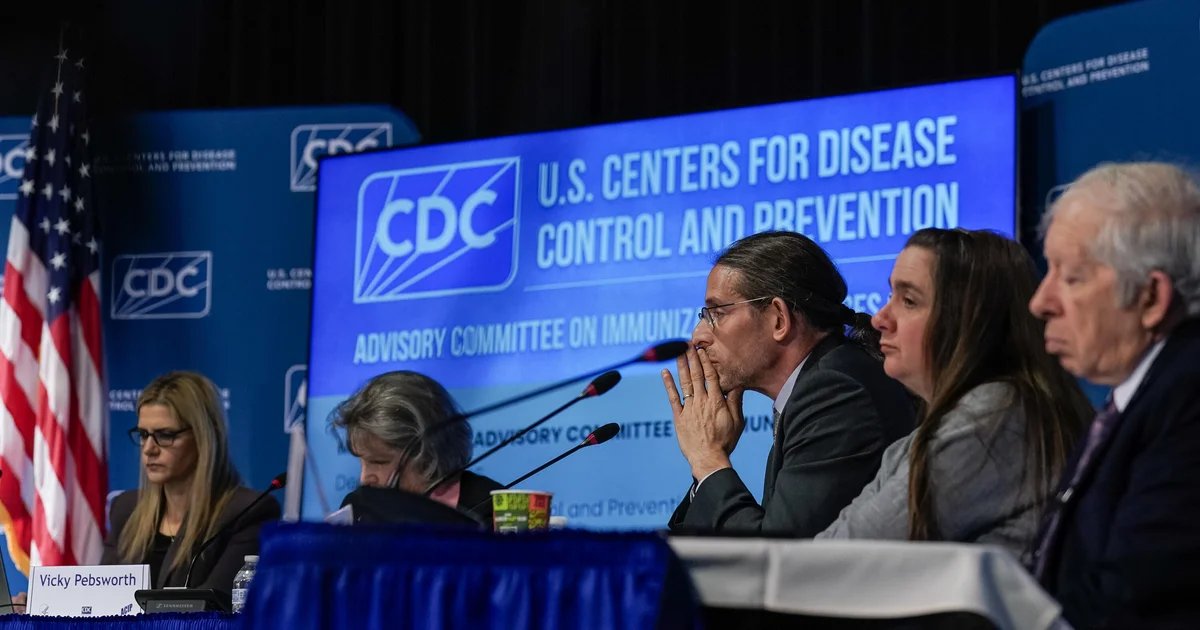
The Centers for Disease Control and Prevention’s vaccine advisory panel voted Friday to change the recommendation for when children should get their first dose of the hepatitis B vaccine. Instead of a first dose within 24 hours of birth — as the CDC has advised for more than 30 years — the panel voted to recommend delaying it until a child is 2 months old for children born to mothers who test negative for the virus.
The panel voted, in a 8-2 decision, to recommend individual decision-making in consultation with a health care provider to determine when or if to give the hepatitis B birth dose to a child whose mother tested negative for the virus.
Many medical experts and organizations including the American Academy of Pediatrics opposed such a change, saying it will leave young children at risk of an infection that can cause lifelong illness. They point to decades of research confirming the vaccine’s safety and effectiveness.
The decision came on the second day of the Advisory Committee on Immunization Practices’ December meeting, after confusion on Thursday led to the vote being delayed.
The panel — whose members were all appointed by Health and Human Services Secretary Robert F. Kennedy Jr. — began the day with a reading of the proposed voting language, followed by discussion from the panel members and other experts. Restef Levi, an ACIP member and mathematician who has no medical training, strongly argued against the universal birth dose, falsely claiming that experts had “never tested (the vaccines) appropriately.” Levi said he believed the committee should not recommend any timeline for the vaccine.
Dr. Cody Meissner, a pediatrics professor who previously served as a member of the Food and Drug Administration’s vaccines panel and an ACIP board member, and committee member Dr. Joseph Hibbeln continued to criticize the efforts to change the recommendations. Hibbeln said this was the fourth version of the language presented in 96 hours, and that “no rational science has been presented” to support changing the recommendations. Meisner emphasized that leaving the recommendation as-is would still allow parents to make their own choices about the vaccines their child receives.
“We’ve heard ‘do no harm’ as a moral imperative. We are doing harm by changing this wording,” Meissner said as he voted to oppose the change.
Elijah Nouvelage / Getty Images 
Hepatitis B is an incurable viral infection that can lead to liver disease, cancer and early death. The hepatitis B vaccine has been universally recommended for newborns in the U.S. since 1991. Over that time, research shows hepatitis B infections among infants and children have dropped 99%.
Recommendations from the advisory committee, known as ACIP, go to the CDC director for approval. Ultimately, decisions are left to the states, which tend to base their policies off the CDC’s guidelines but can choose to set their own. ACIP’s recommendations also carry weight with insurance companies: Most private insurers are required to cover the recommended vaccines. If the recommendation changes, what’s covered by insurance may also change.
Sen. Bill Cassidy, a Louisiana Republican who chairs the Senate Committee on Health, Education, Labor and Pensions, and who is also a physician whose medical practice focused on hepatitis B, called the change “a mistake” and urged acting CDC Director Jim O’Neill to reject ACIP’s vote.
“The hepatitis B vaccine is safe and effective. The birth dose is a recommendation, NOT a mandate,” Cassidy wrote on social media. “Before the birth dose was recommended, 20,000 newborns a year were infected with hepatitis B. Now, it’s fewer than 20. Ending the recommendation for newborns makes it more likely the number of cases will begin to increase again. This makes America sicker.”
In a recent interview on CBS News’ “Face the Nation with Margaret Brennan,” Cassidy said he was “very concerned” about the impact of such a change.
O’Neill said in a statement that he believed the public “benefited from the committee’s well-informed, rigorous discussion about the appropriateness of a vaccination in the first few hours of life.”
Elijah Nouvelage / Getty Images 
The birth dose of hepatitis B vaccine has become a target of vaccine critics, including Kennedy, who falsely claimed on a podcast in June that it was a “likely culprit” in autism.
The birth dose of the vaccine has a long track record, and multiple studies show the shot is not associated with any increased risk of infant death, fever or sepsis, multiple sclerosis or autoimmune conditions. Severe reactions to the vaccine are rare. Research also shows there is no evidence of any safety benefit in waiting until a child is older.
The panel also voted Friday in a 6-4 decision, with one abstention, to recommend parents consult with their doctors about whether to have their children tested to see if the first vaccine dose gave them a certain level of protection against hepatitis B. Typically, the vaccine is given as part of a three-dose series. Some panelists criticized the lack of data showing one dose was as effective as three doses and called the language of the recommendation confusing.
A contentious 2-day meeting
Following Friday’s vote on the hepatitis B vaccine, the panel planned to discuss childhood vaccination schedules and some vaccine ingredients, but there are no other votes scheduled, according to a public agenda.
The meeting began on Thursday morning, with the hepatitis B recommendation vote originally scheduled for that afternoon. Panel members presented information on the prevalence of acute and chronic hepatitis B, and discussed transmission and safety data.
Meissner sharply criticized the presentations, especially one that claimed there was little safety data for the hepatitis B birth dose.
Dr. Jason Goldman, liaison to the ACIP for the American College of Physicians, called the meeting “completely inappropriate” and accused the panel of “wasting taxpayer dollars by not having scientific, rigorous discussion on issues that truly matter.” Goldman also highlighted that the hepatitis B birth dose is not mandated and that parents are encouraged to make individual decisions in consultation with their doctor.
The vote was delayed until Friday after some members complained that the panel had seen multiple versions of the questions to vote on, and a technical issue prevented the most recent voting language from being displayed. There was uncertainty about how many questions members would be asked to vote on, and there were no hard copies of the language available. Committee member Dr. Joseph Hibbeln said the panel was being asked “to evaluate a moving target.”
Similar confusion pervaded ACIP’s September meeting, when members admitted they didn’t know what they were voting on, first rejecting a combined measles-mumps-rubella-chickenpox vaccine for young toddlers before voting to keep it funded minutes later. They reversed themselves on the funding the following day.
Why are newborns vaccinated for hepatitis B?
Newborns who become infected with hepatitis B from their mother at birth and infants who contract the virus within the first year of their life have a 90% chance of developing chronic hepatitis B, an illness that can cause life-threatening issues including cirrhosis, liver failure and liver cancer. About 25% of those patients end up dying prematurely as a result.
Previous research has shown that if the vaccine is only given to babies whose mothers tested positive, many cases get missed.
The CDC recommends that pregnant women get tested for hepatitis B, but about 16% of expecting mothers fall through the cracks, according to the agency.
“The birth dose has served as a critical safety net in the U.S. healthcare system — to protect against gaps in prenatal screening, missed HBV [hepatitis B virus] diagnoses, communication errors, and inconsistent follow-up,” according to the Vaccine Integrity Project of the University of Minnesota’s Center for Infectious Disease Research and Policy.
Many schools and child care facilities require a child be vaccinated for hepatitis B because it is contagious, spread through contact with blood or bodily fluids or via contaminated surfaces.
The American Academy of Pediatrics says the first dose of the vaccine given soon after birth provides crucial protection, and warned that delaying it would leave children vulnerable.
“The hepatitis B vaccine has … one of the most well established safety records of any vaccine,” Dr. Sean O’Leary, chair of the AAP’s Committee on Infectious Diseases and an assistant professor of pediatrics at the University of Colorado School of Medicine, told CBS News ahead of the meeting. “We’ve been using it for a long time. It’s one of our best tools to protect babies from chronic illness and liver cancer.”
He added, “This is a situation where one missed case is too many.”