dailynewsnblog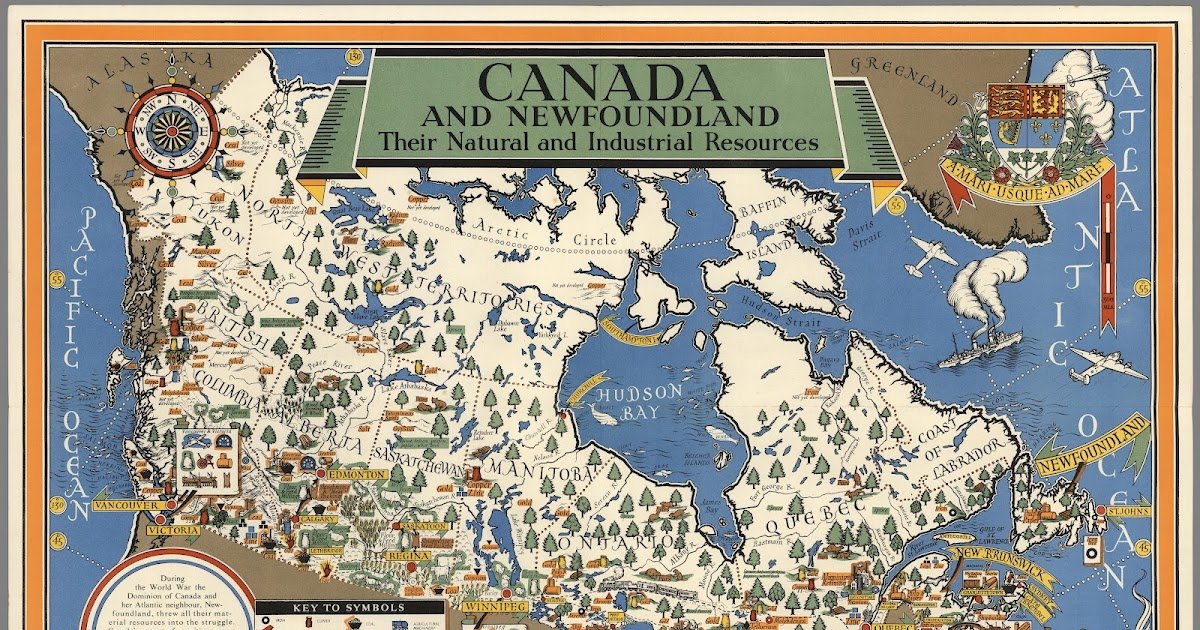

1942 map
I’m reading so much lately about how Canada and other countries are building military and economic capacity and resilience to withstand hegemon pressure, so I thought I would share a few of these tonight. And then I also found this map from eight decades ago – isn’t it fascinating to see what has changed and what hasn’t?
Last week, Carney and the Premiers met about what is next:
TLDW: This is the press conference where Kinew and Ford joked about their Heated Rivalry. Anyway, Carney also announced a “Team Canada” trade and investment office plus monthly progress meetings about the CUSMA review and the Port of Churchill plan..
Score one for the red and white.
www.theglobeandmail.com/politics/art…
[image or embed]
— Charlie Angus (@charlieangus104.bsky.social) January 28, 2026 at 1:50 PM
Looks like Japanese automakers are stepping quite easily into the breach. Looking forward to other car makers signing up to do business in a stable country
Report suggests Ottawa reward companies that have shown commitment to making cars in Canada
#cdn
www.cbc.ca/news/busines…[image or embed]
— TopKat_GlassDragon (@topkatglassdragon.bsky.social) February 2, 2026 at 8:37 PM
Mark Carney appears to have outmaneuvered Trump on many different fields at the same time.
[image or embed]
— Scott Horton (@robertscotthorton.bsky.social) February 2, 2026 at 5:06 PM
German submarine manufacturer TKMS has signed an agreement to team up with Seaspan Shipyards to support and maintain potential future patrol submarines supplied to Canada over the long term.
[image or embed]
— CHEK News (@cheknews.ca) January 29, 2026 at 11:51 AM
❗️🇰🇷South Korean company Hanwha will help 🇨🇦Canada build submarines
[image or embed]
— 🪖MilitaryNewsUA🇺🇦 (@militarynewsua.bsky.social) January 27, 2026 at 10:05 AM
#ElbowsUp
Exclusive: China buys more Canadian canola after Mark Carney visit. www.reuters.com/world/chines…
[image or embed]
— Canadians United Against Trump (@bestone.bsky.social) January 28, 2026 at 12:40 PM
Air Canada Expands Globally Except For 1 Country as Canada and Korea Strengthen Ties – YouTube www.youtube.com/watch?v=A6EN…
[image or embed]
— E. Grier (@cottonjenny.bsky.social) February 2, 2026 at 7:18 AM
The 100,000 club
www.cbc.ca/news/canada/…[image or embed]
— Andrew Kurjata (@akurjata.ca) February 2, 2026 at 9:44 AM
Here’s a thoughtful piece on Canada’s overall CUSMA negotiation strategy:
At Between the Lines Canada, Leni Spooner writes When Prudence Becomes Paralysis: Canada, Trade, and the Fear of Being Seen Canada is entering a harder phase — and silence won’t make it easier
…None of this is an argument for confrontation, nor for abandoning the United States as a trading partner. Geography alone ensures the U.S. will remain central to Canada’s economy for the foreseeable future. Nor does it diminish the importance of preparation, sequencing, or institutional capacity. Those remain essential.
But it does require honesty about the environment Canada is now operating in.
The belief that upcoming negotiations can be conducted in a purely collegial, rules-based, or expeditious manner no longer reflects reality. Under the current U.S. administration, pressure is not an occasional tactic; it is a governing approach. Leverage is applied publicly and privately. Ambiguity is cultivated. Escalation is not avoided — it is used.
In this context, Canada should expect pushback not only for missteps, but for visibility itself. Assertions of agency — in trade, regulation, or diplomatic speech — will be met with resistance. Sometimes sharply. Sometimes gradually. But consistently. This is not a temporary mood; it is a strategic posture.
Pretending otherwise does not reduce risk. It merely delays preparation.
Failure to engage judiciously and strategically with bullying tactics — or retreating from agency in the hope of preserving calm — carries its own costs. It may preserve access in the short term. But it does so by quietly trading away leverage, policy space— room to make domestic decisions without external veto, and resilience over time. Giving up the farm to sell the crop is rarely a winning bargain.
Prudence, in this moment, does not mean silence. It means readiness under pressure. It means building options before they are demanded. It means understanding that cooperation and firmness are not opposites, but complements.
Sovereignty does not require defiance. But it does require the willingness to stand — visibly, strategically, and without illusion — when pressure is applied. In a world where leverage is explicit and asymmetry is openly exercised, having options is not theatre. It is survival.
As we ride the waves of reaction to actions and signals from both Canada and the United States — and from the commentators who thrive on amplifying each moment — it is worth judging events with an eye to the long view. Not every headline matters equally. What matters is the larger picture of the outcomes Canada both needs and wants: economic resilience— the capacity to absorb shocks without long-term damage, policy space, and the capacity to act with intention rather than impulse.
We have little choice but to ride this storm. The question is how we do so.
The task ahead is not to retreat in the face of pressure, nor to lash out reactively in response to it, but to stay as clear-eyed as possible while navigating it. That is the work of a middle power: resisting both panic and withdrawal, avoiding performance in place of strategy, and holding steady to long-term goals even as the weather turns rough.
Clarity, preparation, and resolve are not luxuries in moments like this. They are how countries come through them intact.
A Threads thread on the CUSMA negotiation and the need for Canadian resilience:
Next, an interesting Wesley Wark piece on building Canada’s space program:
In The Walrus, Wesley Wark writes Canada Is Building a Surveillance Network in Space A reborn Cold War telescope is part of a broader effort to stop relying on US intelligence
…Sapphire, NEOSSat, Redwing, Son of Sapphire, Earthfence. What is all of this ultimately for? Why is it an important Canadian investment? The darkest reality is: for war fighting. Keeping a watch on space and any satellite threats is essential to preserve the military’s ability to communicate, navigate, collect intelligence, understand the weather, find targets for long-range precision strikes, and, if necessary, degrade an adversary’s space-based capabilities.
But there is a brighter side. SDA [“space domain awareness”] can assist in avoiding collisions with other man-made objects in space and help navigate out of harm’s way when confronted by space debris, of which there is an extraordinary amount. Some of that debris is sizable. The National Aeronautics and Space Administration estimates there are over 25,000 debris objects in space larger than ten centimetres. If you go smaller, down to one millimetre, then the number is, well, astronomical—in excess of 100 million. Even the smallest piece of debris, when hurtling at high speed in near-earth orbit, can cause damage in collisions.
There is also strategic doctrine attached to SDA. It can help avoid conflict escalation in space, acting as a deterrent to risk-taking by other space faring nations. Deterrence works, at least in theory, when your adversaries know you are watching and that you can call out bad behaviour or respond in kind. SDA can also be a tool of space diplomacy to try to preserve an open and free space environment for all, the supreme goal of the United Nations Outer Space Treaty, signed in 1967. It can maybe, in the long run, help establish internationally agreed-upon rules of the road for the use of space, something that is sorely deficient.
For a mid-size nation, Canada is set to become a major player in a new space race, combining military need, entrepreneurial science, industrial innovation, and commercial ambition. It’s not just about blasting innumerable payloads into space to service the world’s needs and keep a watch on our torn planet. It’s not just about going to the moon again or maybe even Mars. This is a race to know what is going on in the increasingly congested, contested, and competitive environment girding Earth….
And you wanna see resilience in action?
Look at Minnesota:
ICE watchers are getting 34,000 volunteers while ICE itself can’t find 15,000 thugs to boost their ranks.
[image or embed]
— Witty Librarian Resistance (@paulwartenberg.bsky.social) January 31, 2026 at 8:03 PM
Look at Denmark and Greenland:
MAGA believed that they had the power, the courts, the money, the media and they would crush democracy.
What they didn’t count on was the resistance of the people.
We are seeing impressive wins as ordinary people stand up against tyranny.
My latest:
www.youtube.com/watch?v=z3vB…[image or embed]
— Charlie Angus (@charlieangus104.bsky.social) February 2, 2026 at 8:42 PM
There was a time – relatively recently, too – when I would have been appalled at increases like this in defense spending. Now, not so much. Carney’s Davos speech convinced me that the “middle powers” have to be at the table too:
At The Concis, Shankar Narayan writes Three Economies, $252 Billion, One Clear Message to Washington A Quarter-Trillion Dollars Just Voted Against the United States
…The MAGA crowd wanted isolationism. They mocked globalization as if trading with another country were a health hazard. Now half the world is behaving as though continuing business as usual with the United States is the real risk.
Be careful what you wish for — sometimes it comes true. And here is the part that should really sting: the three nations I am talking about are the third, fourth, and fifth largest economies on the planet — Germany, India, and Japan.
India announced its 2026–27 fiscal budget today and made a record-breaking move, lifting defense spending to $86 billion — a 15 percent increase year-over-year. That $86 billion figure is no longer small. It now sits uncomfortably close to Germany’s decision to spend roughly $108 billion on defense next year.
Japan followed the same path, pushing defense spending to an all-time high of $58 billion for 2026.
…Each, for their own reasons, does not want to pump fresh cash into U.S. defense companies.
This morning we reported that German defense minister Boris Pistorius is now openly speaking in the language long used by the French president — sovereignty, independence, and strategic autonomy. Words matter, but budgets matter more. For 2026, Germany has set aside less than $7 billion out of a $108 billion defense budget for U.S. weapons. Add the statement to the allocation and the conclusion is unavoidable: Germany’s 2026 restriction on American weapons spending is not an anomaly. It is the beginning of a pattern.
Japan offers an even cleaner case. Just as Tokyo pushed defense spending to an all-time high, it publicly complained that despite paying in full, the United States has failed to deliver contracted weapons. There is no effective mechanism to force delivery once payment is made — and the delays are now impacting Japan’s operational readiness.
There is no need to overthink this. Japan is not going to add new strategic money to a queue it has already said is not moving. Yes, some cash will continue to flow to the United States through legacy sustainment, spare parts, maintenance, and upgrades tied to existing platforms — that dependency does not vanish overnight.
But that is not where the future is.
The growth capital — the money that determines who builds the next factories, writes the next standards, and anchors the next supply chains — is going to flow anywhere but the United States.
And then there is India. Let’s not pretend this is a two-way conversation. It is India deciding whether or not to buy American weapons — not the other way around. Given how this administration and its officials have treated India, most of that defense money is going to fly into Europe, and to a lesser extent Russia.
India still carries far too many Russian systems inside its military to sever ties overnight. With the United States effectively out of the picture and Europe positioned to capture the bulk of Indian defense spending, New Delhi is likely to balance European procurement with selective Russian orders. But this will not be the old hierarchy. The order book is changing. It is likely to become France first — Russia second — Germany third.
This is not incremental. This is historic. Russia is on track to be pushed into second place in India’s defense ecosystem for the first time in decades. Europe now has a narrow window to knock Moscow down to third in 2027. They still have a shot this year — but it will require real effort. We will see.
Whatever the final configuration, one thing is already clear: this is an absolute disaster for the United States. Its control over the global defense market is not slipping quietly.
It is melting in real time, right in front of everyone’s eyes….
And Canada is preparing too:
www.eurasiantimes.com/u-s-invasion…
[image or embed]
— Memento Mori (@mementomori4950.bsky.social) January 22, 2026 at 5:52 PM
Just about everyone I meet under 45 is planning on signing up for the Volunteer Army – when they open the signups, I expect the website will crash because millions of Canadians will want to join.
Nearly two weeks later, there’s an analysis piece in Politico Europe analyzing the speech. The NY Times Ezra Klein podcast has devoted its last two episodes to engaging with it. Forget Canadian speeches, are there any modern speeches, period, that have resulted in this sort of news cycle?
[image or embed]
— Andrew Kurjata (@akurjata.ca) February 3, 2026 at 12:53 AM