dailynewsnblog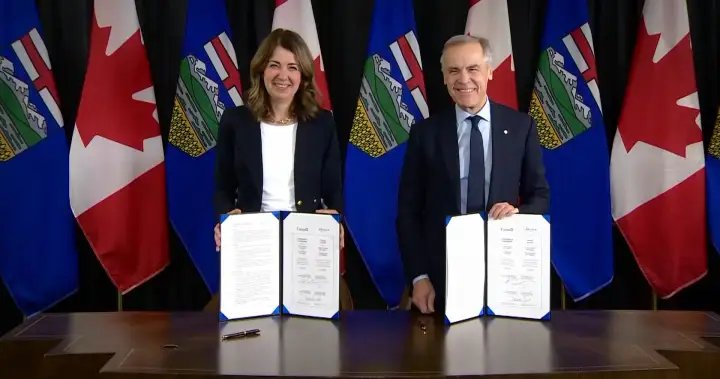
Prime Minister Mark Carney said Tuesday that there will likely be no deal between Alberta and Ottawa by Wednesday’s deadline on several outstanding climate change policies outlined in last year’s memorandum of understanding between the two levels of government.

The MOU, which was signed by Carney and Alberta Premier Danielle Smith on Nov. 27, set April 1 as the target date for Alberta to agree to a carbon price on emissions.
While the centrepiece of the MOU was an agreement to work towards the construction of a new pipeline to the B.C. coast, it also exempts Alberta from Canada’s Clean Electricity Regulations while the two governments work out a new industrial carbon pricing agreement that aims for Alberta to “achieve net-zero emissions by 2050.”
The new clean energy regulations, which are to come into effect in 2035, would set limits on emissions from power generation using fossil fuels, but Alberta has long criticized the regulations because the province’s electricity grid is predominantly powered by natural gas.
Speaking to the media at an appearance in Wakefield, Que. on Tuesday, Carney admitted it’s unlikely the negotiations will meet Wednesday’s deadline.
“Premier Smith and I had with colleagues a very constructive conversation yesterday afternoon, so we’re continuing to move forward. I’d note that we have made a series of progress. We’re continuing to move forward, so there’s a lot of momentum,” said Carney.
“But will we perfectly meet the first? Not necessarily, but are we making progress? We’ll get the right agreement at the right time.”
“It’s very complex, very important set of negotiations. Do I think we’re going to announce an agreement tomorrow? No, I don’t think we’re going to have an agreement tomorrow, but I feel very good about the progress and the state of the discussions,” added Carney.

Get weekly money news
Get expert insights, Q&A on markets, housing, inflation, and personal finance information delivered to you every Saturday.
Carney pointed to an agreement-in-principle between the two governments, announced on March 25, that would commit the province to reducing emissions of methane from the oil and gas section by 75 per cent from 2014 levels by 2035 as an example of the progress he said is being made.
The two governments have also signed an agreement-in-principle to streamline the environmental impact assessment process by creating a single process for major projects in Alberta, recognizing the province as best suited to lead the assessments for projects within its jurisdiction.
The aim of the new single-track process is to reduce duplication, save time and help approved projects move forward more quickly.
Speaking at an event in Edmonton on Tuesday, Smith appeared to share Carney’s optimism that a deal can be reached.
“We want to move quickly, we want to create the certainty so private capital can come into this market, and that doesn’t get helped with any further delays. So I think we all have a sense of urgency,” said Smith.
“I think that looking at where the world is right now, with Europe talking about suspending their industrial pricing, Americans not having it at all, industry telling us that there are more attractive environments to invest in because they don’t have carbon taxes, I mean, I think all of that has to be brought into context for this,” Smith added..
“So I don’t want to lock in on a certain date just yet. I’d rather the prime minister and I both announce what that date is when we agree on it.”

In addition to an agreement on carbon pricing, the provincial and federal governments are also working to finalize details of The Pathways Project, billed as the world’s largest carbon capture, utilization and storage project to be built in northern Alberta to reduce greenhouse gas emissions from the oilsands.
The project would capture CO2 from more than 20 oilsands sites and transport it through a 400-plus kilometre pipeline to underground storage facilities in the Cold Lake region.
But according to Smith, the absence of agreement on carbon pricing is also preventing the finalization of the agreement between industry (Oilsands Alliance) and the governments on the carbon capture project.
First Nations and local land owners are also calling for the project, which they describe as “massive and unprecedented,” to be reviewed under the federal Impact Assessment Act.
According to a new study released by the Pembina Institute, a non-profit industry think tank, there’s a lot riding on negotiations between the two governments to finalize the agreements outlined in the MOU.
“We did the number crunching and we found out there’s $40 billion worth of investments in low-carbon projects in Alberta that are at stake in this MOU,” said Jan Gorski, director of government relations for the Pembina Institute.
“The quicker that we can actually get these policies finalized, the faster we can provide certainty so that these projects can actually move forward.”

© 2026 Global News, a division of Corus Entertainment Inc.