dailynewsnblog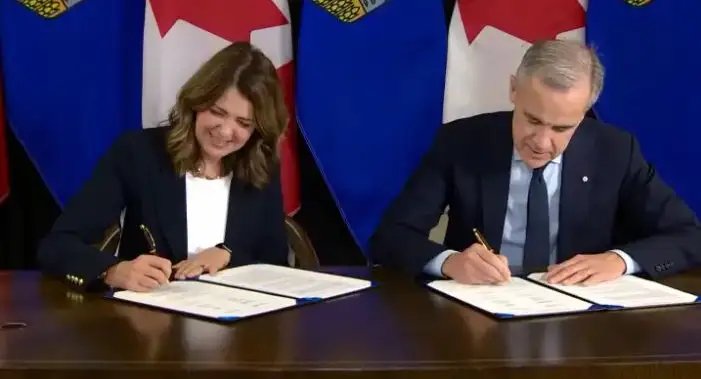
A key plank of Canadian Prime Minister Mark Carney’s climate plan will likely miss its target implementation date, industry sources said, raising new doubts about Canada meeting its environmental goals in the face of higher oil prices and uncertain U.S. trade policy.

Carney, a former U.N. climate envoy, committed last fall to negotiating a stronger industrial carbon pricing policy with Alberta by April 1.
He is counting on a strengthened pollution pricing scheme to keep Canada’s emission reduction targets on track after rolling back many of his predecessor Justin Trudeau’s climate policies to restore friendlier relations with the oil-and-gas producing province and prioritize economic growth.

Two industry sources familiar with the talks told Reuters these negotiations have been challenging, and that no deal will be struck by the April 1 deadline because large oil sands companies are pushing back on parts of the federal proposal.
Natural Resources Minister Tim Hodgson has acknowledged there may be a slight delay. “As we all know in doing deals, sometimes deals come right up to the deadline.
Sometimes they go a little bit over the deadline,” he told reporters.
One of the sources said even if a pricing agreement is reached later this spring, oil sands producers are now unlikely to commit to another key part of the agreement: building the entire high-profile C$16 billion ($11.47 billion) Pathways Plus carbon capture and storage project, though a smaller, scaled-down project is possible.
The Canadian government continues to work closely with Alberta and all relevant parties and will have more to share in due course, said Keean Nembhard, press secretary for Environment Minister Julie Dabrusin.

Get daily National news
Get daily Canada news delivered to your inbox so you’ll never miss the day’s top stories.
A spokesperson for Alberta Premier Danielle Smith declined to comment directly, pointing instead to a television interview earlier this month in which she said the discussions are “complicated,” but that all parties are committed to getting to an agreement soon.
POLITICAL, ECONOMIC CLIMATE SHIFTS
Oil companies hope to boost production and sell more oil and gas to Asia in the coming years to diversify away from the U.S.
Carney also wants to reduce economic dependence on the United States, which buys 90 per cent of Canada’s oil.
Now, the Iran war has bolstered global demand for Canadian oil and gas, and Canada agreed last week to support the International Energy Agency’s oil release with 23.6 million barrels from domestic producers.

A December report from the Canadian Climate Institute had already warned Canada is not on track to meet any of its climate targets, including its 2030 Paris Agreement commitment.
The benchmark Brent crude now trades near US$100 a barrel, about 65 per cent above its level at the start of the year.
While some Canadian oil sector leaders once spoke publicly in favour of industrial carbon pricing as a way to incentivize emissions reduction, their tone has shifted.
Oil sands companies investing in carbon capture and storage should not have to pay an industrial carbon price on top of the costs of constructing and operating the project, Canadian Natural Resources CEO Scott Stauth said in a March interview.
While Stauth said he had no reason to think the April 1 deadline on carbon pricing would be missed, he noted the negotiations are complex.
“It takes time to work through all the details to ensure that the needs of all of those involved are met and that it supports the vision that I think the prime minister has for growth in Canada,” he said.
HIGHER CARBON PRICE
Stauth’s comments followed an open letter released in January by the Canadian Association of Petroleum Producers lobby group, which argued that higher costs for carbon directly reduce Canada’s competitiveness, at a time when the U.S. has demonstrated a “willingness to leverage all tools at their disposal to achieve geopolitical and energy goals.”
Both Alberta and the federal government pledged last fall to work together on a new industrial carbon pricing policy, aiming to increase the effective price the province’s heavy emitters must pay on carbon from an existing C$95 a metric ton to C$130 a metric ton.
The date at which this will happen, and the price increases over time, were to be negotiated.
Alberta and the federal government also agreed to cooperate on building the Pathways Plus project, pitched by Canada’s five largest oil sands companies in 2021 to be the world’s biggest carbon capture project.
The Carney government has bundled that project together with Alberta’s vision of a new pipeline to export its oil to the Pacific coast — a pipeline no company has yet committed to build — and placed them both on its priority list for fast-tracking.
Just 28 per cent of countries globally require industrial emitters to pay a carbon price, which means Canada’s oil and gas sector has legitimate concerns about the ways in which a strengthened regime could impact its competitiveness, said Kevin Birn, head of carbon research for S&P Global.
“Canada needs to find a policy approach that ensures this industry is competitive, and ensures it can achieve its objectives around diversifying markets, but also maintains policies that are important to Canadians for environmental protection purposes,” he said.