dailynewsnblog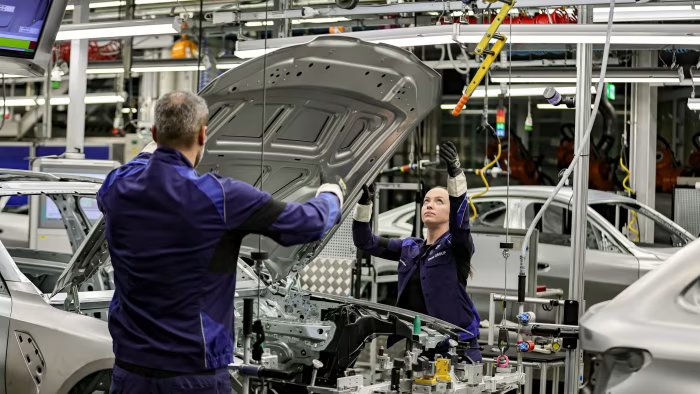
Stay informed with free updates
Simply sign up to the EU business regulation myFT Digest — delivered directly to your inbox.
Carmakers have warned that “Made in Europe” proposals that set local content levels for products could cause further disruption to supply chains and trigger a slowdown in the transition to electric vehicles.
Oliver Zipse, BMW’s chief executive, said that setting complex local sourcing rules was “very dangerous” because they would be “extremely cumbersome” to calculate. Europe would risk being “cut out of the [global] innovation race”, he added.
EU plans to set local sourcing targets for parts in products such as cars and solar panels have divided industry and prompted heavy lobbying over what would count as European.
The targets, first reported by the Financial Times, will vary according to Europe’s dependency on certain trading partners, particularly China, and the bloc’s ability to scale up production. Initially local content levels of up to 70 per cent for some goods such as solar panel inverters or cars were discussed, but are now likely to be reduced.
They will be part of a set of proposals aimed at boosting the EU’s flagging industrial base and are subject to intense negotiations within the European Commission. A policy announcement scheduled for this week has been pushed back and officials have warned that the sourcing rules could still change before they are due to be presented on January 28.
France has been the biggest proponent of the local sourcing strategy but member states and businesses have been divided over how the rules should be designed and implemented.
Japanese carmakers, for example, are concerned that “made in Europe” will exclude even friendly trading partners and have requested its expansion in a letter sent to the European Commission last week, according to people with knowledge of the matter.
Katsuhisa Okuda, president of Honda Motor Europe, said overly restrictive sourcing requirements risked “unintended consequences, which could slow down Europe’s transition towards clean mobility”. He called for a “made with common values” framework that included factors such as “trade liberalisation, market economy status and alignment with common political and economic values”.
Other carmakers, including several inside the EU, want countries such as the UK and Turkey — where they have large manufacturing hubs — to be included in local content thresholds.
European industry, which is subject to strict climate rules and high energy costs, has been struggling as Chinese manufacturers have caught up or overtaken their technical expertise but have managed to keep prices low.
Unlike the carmakers themselves, their suppliers have argued that local content measures were critical to their survival especially since the EU’s higher tariffs on China-made EVs have failed to slow the incursion of Chinese rivals into the continent.
Benjamin Krieger, secretary-general of CLEPA, representing auto parts suppliers, said the EU could not afford to wait to introduce the rules, which would “protect jobs and reduce our reliance on imports until deeper reforms kick in”.
Renewable energy companies have also been vocal in their support.
“We have seen what’s happened with clean tech in Europe in the past — Chinese oversupply and then dumping in Europe,” said Constantine Levoyannis, head of government affairs at Norway’s Nel Hydrogen. The “devil is in the detail . . . but we would be happy with a high share of European content on the component level,” he said.
Last year, the EU proposed targets for domestic manufacturing in industries such as solar, wind and heat pumps in response to former US president Joe Biden’s $370bn Inflation Reduction Act. But many executives have warned that these were far from being met.
Ilka von Dalwigk, director-general of Recharge Europe, which represents companies in the battery supply chain, said that as projects were getting postponed or cancelled, local sourcing requirements would provide “investment certainty”. However, the rules should be part of a wider industrial strategy that included incentives and support, she added.
Walburga Hemetsberger, chief executive of SolarPower Europe, said local content mandates should be build into public procurement.
However, Fatih Birol, executive director of the International Energy Agency, said Europe needed to find a balance between local sourcing and accept that there were technologies where it was “difficult for Europe now to start and compete”.
He added: “Europe needs to look at the areas where Europe can be competitive.”
Additional reporting by Sebastien Ash in Frankfurt and Ian Johnston in Paris