

 dailynewsnblog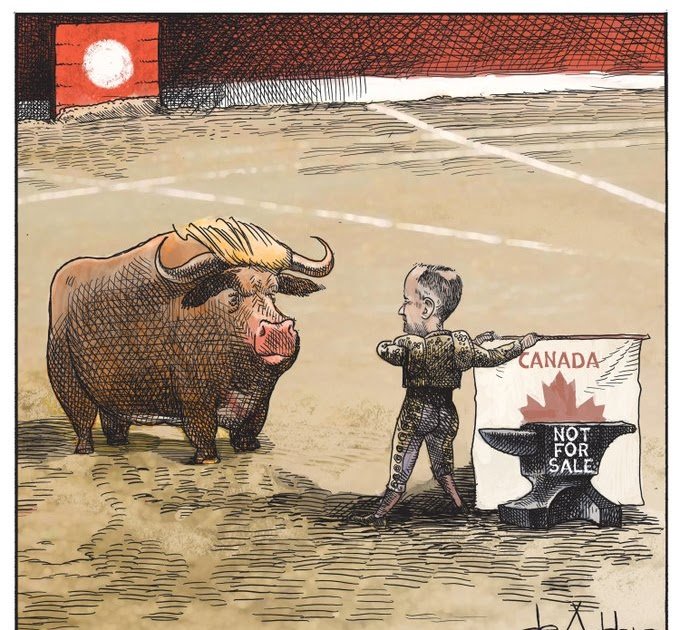

Canada update:
“We’re recalibrating Canada’s relationship with China — strategically, pragmatically, and decisively — to the benefit of the people of both our nations.”
— Mark Carney
Canada’s Prime Minister 🇨🇦 / via 𝕏❤️🍁🇨🇦TEAM CANADA FOREVER🇨🇦🍁❤️
❤️🍁🇨🇦VIVE LE CANADA🇨🇦🍁❤️[image or embed]
— 🍁🇨🇦Team Canada Forever🇨🇦🍁 (@teamcanadaforever.bsky.social) January 16, 2026 at 2:42 PM
Carney’s team doesn’t fly by the seat of their pants. That’s why Canada’s trade deals are meaningful:
Carney’s Canada-China deals are the product of months of diplomatic hustle nationalnewswatch.com/2026/01/16/c…
[image or embed]
— National Newswatch (@nationalnewswatch.com) January 16, 2026 at 2:45 PM
…The government’s framing is explicit: in a more fragmented and unstable global economy, Canada is pursuing diversification, resilience and independence. China, as the world’s second-largest economy, is positioned as both an opportunity and a necessity in that strategy.
…This is a notable shift. Rather than focusing solely on export volumes, Ottawa is signalling openness to inbound investment tied to domestic manufacturing and supply-chain build-out. That framing reflects a broader recalibration in Canadian industrial policy, where foreign investment is being assessed less on origin and more on structure, safeguards and domestic benefit.
The most politically sensitive element of the announcement is Canada’s decision to allow up to 49,000 Chinese electric vehicles into the Canadian market at a most-favoured-nation tariff rate of 6.1%.
The government argues that this volume mirrors pre-friction import levels and represents less than three per cent of Canada’s new vehicle market. It also projects that, within three years, the policy will catalyze joint-venture investment in Canadian EV manufacturing and that within five years, more than half of imported vehicles will be priced under $35,000.
This is a calculated trade-off.
On one side: affordability, supply-chain acceleration and climate targets.
On the other: domestic auto sector anxiety, industrial competitiveness and geopolitical scrutiny.
Whether the promised joint-venture investment materializes and under what governance conditions, will determine how durable this decision proves to be.
Agriculture and food exports are where the reset delivers its clearest near-term gains.
…China is a $4-billion canola seed market for Canada. The government estimates that these measures could unlock nearly $3 billion in export orders, providing immediate relief to producers who have been caught in prolonged trade disputes.
For agricultural regions, this portion of the agreement will be the most tangible and closely watched.
Beyond trade, the partnership places heavy emphasis on multilateral cooperation, climate governance, financial stability, and global institutions.
….There is no ambiguity about the signal Ottawa is sending. Canada is no longer treating disengagement as a default position. It is choosing managed engagement in a world where economic isolation carries its own risks.
In The Globe and Mail, columnist Shannon Proudfoot writes It’s clear Carney is now dealing with the world ‘as it is’ and she discusses the ethical implications of this deal:
…One reporter pointed out the perpetual concerns about human rights abuses and freedom of speech in China, and asked where those issues fit into Mr. Carney’s calculations – are these things Canada can’t afford to think about right now because we have to find new markets?
Mr. Carney deked lightly around the premise, saying that Canada “fundamentally” defends rights of all sorts, and as a result, it calibrates its engagement with other countries to work with overlapping interests and steer around issues of conflict.
“We take the world as it is, not as we wish it to be,” he said.
The world as it is, and not as we wish it to be. The year 2026 is still just a newborn thing, and yet those words feel like its epitaph and savage lesson in one.
It explains the strange, clench-jawed triumphalism of Mr. Carney’s announcement of a trade deal with a repressive behemoth of a country that’s a leading source of foreign interference in Canada. This is not 2016, when Justin Trudeau purred about exporting Canada’s many virtues to China; this is eyes-wide-open pragmatism.
What Jonathan Manthorpe, a former foreign correspondent and author of Claws of the Panda: Beijing’s Campaign of Influence and Intimidation in Canada, saw Mr. Carney outline was a limited, transactional relationship. In this arrangement, he says, Canada and China sell things to each other, cash the cheques and keep moving.
“I think we approach an expanded and restored relationship with China with much more sanity than we have in the past,” Mr. Manthorpe says.
It’s a profound shift from the history laid out in his book. Canada spent much of the 1960s, 1970s and 1980s believing – naively or smugly – that it could bring China around on nice ideas such as the rule of law and multiparty democracy.
A hard reset came in 2018 with the imprisonment of the “two Michaels” in retaliation for Canada’s arrest of Huawei executive Meng Wanzhou, Mr. Manthorpe says. But it’s the overt aggression and capsizing of the postwar order of the second Trump administration that he believes will be the more lasting factor.
“We have to now deal with the world as it is,” he says. “And it’s a very, very different place from what it was 10 years ago.”…
Also in The Globe and Mail, columnist Andrew Coyne writes In seeking to deepen trade with China, Canada is hedging its bets We face the risk of Finlandization – nominal independence, but subordinate to a superpower (gift link)
… Sailing the trade and security seas of the 21st century is a much more complex task than it was in the past. It was easy to separate trade and security concerns in the Cold War: Who wanted to buy anything from the Soviet Union? But in today’s world our adversaries are also our trading partners – and our trading partners may become our adversaries.
Still, to the extent that trade and national security conflict, the latter must take precedence. To depend on trade with the United States to the degree we have until now might have made economic sense, once; it might still do so. But it is inimical, as we must surely now realize, to our national security. That national security now obliges us to deal with odious regimes like China’s is an unpleasant consequence of the world Mr. Trump has made. But such is the ruthless pragmatism our current predicament requires.
For make no mistake, a predicament we are now in. Not only are we whipsawed between the United States and China, but wedged, geographically, between the United States and Russia: formerly antagonists, but under their current leaders increasingly aligned and increasingly alike; aggressive, expansionist powers, that menace their neighbours and repress their own citizens. Again, you don’t have to claim equivalence to see a certain convergence.
If you doubt the United States has become a potential adversary, have a look at what is going on in Greenland. I have seen it suggested that the idea that the U.S. might forcibly annex Greenland is pure fantasy, a figment of the media’s imagination. I don’t know: It seems real enough to the Danes. It’s real enough to the top U.S. military brass, who are under pressure from Mr. Trump to draw up invasion plans. It’s real enough to France, Germany, Sweden and the Netherlands, among others, who have all rushed troops there to prevent it. It’s real enough to the U.S. Senators who have hurriedly drafted legislation to forbid it. And it’s real enough to Mr. Trump, who keeps insisting it is an option.
Suppose he does what he usually does, and opts for the most insane, self-destructive choice available to him. The consequences of such a monstrous betrayal – the United States invading a NATO ally – are incalculable. At a minimum, it would mean the death of NATO, as a transatlantic alliance. The U.S. would find its military bases in Europe expelled, its arms sales ended, its air and sea access denied, as well as whatever trade and economic sanctions the Europeans saw fit to impose. At worst, it could mean a shooting war. Oh, I forgot to mention: To the list of countries sending troops to Greenland add (perhaps: They’re thinking about it) Canada.
Here is where we are at: The most probable current source of an attack on NATO territory is not Russia or China but the United States. And the country in the second-most trouble in that event, after Denmark, is Canada. The risk, even then, is not invasion: An attack on Canada is orders of magnitude more insane than an attack on Greenland, which is orders of magnitude more insane than the attack on Venezuela, which was insane enough to begin with.
The risk, rather, is vassalization – Finlandization, as it was called during the Cold War: subordination to the dictates of the neighbouring superpower, even as we retain our nominal independence. We talk of diversifying our trade to China and other countries, to lessen our dependence on the U.S. But what if the U.S. objects to this attempt to evade their grasp? We talk about refusing to buy U.S. military hardware. But what if the U.S. insists that we must? We talk about using our natural resources, especially our critical minerals, as bargaining chips. But what if the U.S. demands we just hand them over?
The United States has a great many tools at its disposal, short of military invasion, to enforce compliance. It could make life pretty miserable for us, if it chose. The reason it did not do so in the past is because it had normal governments with a normal sense of limits and a normal awareness of the benefits of co-operation, rather than coercion, in the affairs of states. That, and because most of the instruments with which they might punish us for disobedience, in the form of trade restrictions, would also punish their own citizens – who would ultimately punish the government that imposed them. Even if we could not always count on the goodwill or good sense of an administration, we could ordinarily depend on their sense of self-preservation.
But Mr. Trump seems unusually unperturbed by such considerations. He is in the low-40s in the public-approval ratings. His party is six to eight points behind the Democrats.
As things stand, he and they are headed for a massive defeat in the midterm elections this fall. And yet he continues to do all of the same things that brought them to their current pass. It is almost as if he doesn’t care what happens in the election. Or as if he does not intend to allow it.
And here’s a pretty good summary of how America will be reacting to Canada’s deal with China. I know Doug Ford is mad, but Carney just may be recognizing that Canada’s auto industry is doomed now anyway, unless China will build cars here:
Can anyone imagine Poilievre being able to negotiate this kind of deal?
America update:
We won’t know whether these brave Americans will be successful in opposing the ICE Gestapo and Trump until we see whether there are Mid-Term elections and whether Congress still exists afterward. But their courage – day after day, standing up to guns and tear-gas with whistles and hope – just makes me weep:
As a social movements scholar, I absolutely love the diversity of tactics being developed by each city, reflecting their local flavor
Portland kept it weird with inflatable costumes
Chicago protected its street vendors by buying up their food each day
Charlotte chased ICE agents into the woods
[image or embed]
— Jocelyn Leitzinger (@jocelynl.bsky.social) January 15, 2026 at 6:38 PM
I am overcome with admiration for ordinary American citizens. Here’s one of the photos from Los Angeles, called The Power Of One, taken by Eric Thayer:

Here is retired Navy Seal Curtis Evans carrying the American flag through tear gas at the Broadview Illinois ICE facility. Photo by Joshua Lott The Washington Post :

Next, the frogs of Portland, where silly costumes kept protestors safe while making the ICE Gestapo look ridiculous:

Now Minneapolis steps up:

They have quite an operation going.
www.mprnews.org/episode/2026…[image or embed]
— Aaron Sojourner (@aaronsojourner.org) January 16, 2026 at 7:02 AM
Americans are fighting back all over:
The Black Panthers in Philadelphia have initiated armed community defense initiatives to counter ICE kidnapping raids within the city. (January 15, 2026) ✊🏽✊🏿✊🏾
[image or embed]
— Raider (@iwillnotbesilenced.bsky.social) January 15, 2026 at 5:32 PM
These Minneapolis folks are not f*cking around:
Finally!
Next, some updates on Greenland too:
1/2 On a Zoom call with experts on Greenland – they essentially agree that US will focus on offering economic opportunities to Greenland as an independent state as a step to US allegiance until late Spring – if this doesn’t work, military operation would proceed.
— Olga Nesterova (@onestpress.onestnetwork.com) January 16, 2026 at 2:52 PM
2/2 Trump clarifies in private that he wants to be the President who has enlarged US territory. They state that he will attempt to do so unless he is stopped externally.
— Olga Nesterova (@onestpress.onestnetwork.com) January 16, 2026 at 2:52 PM
And just in case you’re still wondering where Canada stands:
I expect Trump thinks if he can take over Greenland by this summer then this will help Republicans win the Mid-Terms:

… Seizing Greenland means the United States runs a great risk of becoming a pariah nation. We could be reduced to only conducting business with a few Latin American and African countries that could milk us for every dime.
Americans would find themselves hated abroad. No matter which side you are on regarding Trump’s imperialist talk of annexation/invasion, Americans could be treated the way Russians are treated now. global outcasts where money cannot speak louder than the actions of a rogue, demented president.
I’m not sure Nance is right about this – I think we might see some temporizing calculations – but the more America tries to throw its weight around, at home and abroad, the angrier the world will get.
And who knows? Maybe even this could happen….


