dailynewsnblog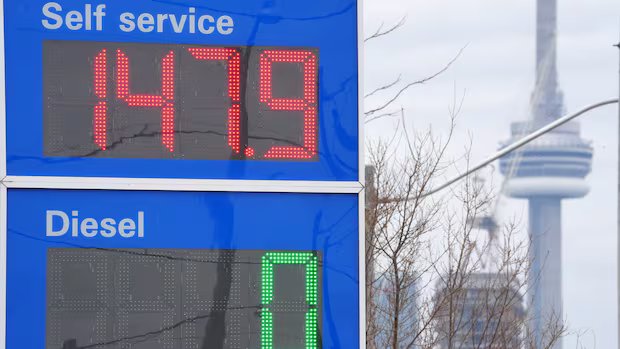

Listen to this article
Estimated 4 minutes
The audio version of this article is generated by AI-based technology. Mispronunciations can occur. We are working with our partners to continually review and improve the results.
Canadians saw fuel prices climbing across the country this week as the conflict in the Middle East drives up the price of oil.
As of Friday evening, average retail prices in Canada had climbed to 150 cents per litre — close to 20 cents higher than the 133.4 cents per litre seen a week ago before the conflict began, according to data from GasBuddy.com. British Columbia is seeing the highest prices at 168.6 cents per litre.
The rising prices come after Israel and the United States attacked Iran last Saturday, resulting in Iran launching retaliatory strikes on Israel and U.S. bases. Hundreds have died, thousands are looking to evacuate and countless more are facing a humanitarian crisis. The widening war has also disrupted oil tanker traffic in the Strait of Hormuz, a crucial artery through which a fifth of the world’s oil passes.
Benchmark crude oil prices in the U.S. hit a two-year high on Friday as the conflict is poised to stretch into its second week, with the price for a barrel of oil rising above $90 US for the first time since October 2023.
There shouldn’t be any actual fuel supply disruptions affecting Canada or the United States, as they produce plenty of their own oil, said Gasbuddy petroleum analyst Matt McClain earlier this week.
“But we are going to see some price points that may be a little inconvenient or, depending upon how this conflict plays out, potentially up to painful.”
Those filling up at the pump this week said they were feeling the pinch.
“To me, I feel like I need gas regardless of the price. But I guess that cuts into other things that you could use the money for,” said Amy Gooding, who was filling up in the Greater Toronto Area.
“We need to drive our car, so there’s not much we can do.

The price of regular gas rose to about $1.45 a litre in most areas of the province. The increase is related to the conflict in the Middle East, which has disrupted oil shipping routes.
WATCH | Independent gas station owner says increases are unfortunate and ‘affect everybody”
In Saint John, N.B., Bailey Jones was feeling the same as she filled up her tank.
“I don’t follow the news, but I’ve heard the rumblings so I assumed it was going to go up and there’s nothing we can do about it,” Jones said. “We still need gas, I still need to get places, but it still sucks.”
She said she didn’t anticipate prices going down anytime soon.
“It’s probably only going to get worse.”
Prices could stay high for weeks
One expert says these prices are likely to stick around for a while, even if the conflict ends within a few weeks as U.S. President Donald Trump has predicted.
“We do know that price disruptions tend to last after the conflict wraps up,” said Warren Mabee, director of the Institute for Energy and Environmental Policy at Queen’s University. “So I think we’re looking for at least a couple of months of disrupted prices.”
How high prices could go, however, remains to be seen.

In Edmonton, the average price of gas increased by about 15 cents per litre compared to to the previous week. GasBuddy, an app that tracks local gas prices, shows prices as high as 136.9 per litre. As Ilka Sweeting-Rodgers reports, there’s a few factors contributing, including war in the Middle East.
In an interview with CBC’s Afternoon Drive, Mabee said he doesn’t expect the same surge prices seen during the gas crises of the 1970s, when the price of oil in North America quadrupled for months.
But he says he expects gas prices to rise around five to 10 per cent higher than they were before the conflict began.