dailynewsnblog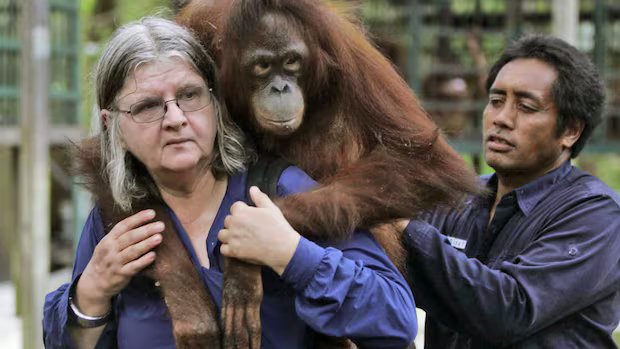
Biruté Mary Galdikas, a Canadian scientist who dedicated her life to the study and conservation of orangutans, has died. She was 79.
Galdikas died in Los Angeles early Tuesday morning with loved ones by her side after a battle with lung cancer, according to the Orangutan Foundation International, which Galdikas founded in 1986 to support her research in Borneo, Indonesia.
Galdikas’s “passion and unwavering dedication for over five decades in Indonesia positioned her as the world’s leading expert on orangutans and gave her a platform from which she passionately advocated,” the foundation said.
“Her efforts most certainly single-handedly preserved the largest remaining population of wild orangutans that remains today.”
Before Galdikas began her research, her professors told her they believed that orangutans would be impossible to study in the wild because they were too elusive, wary of humans and lived deep in swampy forests.
“I got skepticism. I got doubt. People said it couldn’t be done,” she told The Current‘s Matt Galloway in 2021.

This Canadian researcher went into the deepest jungles of Borneo to live among the orangutans as one of the ‘Trimates.’ Her love for the apes stemmed from her eagerness to understand humans and where we came from.
Undeterred, she travelled in 1971 to Tanjung Puting in central Borneo with her then-husband, photographer Rod Brindamour.
“Nobody had ever been there. Nobody knew anybody who had been there,” she said. “So it was really a voyage into terra incognita,” Galdikas recalled.
The orangutans were shy, and Galdikas said it took some of them many years to get used to her. Nevertheless, her dedication, patience and observation came to paint a vivid picture of the lives of these little-known apes — she recorded 400 kinds of food they ate; how they organized their societies, fought and chose mates; and witnessed how they gave birth. One of her interesting discoveries was that orangutans at Tanjung Puting only have a baby every 7.7 years.
Galdikas also set up a rehabilitation centre that has since helped 450 captive orangutans return to the wild.
Tanjung Puting became a national park in 1983 because of her work.
“I still feel extraordinarily fortunate that God graced me with years in the forest,” with orangutans, she told Galloway.
Galdikas said she was driven by a desire to understand humans. “So my love of orangutans grew out of my curiosity and urge to understand where we came from, where we’re going and how we fit into the universe,” she said in a 2019 CBC documentary.

The Canadian scientist and educator spent nearly 50 years studying orangutans in the wild. She has sadly passed at the age of 79. Watch She Walks With Apes on CBC Gem.
Galdikas was born en route to Canada from Lithuania and grew up in Toronto. At age six, she checked out her first library book, Curious George, about a man and his monkey, and soon decided she wanted to be an explorer, according to her bio on the foundation’s website.
She studied psychology and zoology at the University of British Columbia and the University of California at Los Angeles, where she also got her master’s degree in anthropology.
Last of the ‘trimates’
She began her work on orangutans for her PhD after meeting renowned Kenyan paleoanthropologist Louis Leakey and convincing him to fund the work.
That made her the last “trimate” — a trio that also included renowned primatologists Jane Goodall, who studied chimpanzees, and Diane Fossey, who studied gorillas. All three were mentored and supported by Leakey, and Galdikas named her research site in Borneo “Camp Leakey” in his honour. Goodall died last year while on a public speaking tour and Fossey was brutally murdered by poachers in Rwanda in 1985.
Galdikas had a son, Binti, with Brindamour in 1975. Brindamour left Indonesia in the late 1970s and the couple divorced. Galdikas later married Pak Bohap, a local indigenous Dayak elder who had worked as a research assistant at Camp Leakey, with whom she had a son and a daughter.

Ruth Linsky grew up in Edmonton, a self-described “rebel without a cause,” until one day she walked into a primatology lecture given by Biruté Galdikas, whom she had never
heard of.
Galdikas published her first scientific article on orangutans in the prestigious journal Science in 1978.
She became a professor extraordinaire at the National University in Jakarta, Indonesia, in the 1970s, and a professor at Simon Fraser University in Burnaby, B.C., in 1981.
She has been recognized with the Tyler Prize for Environmental Achievement, the United Nations Global 500 Award, the Explorers Medal, was made an Officer of the Order of Canada, and was awarded both the Indonesian Satya Lencana and Kalpataru honors for service to the country, presented directly by the president of Indonesia.
Anna Rathmann, executive director of the Jane Goodall Institute USA, wrote in a Facebook post Wednesday, that Galdikas was “steadfast in her dedication to wild orangutans and their rainforest habitat. Like Jane Goodall, she believed in the sentience of all animals, especially the orangutans she worked so hard to conserve, and reminded us that we are intrinsically connected to the natural world.”
Ian Redmond, chair of the Ape Alliance, a coalition dedicated to the conservation of apes that Baldikas helped found, wrote: “Her legacy is immense, laying the foundation for much of our scientific understanding of orangutan behaviour and ecology, the better protection of key orangutan habitat, and public awareness of the red ape and its role as a keystone species in the forests of Borneo.”