dailynewsnblog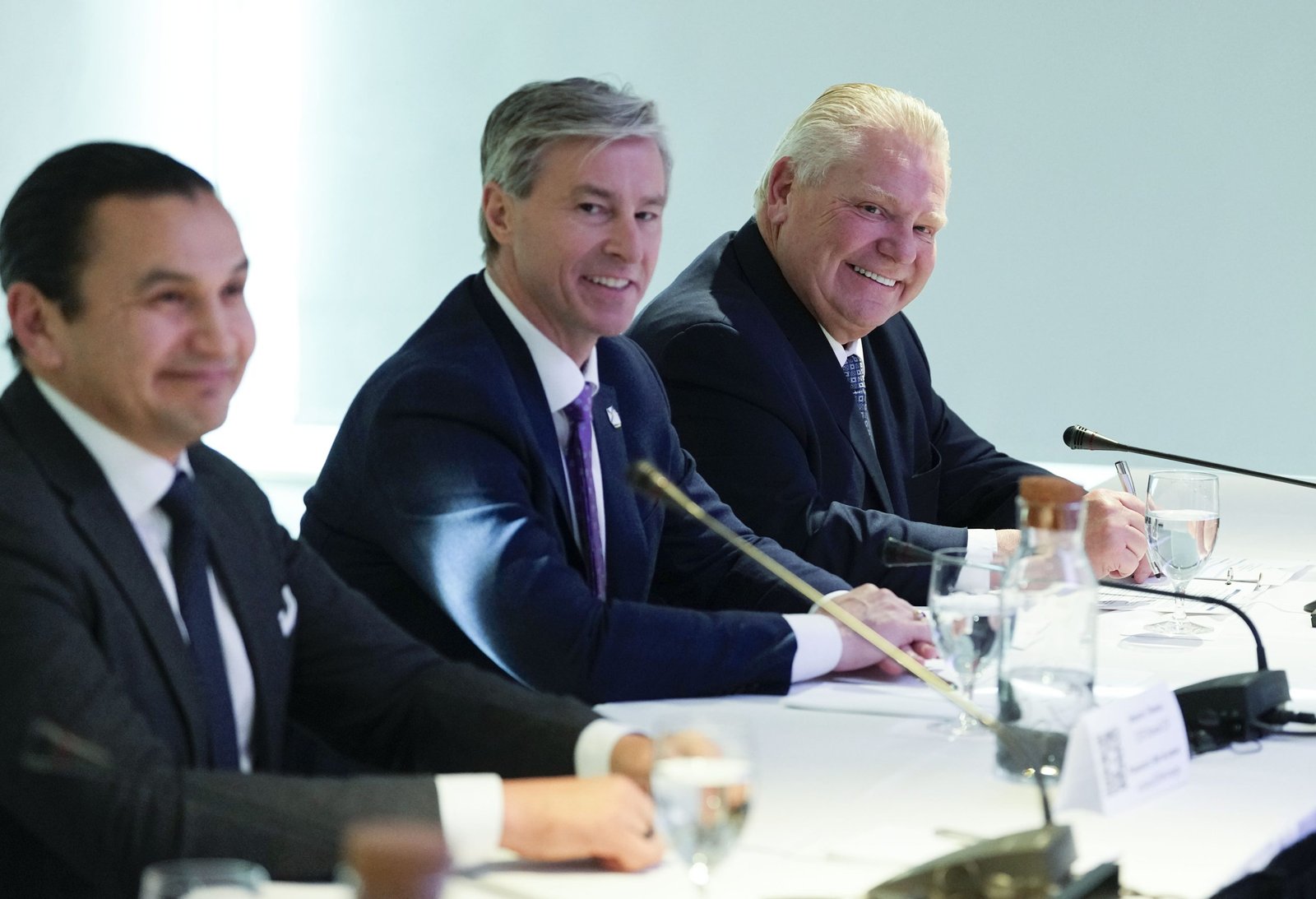
Ontario Premier Doug Ford told reporters he was prepared to let Carney take the lead in talks with the White House on the Canada-United States-Mexico Agreement (CUSMA), while saying he would work with his provincial colleagues to discuss matters with U.S. governors.
Canada’s premiers gathered in Ottawa on Wednesday and made a call for unity across their borders in advance of the start of renegotiations of the continental free trade pact later this year.
It comes as the premiers grapple with a series of intra-provincial disputes from Alberta and B.C. locking horns over a proposed pipeline to Manitoba crying foul over Ontario’s threat to remove Crown Royal from the shelves of its liquor stores.
Prime Minister Mark Carney’s recent trade pact with China also showed divisions amongst the premiers, with Ontario protesting dropping tariffs on some Chinese electric vehicles, while Prairie and East Coast premiers lauded the reopening of agri-food trade with the Asian superpower.
Ontario Premier Doug Ford has been front and centre in these disputes and has made opposition to U.S. President Donald Trump’s tariffs on Canada a key focus for his government.
But he told reporters at a press conference on Wednesday that he was prepared to let Carney take the lead in talks with the White House on the Canada-United States-Mexico Agreement (CUSMA), while saying he would work with his provincial colleagues to discuss matters with U.S. governors.
“It’s his job [the prime minister’s] to make sure that we have a united country, that he’s out there selling Canada, but it’s also our job as provinces and territories to do the same thing. It’s a Team Canada approach, and I think we’re going to have a better year,” Ford said, adding that he took on a more prominent role in the Canada-U.S. dispute last winter because the federal government at the time was “pretty well falling party” amid Justin Trudeau’s resignation.
“Let the prime minister deal with the president and myself and the other premiers, we have a great relationship with governors.”
Ford’s presence in Canada-U.S. trade talks has been impactful.
He threatened last winter to end electricity exports to the U.S. if tariffs were imposed but eventually opted to slap a 25 per cent surcharge instead.
That was quickly suspended after the White House offered a meeting with the premier.
In the fall, Ford paid for advertisements to run in the U.S. against tariffs that featured president Ronald Reagan. The ads so angered Trump that he ended negotiations with Canada, killing a prospective deal between the two countries that appeared to be close to completion.
Ford eventually pulled the ads but refused to apologize.
The premier on Wednesday said he would “continue being vocal” on trade talks even with Carney taking the lead.
“I’m going to continue defending Ontario and Canadians right across the board,” he said in response to a question from iPolitics.
“I’ll always voice my opinion and just explain to Americans how important a trade deal with Canada is and reminding them that we’re their number one customer in the world. We buy more products, more services, more widgets off Americans than any other country and vice versa.”
Brian Clow, a former Canada-U.S. relations advisor to Trudeau, said it’s risky for premiers to break from the prime minister in trade talks because it makes the country look divided and offers openings for the Americans to exploit.
“When the Americans look at the Canadian political scene and see disunity that presents them advantage and leverage in the talk. It’s just like in Canada when governors and members of Congress speaking out against the Trump administration,” he said in an interview.
He said premiers in trade talks during Trump’s first term “held their fire to present a united front” and suggested that they keep their concerns “a little further away from the microphone.”
Clow acknowledged that Canada faced a “bumpy, complicated road ahead” in CUSMA renegotiations even before Carney brokered a deal with China and delivered a speech at the World Economic Forum in Davos that drew Trump’s ire.
The sectors that would appear to the “most trouble” in talks are the same ones feeling the biggest hit from existing U.S. tariffs, he said, singling out automotive, steel and softwood lumber.
Trump has been insistent on bringing back steel and auto jobs to the U.S., and those sectors form a major economic footprint in Ontario.
The Carney government has suggested Canada partly could offset the impact of U.S. tariffs by attracting manufacturers from overseas, including China.
But Clow warned that would be a “serious point of friction with the U.S.” because the White House feels it in their bones that China poses a threat to their economy and national security.
“They will not abide by their free-trade partners becoming a backdoor to China.”
Despite disagreement with Ford over the China deal, the premiers were still eager to present a united front.
Newfoundland and Labrador’s Tony Wakeham, who supported the China pact, said it was important to “stand together as a country” as “people in other places in the world are trying to divide us.”
“I support premier Ford and his concerns for his province like I do and support all the other premiers and their concerns,” he said in response to a question from iPolitics.
“But that’s where we ought to be. For us right now, the [Chinese] tariffs that have been removed have been somewhat of the helpful… [but] there’s a lot more to do”
New Brunswick Premier Susan Holt, who joined Ford for the press conference, said she was looking for “opportunities to collaborate” with other provinces to try to “build the strongest economy in the world.”
She said for New Brunswick that includes working on a natural gas pipeline from Quebec City through to an LNG terminal in her province.
That show of unity came as concerns mount that Quebec could elect a separatist government in this fall’s election. Most polls show the Parti Quebecois comfortably leading the provincial race.
Ford said it would be a “disaster” if the PQ won power, and we “have to be a united Canada right now.”
In this tumultuous time, Holt said we “shouldn’t contribute to the economic and social uncertainty.”
Carney held a series of meetings with the premiers on Wednesday, including with B.C. Premier David Eby. The two were later joined by Alberta Premier Danielle Smith.
Eby said it was a “wide-ranging” conversation with Carney that touched on extortion, the coming FIFA World Cup and the “huge opportunities” for economic development in B.C, as well as other issues.
He said the meeting with Carney and Smith was “very civil… and borderline friendly,” but maintained his concerns about the prospect of a West Coast pipeline, reiterating the need for Indigenous consultation and investments in spill response should the project proceed.
But Eby said he understood the “limits of my constitutional authority” and couldn’t halt the project if the federal government decided to approve it.
Carney is set to hold a dinner on Wednesday night with the premiers. He will join the premiers for meetings on Thursday.