dailynewsnblog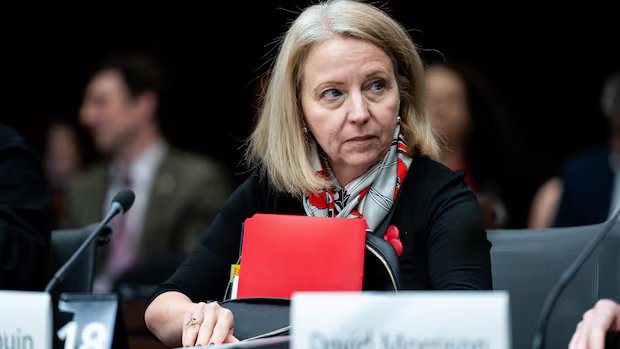

Listen to this article
Estimated 5 minutes
The audio version of this article is generated by AI-based technology. Mispronunciations can occur. We are working with our partners to continually review and improve the results.
Bad actors will likely use artificial intelligence to try to disrupt Canada’s next federal election, warn two of the country’s top election watchdogs.
Testifying before a parliamentary committee and speaking to reporters on Tuesday, foreign affairs deputy minister David Morrison and Nathalie Drouin, national security adviser to Prime Minister Mark Carney, said foreign adversaries are likely to use the increasingly popular technology.
The two pointed to the rise of deepfakes — hyperrealistic synthetic or manipulated images and video generated with AI — in particular.
“Look at how fast all this is going,” Morrison told reporters. “I don’t know when the next election is going to be but it’s a tool that all adversaries will use.”
Drouin said attempts to use AI to disrupt the election could come from foreign actors or even those just trying to cause mischief.
“AI [proliferation] is exponential so I think that as we go, we’re going to see more and more,” Drouin told reporters. “I think we can expect that. Hopefully, AI will help us to detect AI. Hopefully.”
Drouin and Morrison both served on a panel of top public servants that was charged with monitoring any attempts at foreign interference in the 2025 general election.
Morrison said government officials had expected attempts to use AI to interfere in the last election, but did not detect it.

Liberal MP Arielle Kayabaga asked whether the government should require labelling for AI-generated videos.
“I think AI is getting so good, compared with a couple of years ago when it first started, where you can’t actually tell what’s real and not real,” she said. “I am a millennial. I consider myself an internet-savvy person but lately my Gen Z teenager tells me you constantly fall for the AI fakes.”
Morrison said the answer is not as simple as labelling videos.
“Our adversaries in this space are continually evolving their tactics. So it’s only a matter of time and we do need to very vigilant — whether the ultimate solution comes through labelling or something else,” he said.
“This needs to be a whole-of-society effort.”
Meanwhile, Drouin told the committee that the government has developed cyber briefings for MPs and training to help them identify deepfake photos or videos.
Drouin said officials did see some attempts to interfere during the last election, such as an attempt by China to affect a Conservative candidate’s campaign, attempts by Russia to engage in foreign interference activities online and attempts to use the names of politicians to promote cryptocurrency and financial activities.
However, Drouin said the attempts officials detected did not reach a level that would have affected election results.
“We expected that foreign interference activities would happen and we were prepared for them,” said Drouin. “But despite their existence during the election the panel, informed by the task force activities, was able to determine that none reached the threshold of threatening the election’s integrity and its outcome.”
Risk of U.S. interference?
However, Conservative MP Michael Cooper challenged Drouin and Morrison on that conclusion — pointing to the experience of Toronto-area candidate Joe Tay. Tay, a supporter of democracy in Hong Kong, has been targeted by Hong Kong authorities, who have put a bounty on his head.
Cooper said Tay and his supporters received threats during the campaign and Tay was advised not to campaign door-to-door for his own safety. Cooper said there was a drop in voter turnout in the riding and some of Tay’s supporters were summoned to the Chinese consulate.
Drouin said the government followed up regularly with the Conservative Party and offered private security. Morrison said they did not pick up on any involvement by the Chinese consulate, however they did talk with the Chinese Embassy about online activity associated with the Chinese government.
While much of the focus on potential foreign interference in Canadian elections has centred on countries like China and Russia, Liberal MP Elisabeth Brière asked whether attempts to interfere in Canada’s next election could come from the United States.
Drouin said officials will be watching for potential interference, regardless of where it comes from.
“Canada has expectations regarding all countries, including the United States, that there is … no damage to our domestic affairs including our elections,” she said.
“We will monitor the situation in an agnostic way — regardless of which country tries to engage in foreign interference.”