dailynewsnblog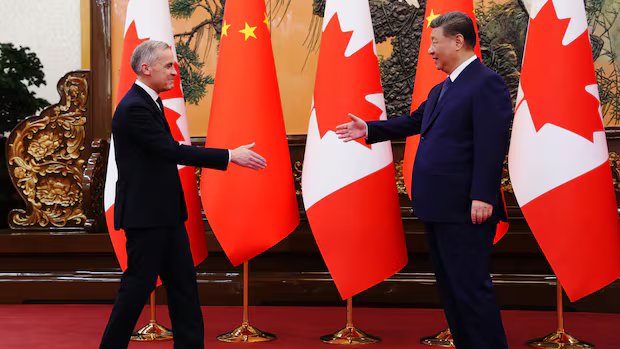
The Liberal government has reached a deal with Beijing to allow tens of thousands of Chinese electric vehicles into the domestic market in exchange for dropping duties on canola products, Prime Minister Mark Carney said Friday.
It marks the prime minister’s first deal on trade with another country since taking office last year and a de-escalation in tensions with a country the Liberal government had, in recent years, branded a disruptive power and Carney had called the biggest threat facing the country.
Carney described this as a “preliminary but landmark” agreement to remove trade barriers and reduce tariffs, part of a broader strategic partnership with China.
“It’s a partnership that reflects the world as it is today, with an engagement that is realistic, respectful and interest-based,” Carney told a news conference in Beijing.
Carney said Ottawa expects Beijing to drop canola seed duties to 15 per cent by March, and called that “enormous progress.”
Saskatchewan Premier Scott Moe said in a social media post that the break on canola tariffs “demonstrates the importance of foreign trade missions and shows what can be achieved when the federal and provincial governments and our export industries work together to strengthen our trade relationships.”
Canadian canola meal, lobsters, crabs and peas will no longer be subject to Chinese “anti-discrimination” tariffs from March to at least the end of the year. There was no mention of canola oil.
In return, Canada, which imposed 100 per cent tariffs on Chinese electric vehicles in 2024, will allow up to 49,000 Chinese EVs into the Canadian market each year, at a 6.1 per cent tariff.

Prime Minister Mark Carney, who announced a deal Friday with China on a range of sectors, including canola and a tariff-quota arrangement on electric vehicles, took questions on the terms of the deal, what it means for Canada — and the implications of moving closer to China.
Carney said that will make some EVs more affordable for Canadians and that this would be just a tiny sliver of the Canadian domestic market — about three per cent.
Ontario Premier Doug Ford was quick to criticize the EV deal, saying China has been given a foothold in the Canadian market that will hurt Canadian workers.
“The federal government is inviting a flood of cheap made-in-China electric vehicles without any real guarantee of equal or immediate investments in Canada’s economy, auto sector or supply chain,” Ford said in a post on X.
The Ontario premier went on to say the deal risks “closing the door on Canadian automakers to the American market” and that Carney needs to balance the deal with support for Ontario’s auto sector.
“That means making the sector more competitive by ending the electric vehicle mandate, harmonizing regulations with key trading partners and scrapping federal fees that do nothing but add thousands to the cost of making vehicles and chase away investments,” Ford said.
- Cross Country Checkup is asking: Why does Canada’s new EV deal with China matter to you? Leave your question here and we may read it or call you back for Sunday’s show.
Carney said in his media conference that the EV market access given to China in this deal is not a radical move but simply “a return to levels last seen in 2023, the last full year before the Canadian tariff actions.”
Speaking in French to reporters, Carney said both he and Ford want to build “a new Canadian auto industry” based on high-tech products and affordability and that this deal will help to “create a future for our Canadian auto sector.”
“In many respects the most important element is the beginning of discussions and expectation of Chinese investment in Canada, and partnership in Canada to produce vehicles over time,” Carney said.
The pact comes just hours after Carney met with Chinese President Xi Jinping, ending a multi-year trade dispute that began when the last Liberal government levied EV tariffs to protect Canada’s auto sector.

Prime Minister Mark Carney, speaking in Beijing on Friday after reaching an initial deal with China across several sectors, said Canada stands up for human rights and democracy but added that Canada engages in what he called ‘value-based realism’ and takes the ‘world as it is, not as we wish it to be.’
Just a year ago during the spring election, Carney described China as the biggest threat facing the country. Speaking to media Friday, his answer was less definitive.
“The security landscape continues to change, and in a world that’s more dangerous and divided, we face many threats,” Carney replied when asked by a reporter. “You manage the threats through engagement.”
Conservative Leader Pierre Poilievre said Carney has to explain how he went from saying China was a threat to announcing a ‘strategic partnership’ with Beijing.
“His agreement will allow 50,000 EVs onto our streets, jeopardizing our security and auto jobs,” Poilievre said in a statement released Friday.
The deal also comes as the Liberal government seeks to double non-U.S. exports by 2030 — and boost them by 50 per cent to China by that date as well.
Carney said he raised human rights in the meeting with Xi, and said Canada has a “value-based realism” to its approach.
Relationship with China ‘more predictable’
“We fundamentally stand up for human rights, for democracy, territorial integrity, rights to self-determination,” he said. “We take the world as it is, not as we wish it to be.”
While taking questions from reporters after meeting Xi, Carney said Canada’s relationship with China has become more predictable than its relationship with the United States.
Carney said that is because Canada enjoys a “candid and consistent dialogue” with China that has led to a “more predictable and effective relationship.”
“In terms of the way that our relationship has progressed with China, it is more predictable, and you see results coming from that,” he said.

Prime Minister Mark Carney, speaking to reporters in Beijing on Friday after making a preliminary deal with China on a range of issues, said Canada’s relationship with the U.S. is ‘more multi-faceted’ and much deeper than Canada’s relationship with China — but noted that ties with China have become more predictable in recent months.
Speaking to reporters as he departed the White House, U.S. President Donald Trump said Carney’s deal with China was “a good thing.”
“Well, that’s okay, that’s what he should be doing. I mean, it’s a good thing for him to sign a trade deal. If you can get a deal with China, he should do that.”
Relations between Canada and China have been frosty in the past five years, but this signals that is starting to thaw — at least on trade.
Two years ago, Ottawa followed moves by former U.S. president Joe Biden and the European Union to counter China’s rapidly growing electric vehicle industry.
Ottawa had also slapped a 25 per cent import tax on steel and aluminum.

As Prime Minister Mark Carney heads to China to ease trade tensions, President Donald Trump reiterated that the U.S. doesn’t need Canadian goods or the CUSMA. Carney was also urged by Ontario’s premier to not back down on tariffs for Chinese EVs.
China responded in March 2025 by hitting Canada with a 100 per cent tariff on canola oil, peas and other products, along with 25 per cent on pork and seafood products, such as lobster.
The move halted exports of canola oil, strangled exports of canola meal and peas and throttled pork as well.
That was followed by a levy of almost 76 per cent on canola seed in August that year, and ratcheted up pressure on Ottawa from the Prairies to ease the escalating trade tensions.
China’s anti-dumping investigation into canola seeds was set to wrap up in March.
Canada is the top global exporter of canola and China is the industry’s second-largest market after the U.S.
Carney and Xi met in the fall on the sidelines of the Asia-Pacific Economic Cooperation forum in South Korea. It marked the first official meeting between the leaders of Canada and China since 2017.
On Friday, Xi described that as a “turnaround” in bilateral relations.
In the wake of that key meeting, both leaders directed their officials to work on resolving lasting trade irritants.
Saskatchewan’s premier travelled to China for some of the top-level meetings this week. The province makes up for just over half of Canada’s total canola production.
Moe was also in China last September alongside federal officials, hoping to resolve the dispute.

Both Carney and Foreign Affairs Minister Anita Anand, also on the trip to China, have spoken to the need for Canada to diversify its trade, while Carney wrote an op-ed late last year in The Economist on what he termed a new era of “variable geometry,” in which Ottawa might engage in a variety of multilateral pacts with partners across the world as the U.S. backs away from international leadership and co-operation.
Carney departs China on Saturday and visits Qatar on Sunday, before attending the annual gathering of the World Economic Forum in Switzerland next week. He will meet business leaders and investors in Qatar to promote trade and investment, his office said.
Trump has excoriated the updated trade deal with Canada and Mexico agreed to in his first presidential administration, and this week called the prospect of a new pact “irrelevant” to U.S. economic fortunes.
Michigan Gov. Gretchen Whitmer — in her last year in office and considered a potential 2028 Democratic presidential candidate — called for a shift in U.S. policy at the Detroit Auto Show on Thursday, saying it was integral for the U.S. to work with Canada and Mexico in order to compete economically with China.
She pointed out that U.S. manufacturing has contracted for nine consecutive months.